

Researchers have developed a novel method to map magnetic fields on the sun’s far side, a section that remains invisible from Earth. By analyzing acoustic waves traversing the solar interior, they can now determine not only the location of emerging solar activity but also its magnetic configuration. This innovation promises enhanced forecasts of solar storms before they face Earth.
While observers on Earth see only the sun’s near side, the opposite hemisphere often hosts active regions capable of rotating into view and triggering solar flares that disrupt satellites and communication networks.
For decades, helioseismology has enabled scientists to peer beneath the sun’s surface and detect large active regions on the far side days ahead of their appearance. A new study in Scientific Reports pushes this technology further by revealing magnetic field polarity from these distant regions.

Unveiling Magnetic Orientation via Solar Sound Waves
The breakthrough addresses a previous limitation: while identifying active zones was possible, discerning their magnetic pole orientation was not. Dr. Amr Hamada of the NSF National Solar Observatory explained that their team detected minute variations in wave patterns that disclose magnetic polarity information.
“Helioseismology has allowed us to detect where active regions exist on the far side of the sun. However, until recently we could not determine one of their most important properties: the magnetic polarity.”
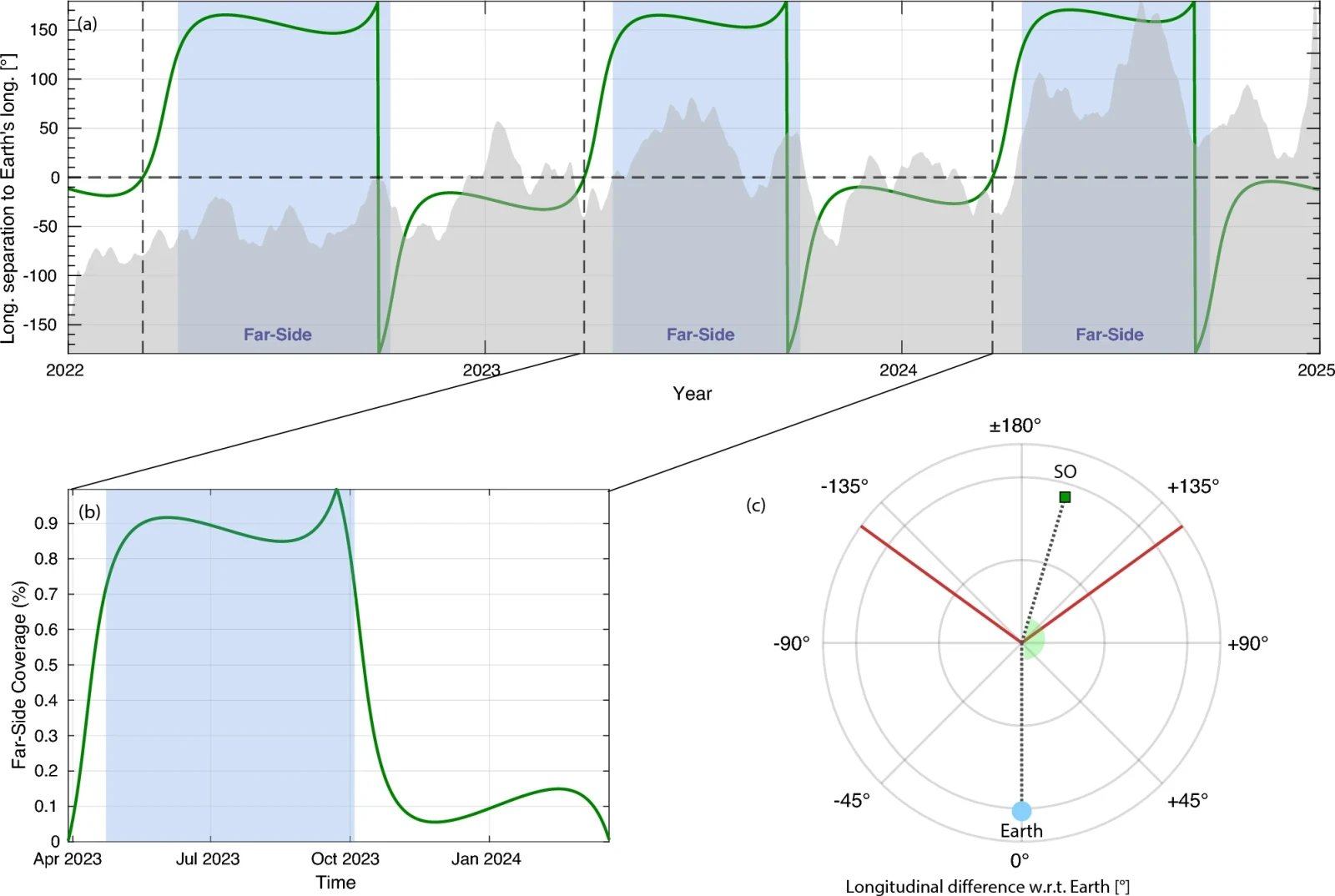
These subtle shifts indicate whether magnetic fields project outward or inward, which influences the magnitude of possible solar eruptions. The research also incorporated established principles like the Hale polarity law to decode the wave data and construct detailed magnetic maps of parts of the sun yet to face Earth.
A Worldwide Network Tuning Into Solar Oscillations
The investigation leverages data from the NSF-NOAA Global Oscillation Network Group (GONG), a global system of automated telescopes monitoring the sun’s surface vibrations nonstop. Dr. Alexei Pevtsov highlighted that such solar oscillations have long served as indicators of far-side solar phenomena.
Now, it is evident that these signals harbor more intricate details than once realized, including insights into magnetic structures.
“The sun is constantly ringing with sound waves,” Dr. Hamada reflected. “One idea that captures people’s imagination is that we can ‘see’ the far side of the sun using sound waves,” he adds.By tracking how those waves move and change, scientists can gather information about both the sun’s interior and its hidden side.
The Importance of Far-Side Magnetic Mapping for Earth
Understanding the sun’s magnetic arrangements is essential for anticipating space weather events. Intense magnetic regions often trigger solar storms that can disrupt satellite functions, navigation, and power grids.
Currently, our magnetic maps are confined to the sun’s near side facing Earth. Because the sun completes a rotation roughly every 27 days, solar activity from the far side can become pertinent before its magnetic characteristics are directly observable. Incorporating far-side magnetic data into space weather forecasting models could extend warning times, enabling better evaluation of potential hazards and deeper insights into the evolution of solar phenomena.
- Categories:
- News








0 comments
Sign in to Comment