
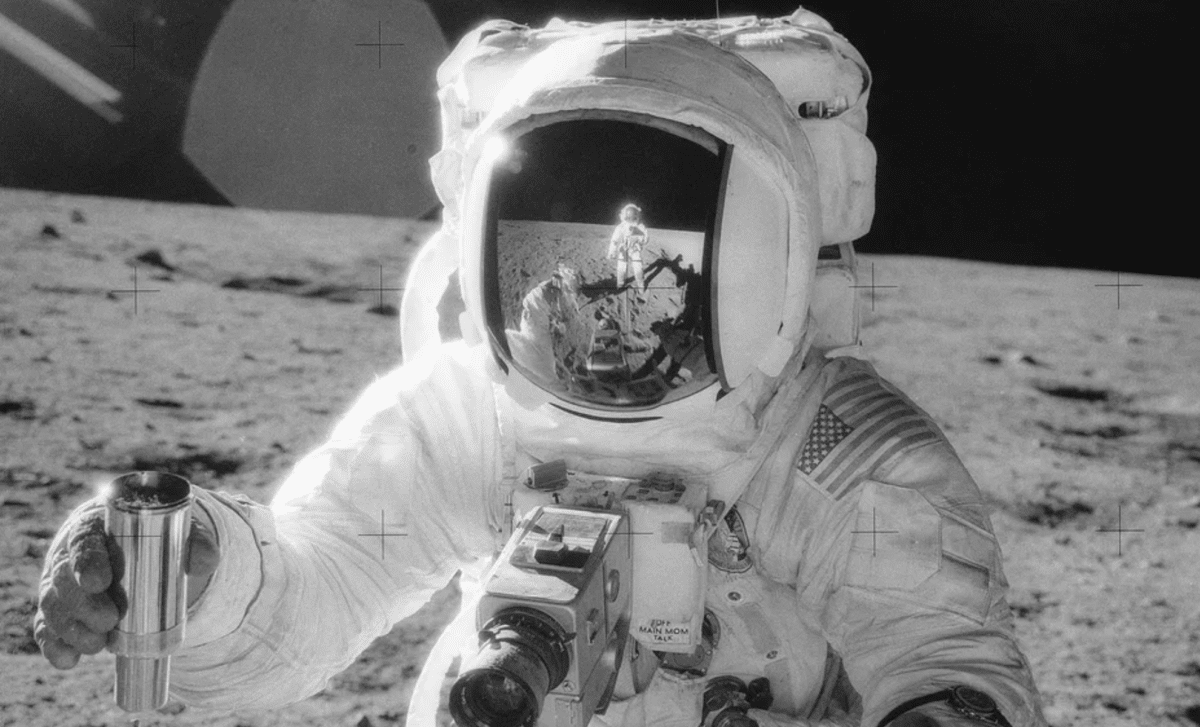
Scientists have long debated the intensity of the moon’s magnetic field throughout its history. While some researchers argued the moon once had a robust magnetic field, others maintained it remained weak for most of its existence. This enduring question has fueled extensive study, and now, a new examination of Apollo mission lunar samples is providing crucial clues. Revisiting these moon rocks has revealed data that challenge earlier beliefs and offer a clearer understanding of the lunar magnetic record.
Unraveling the Mystery of the Moon’s Magnetic Past
For decades, the strength of the moon’s ancient magnetic field puzzled researchers. The Apollo program rock samples, gathered from various lunar regions, were among the first physical evidence hinting at magnetic activity on the moon. Some samples displayed unexpectedly high magnetic readings, suggesting a potent magnetic field might have existed at an earlier stage. Yet, due to the moon’s relatively small core—only about one-seventh of its radius—many scientists questioned whether such a long-standing, strong magnetic field was feasible.
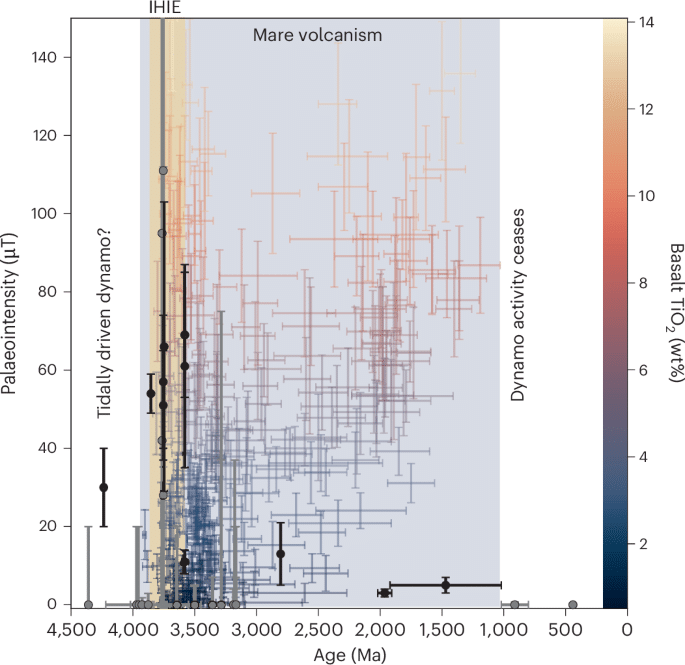
A new investigation, led by Claire Nichols at the University of Oxford and published on Thursday (Feb. 26) in Nature Geoscience, offers a new interpretation. The research indicates that while the moon experienced brief and intense periods of magnetic activity early on, these episodes lasted merely thousands of years or even only decades. This insight reconciles the moon’s magnetic history with its size and internal structure, showing that it mostly had a weak magnetic field over its 4.5-billion-year lifetime.

Titanium-Rich Lunar Rocks Provide Key Insights
Investigations into titanium-rich lunar specimens proved pivotal in unveiling the moon’s magnetic story. Findings revealed that magnetic intensities were notably higher in rocks containing elevated titanium levels compared to those with less titanium.
“For very short periods of time — no more than 5,000 years, but possibly as short as a few decades — melting of titanium-rich rocks at the moon’s core-mantle boundary resulted in the generation of a very strong field,” explained Claire Nichols.
This suggests that at specific intervals, the melting of titanium-rich minerals deep beneath the moon’s surface temporarily triggered powerful magnetic fields.
Such magnetic bursts likely coincided with interactions between the moon’s core and mantle, causing molten titanium-enriched material to form and produce pronounced magnetic effects. These phenomena, however, were fleeting and localized. As lunar internal activity waned, the magnetic field gradually diminished. This discovery improves our understanding of the moon’s early geological dynamics and the source of its transient magnetism.
How Apollo Sampling Sites Influenced Magnetic Interpretations
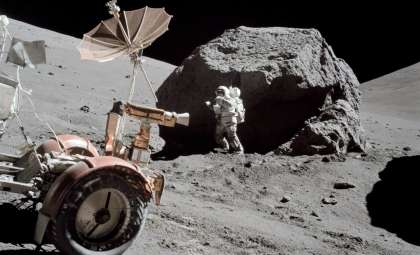
The restricted landing zones of the Apollo missions played a major role in shaping our perception of lunar magnetism. From 1969 to 1972, six Apollo landings targeted similar areas along the moon’s equatorial zone, mainly within expansive, flat maria plains. These regions are dominated by basaltic rocks enriched in titanium.
This focused sampling introduced bias, leading to assumptions that the moon sustained strong magnetic fields over time, based primarily on titanium-abundant rock findings. Nonetheless, these samples do not represent the moon’s full geological diversity. Co-author Jon Wade reflected,
“If we were aliens exploring the Earth, and had landed here just six times, we would probably have a similar sampling bias — especially if we were selecting a flat surface to land on.”
The lunar maria offered safer and more convenient landing sites for Apollo spacecraft, but this emphasis may have limited exposure to other rock types and magnetic histories.
Wade added,
“It was only by chance that the Apollo missions focused so much on the mare region of the moon — if they landed somewhere else, we would likely have concluded that the Moon only ever had a weak magnetic field and missed this important part of early lunar history entirely.”
This study underscores the need to expand future lunar exploration, such as NASA’s Artemis missions, to visit varied locations for a more comprehensive grasp of the moon’s magnetic and geological evolution.
- Categories:
- Space




0 comments
Sign in to Comment