
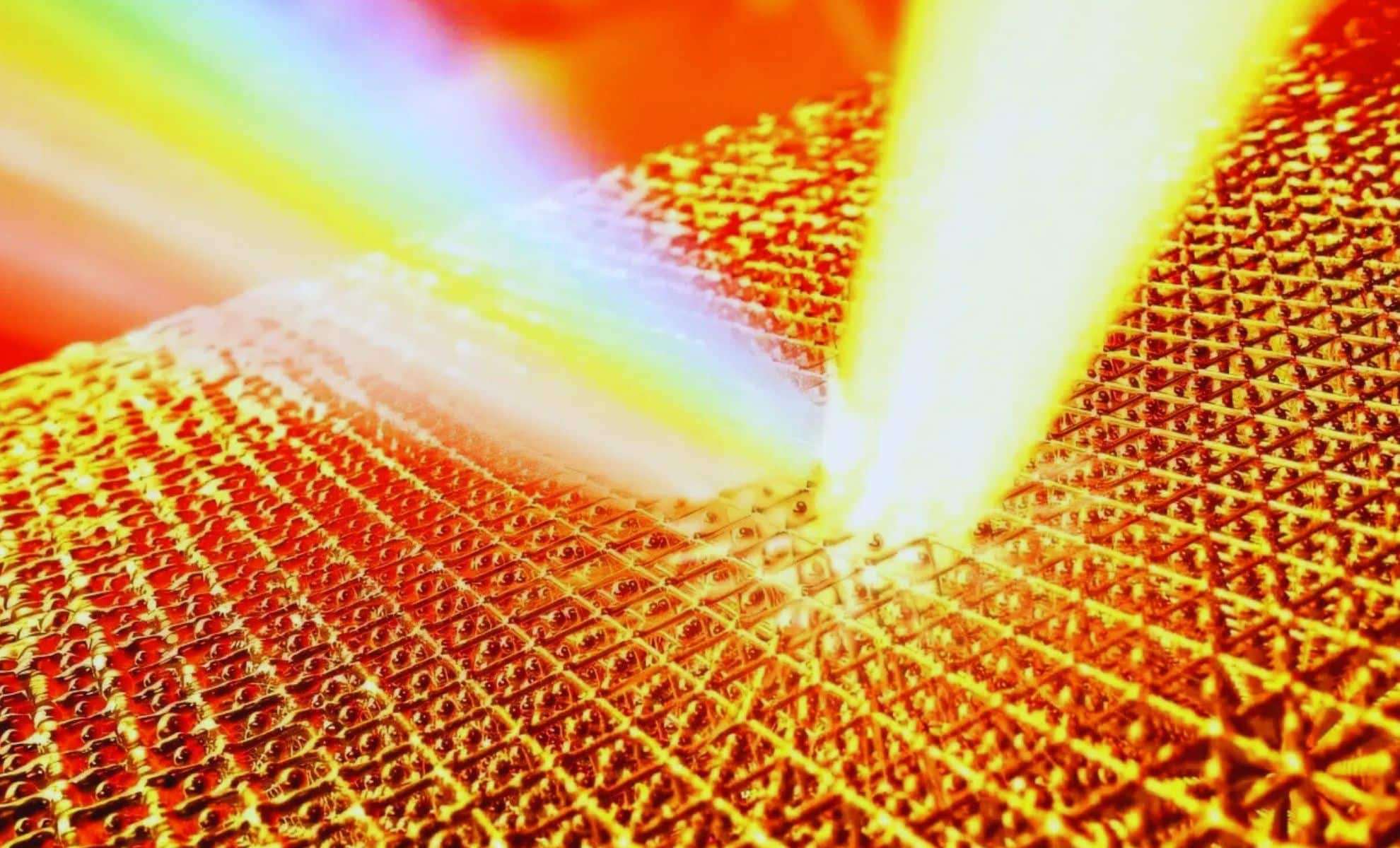
Researchers have challenged a cornerstone of materials science by raising gold temperatures beyond 19,000°C—exceeding its melting point by more than 14 times—while it remained solid. Published in Nature, this work introduces a major advance in high-temperature physics, overturning the four-decade-old concept of an “entropy catastrophe” limit, a fundamental thermodynamic boundary.
Performed at the SLAC National Accelerator Laboratory in California, the team combined ultrafast laser technology with precise X-ray scattering methods to directly assess the ion temperatures within solid gold. This finding may recalibrate how we understand matter’s endurance under extreme heat, impacting areas like fusion energy development, planetary interiors, and materials science.
“We thought the laws of entropy were like traffic signs. This study shows they might be more like guidelines — especially when you’re driving fast enough,” said Tom White, physicist at the University of Nevada and co-lead of the research.
Add Cosmo Herald as a Preferred Source

Surpassing Traditional Melting Points in Metals
The experiment utilized the Matter in Extreme Conditions (MEC) setup at the Linac Coherent Light Source (LCLS), a cutting-edge X-ray free-electron laser. By subjecting a thin (50-nm) sheet of gold to an intense 45-femtosecond laser pulse, the heating rate exceeded 6×10¹⁵ K/s, an unparalleled speed.
To probe the material’s internal response, scientists employed monochromatic X-ray radiation within trillionths of a second. The detected Doppler broadening of scattered photons revealed the ions’ vibrational velocity and, consequently, their temperature.
Surprisingly, the gold retained its crystalline order up to 19,000 Kelvin (~18,727°C), remaining solid for approximately 3 picoseconds, which is significantly longer than the usual melting timeframe.
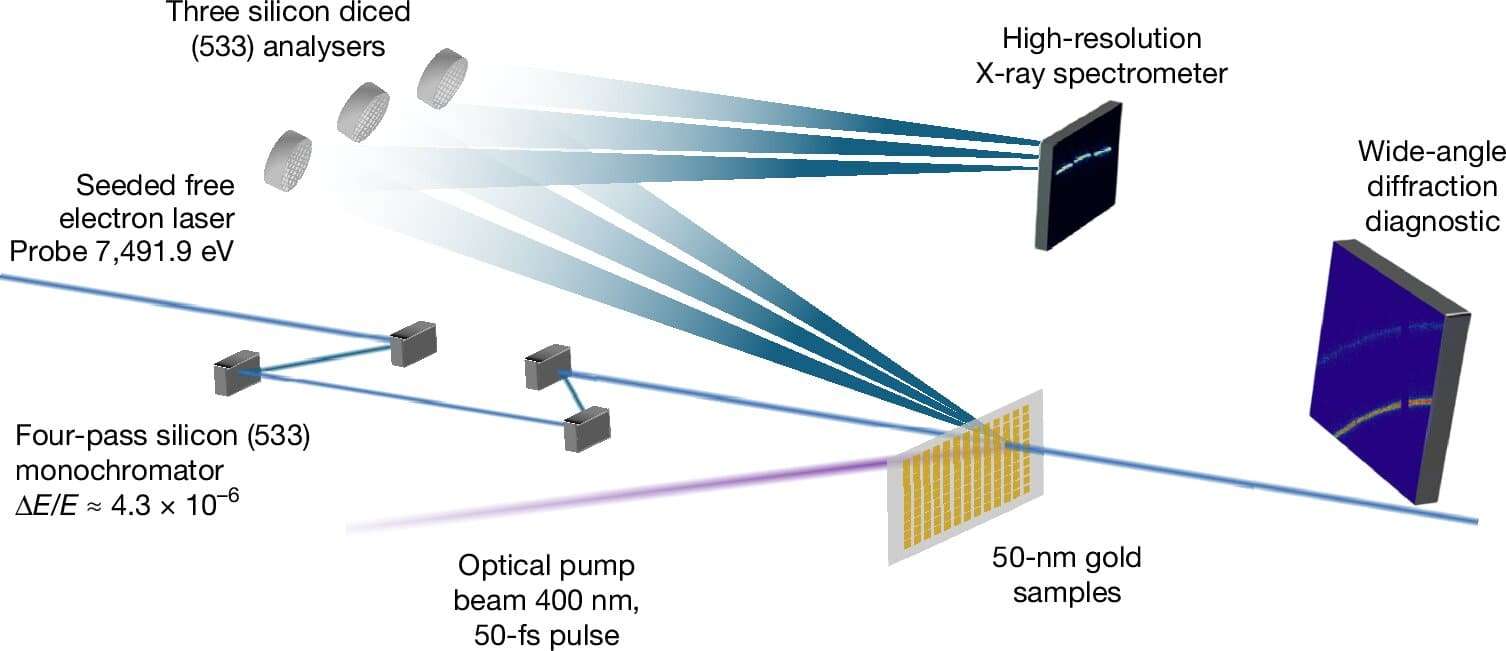
This finding contradicts the accepted entropy catastrophe theory, where it was believed that solids cannot survive above about three times their melting temperature due to an overwhelming entropy spike. In this case, the limit was dramatically surpassed.
Decoding Gold’s Unexpected Stability
To interpret these results, researchers applied thermodynamic simulations. Typically, solids melt when lattice vibrations become intense enough to disrupt atomic arrangement. However, the ultra-rapid heating prevented the atoms from reorganizing.
“Gold simply didn’t have enough time to deform or liquefy,” explained Bob Nagler from SLAC. “It’s like flooring the accelerator so the wheels spin before the vehicle starts moving.”
X-ray diffraction data confirmed that the (111) and (200) Bragg reflections — indicators of orderly atomic patterns — remained visible beyond the critical heat threshold. They faded only after a few trillionths of a second, marking the start of melting.
This suggests classic entropy frameworks, such as those formulated by Fecht and Johnson (1988), do not account for ultrafast, non-equilibrium states. Under these special conditions, thermodynamic limits behave differently than traditionally predicted.
Implications for Science, Energy, and Engineering
These insights extend beyond a laboratory curiosity. They offer fresh perspectives on nuclear fusion, planetary core science, and astrophysics.
In fusion experiments replicating stellar interiors, accurate ion temperature readings are essential. Previously, such data were inferred indirectly from models or electron behavior. This new approach delivers direct, model-independent temperature measurements, fulfilling a long-standing need.
“It’s a game-changer,” said Nagler. “When fusion fuel implodes, you need to know exactly when and where it melts. Now we can see that in real time.”
Planetary scientists may also benefit. Massive gas giants like Jupiter and super-Earths harbor hot metallic interiors. Understanding matter’s behavior in these extremes could improve models of planetary evolution and magnetosphere formation.
Moreover, these findings could inspire creation of materials capable of withstanding harsher conditions, opening new avenues for engineering advanced solids beyond former thermal limitations.
- Categories:
- Science











0 comments
Sign in to Comment