
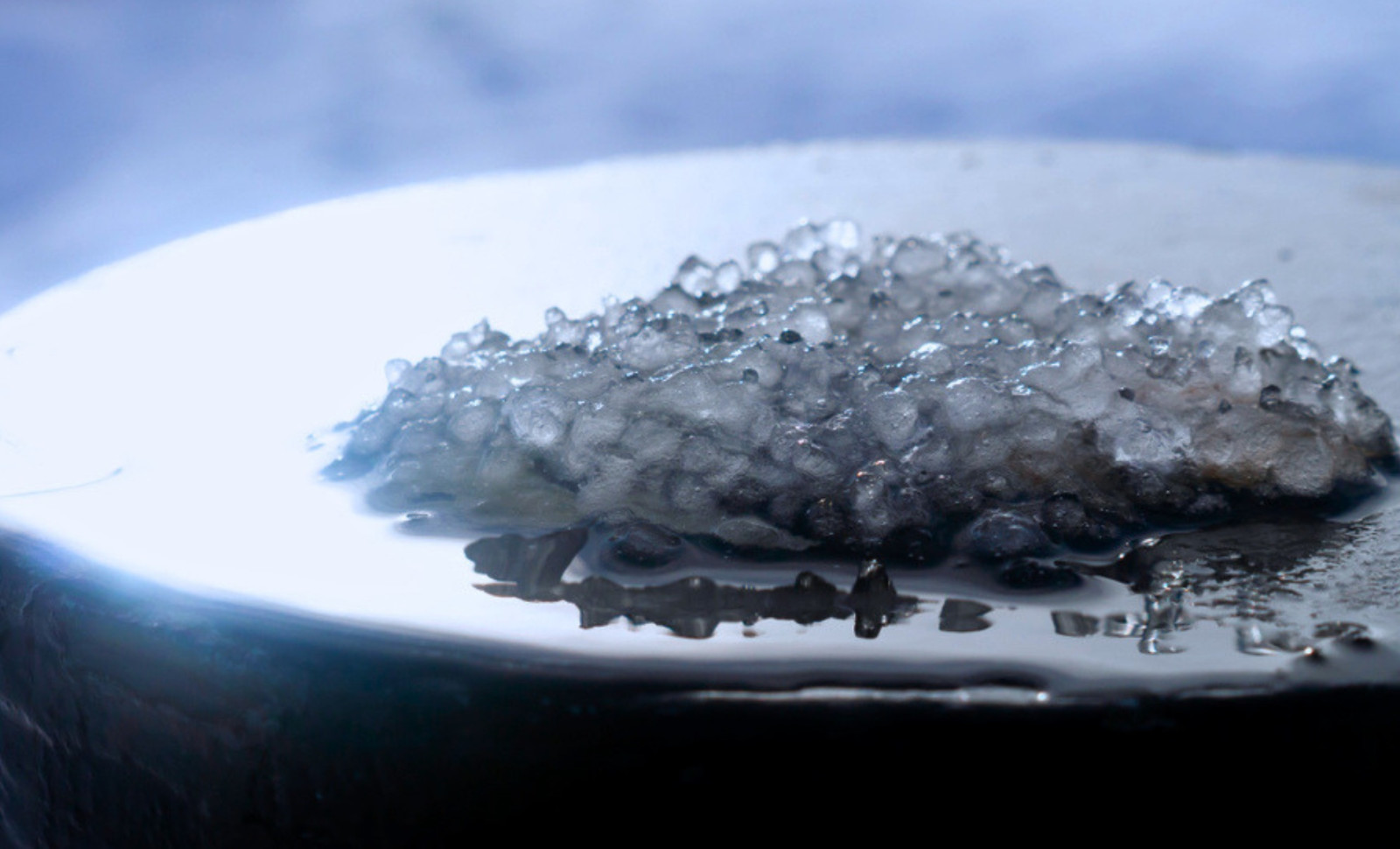
Anthony Raykh, a graduate researcher at the University of Massachusetts Amherst, was wandering through his department halls while carrying a small vial blending water, oil, and magnetized nickel particles. Despite vigorous shaking, the liquid never behaved as standard physics would predict. Instead of separating into typical mixed droplets, it consistently morphed into the graceful silhouette reminiscent of a classical Greek urn.
Raykh had unknowingly produced a shape-memory liquid, representing a novel state of matter that challenges established concepts in the laws of thermodynamics, which dictate energy flow, entropy, and matter interactions.
The research, featured in Nature Physics, reveals a phenomenon never before documented within the realm of soft matter physics.

Unexpected Physics from a Simple Mixture
This discovery emerged during routine lab work. Raykh, specializing in polymer science and engineering, was investigating fluids containing magnetic particles. Instead of the conventional particles used to stabilize oil-and-water blends, he introduced nickel magnetic nanoparticles.
In typical salad dressings, shaking briefly combines oil and water, but they separate over time to minimize surface area, forming spherical droplets as predicted by thermodynamics. However, Raykh’s mixture defied this norm.
“To our astonishment, the mixture consistently molded itself into a flawless urn shape,” Raykh shared in a university release. This shape endured repeated intense shaking, always reforming identically.
The urn silhouette is perplexing because it exhibits a larger surface area than the minimal-energy spherical form. Thermodynamic principles suggest systems seek configurations with the least energy, normally indicated by minimal surface area.
Magnetism Alters the Rules of Surface Tension
To understand this anomaly, UMass Amherst partnered with scientists at Tufts and Syracuse universities to run experiments and advanced simulations. They uncovered that the unusually strong magnetism anchoring the nickel particles at the oil-water interface was crucial.
“Examining each magnetized nanoparticle forming the boundary reveals intricate details of their collective arrangements,” explained David Hoagland, the study’s senior author and professor.
Typically, particles added to oil-and-water mixtures reduce interfacial tension, facilitating emulsification. Yet here, the powerful magnetization of the nickel nanoparticles caused an increase in tension, compelling the liquid interface to curve into a stable, non-flat form — the urn.
This phenomenon stems from attractive dipolar magnetic interactions between particles, which limit emulsification and stabilize this unique shape.
A New Matter State, But No Immediate Uses
The research team notes there’s no current practical use for this discovery. “Although real-world applications remain unknown, Raykh is eager to explore how this unprecedented state may impact soft matter physics,” according to the university announcement.

Thomas Russell, a senior co-author, summed up the discovery succinctly: “When nature shows something that seems impossible, it demands further scrutiny.”
While shape-recovering liquids remain an intriguing laboratory curiosity, this accidental breakthrough suggests the laws of thermodynamics might not be as definitive as previously believed, inviting fresh questions at physics' core. This work was supported by the U.S. National Science Foundation and the U.S. Department of Energy.
- Categories:
- Science












0 comments
Sign in to Comment