
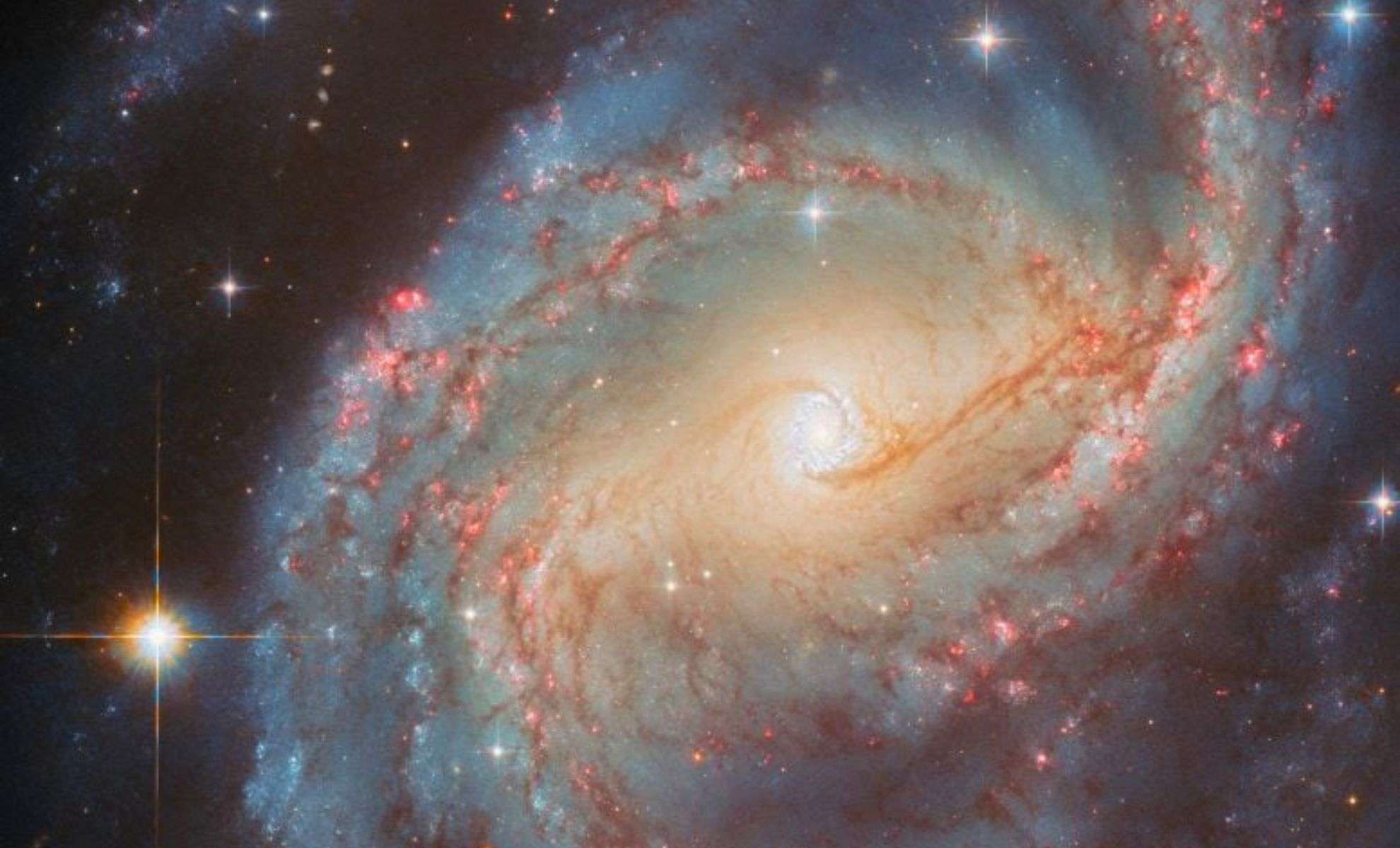
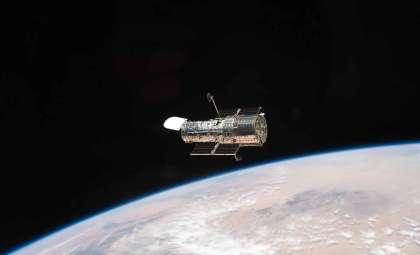
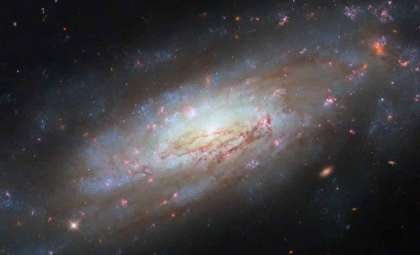
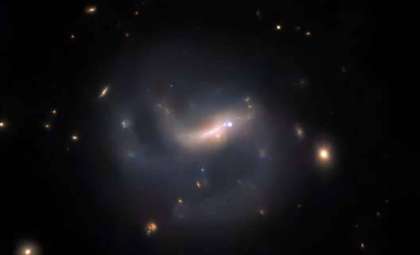
The Hubble Space Telescope has unveiled a luminous ring of stellar formation nestled in the core of NGC 6951, a barred spiral galaxy situated about 70 million light-years away. At its center, a dense circular region thrives, fueled by gas funneled inward along prominent dark dust lanes.
This striking structure, termed a circumnuclear starburst ring, encircles the galaxy’s nucleus like a brilliant cosmic halo. According to The U.S. space agency, such rings demonstrate how internal features of galaxies, including stellar bars, orchestrate star creation over extensive periods.
Located within the northern constellation Cepheus, NGC 6951 belongs to a celestial neighborhood crowded with star-producing galaxies. While it might look unremarkable from afar, detailed examination reveals a turbulent core shaped by powerful internal gas motions. These currents feed and sustain the central ring, where numerous youthful star clusters have recently formed.

The Galactic Forces Shaping the Ring
The dynamics within NGC 6951 are largely governed by its elongated stellar bar, a slowly rotating structure that acts as a gravitational channel. As noted by NASA, this bar captures gas from the spiral arms and guides it along two contrasting dark dust lanes bordering the bar. Upon reaching the galaxy’s center, the gas settles into a ring spanning approximately 3,800 light-years.
This continuous influx of material sparks an ongoing starburst within the ring, visible as a pale blue glow in Hubble’s imagery. While many stars currently forming are younger than 100 million years, scientists believe that the starburst activity has persisted for up to 1 to 1.5 billion years, marking it among the most enduring circumnuclear star-forming regions detected.
More Than 80 Newly Discovered Star Clusters
Leveraging the high resolution of Hubble’s instruments, astronomers have pinpointed over 80 probable star clusters residing in the ring. Each cluster houses tightly packed groups of newly formed stars. The interaction of dense gas, gravity, and steady gas inflow along the bar creates perfect conditions for widespread star formation.
Rather than a random scatter, these clusters align in a pattern dictated by the galaxy’s rotation and internal stellar framework. Their ordered distribution offers essential insights into how galactic centers independently manage star growth without relying on external events like mergers or accretion episodes.
NGC 6951: A Well-Studied Cosmic Laboratory
NGC 6951 has long been a subject of focused investigations. The Hubble telescope has observed it multiple times to analyze features ranging from dust formations and stellar movement to supernova debris. As reported by SciTechDaily, the galaxy has experienced at least five to six supernova explosions, providing a rich dataset to study how star-forming regions progress and fade.
These ongoing observations have enabled scientists to enhance their understanding of barred spiral galaxies and the flow of matter inside them. The radiant starburst ring in NGC 6951 serves as a lasting natural experiment for examining stellar life cycles and galactic evolution mechanics.
- Categories:
- Space



0 comments
Sign in to Comment