
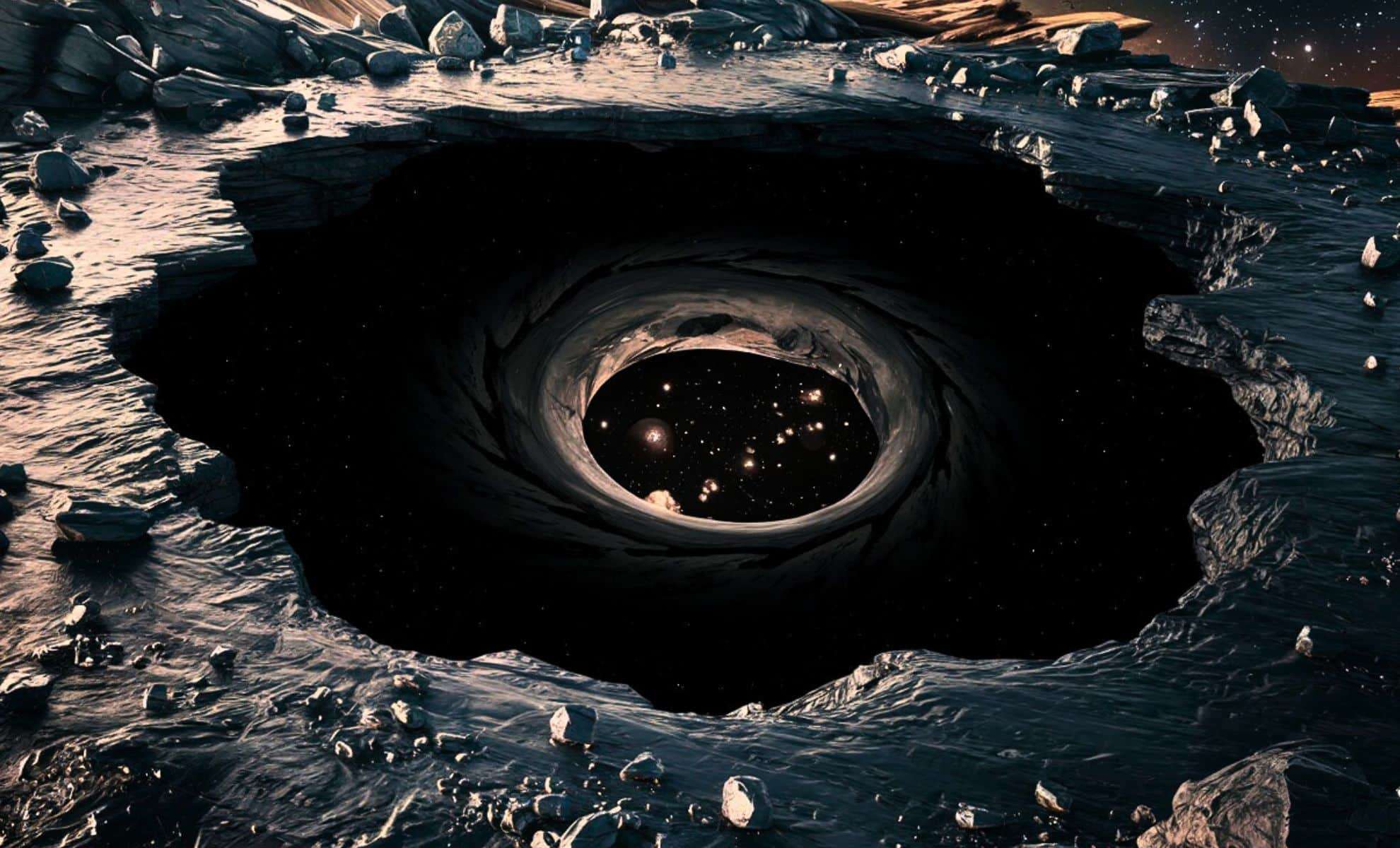
Primordial black holes, hypothesized relics from the Big Bang, have captivated researchers for many years. Believed to have formed within the universe’s initial moments, these tiny black holes might be among the most elusive cosmic objects. Although their discovery could illuminate the nature of dark matter and black hole origins, they have yet to be observed directly.
In a novel study, scientists De-Chang Dai from National Dong Hwa University in Taiwan and Dejan Stojkovic of the University of Buffalo in New York suggest a groundbreaking detection method—examining ancient terrestrial materials to find evidence of their passage, detailed in a paper published in Physics of the Dark Universe on September 20, 2023.
Exploring Timeworn Clues
Typically seen as immense cosmic vacuum cleaners, black holes formed after stars die, primordial black holes could be dramatically smaller—comparable in mass to Earth but with an event horizon scarcely larger than a coin. The researchers propose that these miniature, rapidly moving black holes might carve tiny channels through solid substances by swallowing matter as they traverse.

Key findings from their analysis include:
- A black hole weighing 2.2 × 10¹⁹ pounds (10²² grams) could bore a hole of merely 0.1 micron in diameter.
- Such an aperture would be detectable with an optical microscope, indicating that even modest lab equipment could reveal their presence.
- The most promising materials for inspection are ancient rocks, glass, or solid artifacts—such as those in historical architecture—where the chances of encounters over billions of years accumulate.
Though the probability of a primordial black hole piercing a billion-year-old rock is extremely low (~0.000001), the low resource demands make the search worthwhile. As Stojkovic observes, “The cost is minimal compared to the potential insight gained.”
Primordial Black Holes: Illuminating the Universe’s Youth
Discovering primordial black holes could revolutionize cosmology by confirming models of the early universe’s dense matter conditions following the Big Bang. The theory posits that fluctuations in early, over-dense regions collapsed to create black holes of varying scales.
Detecting these objects may also provide clues about dark matter, an invisible substance constituting roughly 85% of the cosmos’ mass. While dark matter cannot be observed directly, its gravitational footprint is undeniable. Primordial black holes might constitute a fraction of this mysterious matter, opening novel paths for cosmic investigations.
Effects on Planetary and Asteroidal Bodies
Dai and Stojkovic suggest that primordial black holes interacting with celestial entities could produce identifiable signatures:
- Planets and stars: A black hole traversing a planet’s dense interior could hollow out its core. While massive planets may collapse inward, smaller bodies such as asteroids composed of rock or metal might remain intact despite interior damage.
- Asteroids and minor planets: Dense materials like iron better resist such black hole encounters compared to gaseous envelopes of larger planets.
Though rare, these interactions might occur over vast cosmic timescales. Detecting hollowed celestial bodies or gravitational anomalies in asteroids could indirectly point to primordial black holes.
Microscopic Black Holes in Everyday Materials
The authors highlight that evidence need not be sought exclusively in space. Tiny black holes could have left subtle traces on Earth, particularly within robust, ancient substances like granite or glass. Older samples stand as prime candidates, given their prolonged exposure. For instance:
- Ideal sites: Ancient geological formations, large boulders, or architectural glass from historic structures.
- Technique: Employing optical microscopy to identify micron-scale holes indicative of a primordial black hole’s path.
This approach democratizes the hunt, making it accessible to researchers and enthusiasts equipped with common scientific devices.
Dispelling Safety Concerns
Regarding fears of personal encounters with black holes, Stojkovic provides reassurance. “A fast-moving object passing through a medium disrupts molecular bonds too quickly for any sensation or damage—much like a bullet effortlessly piercing glass,” he explains.
An Invitation to Cosmic Discovery
The innovative methodology developed by Dai and Stojkovic opens new opportunities to probe the universe’s infancy using familiar resources. While chances of a find may be rare, the insights gained into cosmic history and the nature of dark matter could be profound. With ancient rocks, historic structures, and everyday materials serving as silent records, the search for primordial black holes might begin much closer than expected—right here on Earth.
- Categories:
- Astronomy ,
- Physics







0 comments
Sign in to Comment