
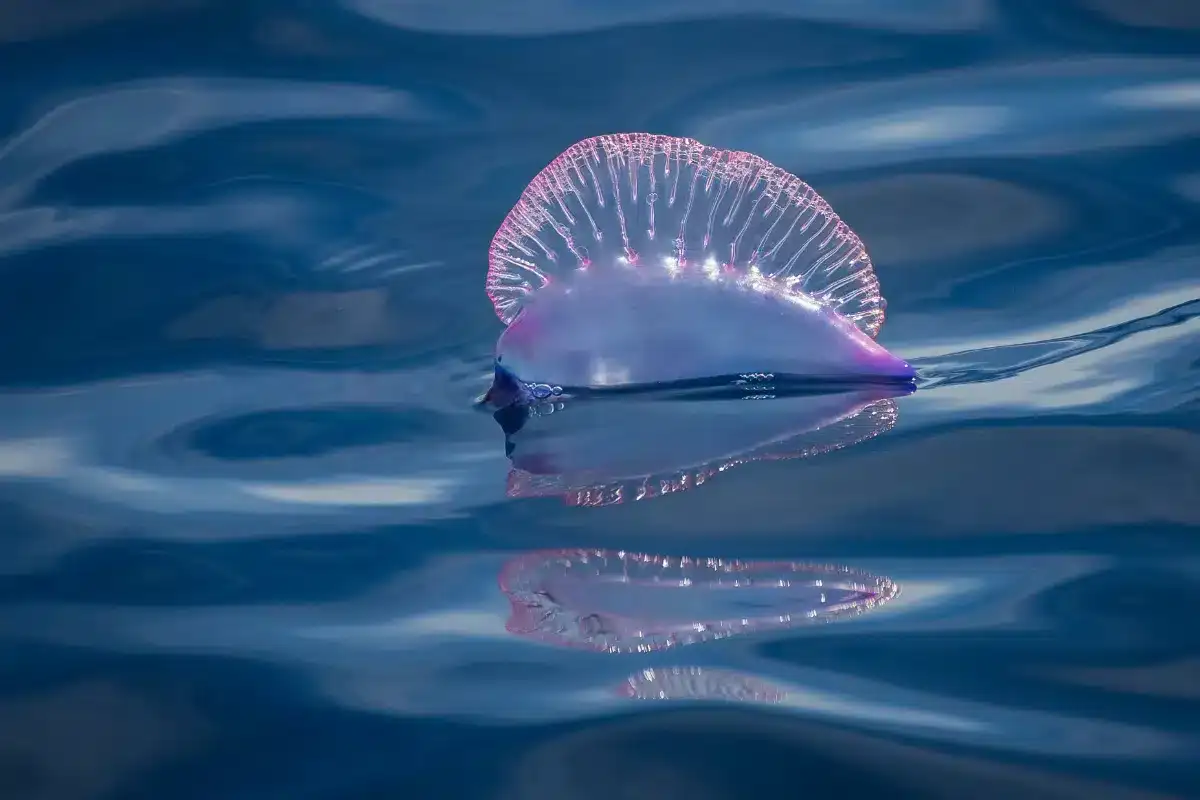
Recently, the tranquil beaches along the Bay of Biscay have faced a surge in encounters with the Portuguese man o’ war, a marine organism often mistaken for a jellyfish. Known for its venomous tentacles, this creature has caused multiple injuries and forced beach closures throughout coastal areas of France and Spain. As more of these stinging entities wash ashore, residents and tourists alike are urged to remain vigilant.
Identifying the dangerous drifter
Despite resembling a jellyfish, the Portuguese man o’ war, also referred to as the sea bladder, is quite distinct. Its buoyant, translucent body floats on the water’s surface while its tentacles can extend up to an astounding 65.6 feet beneath, delivering potent stings. The creature’s purplish, balloon-like appearance might look benign, but it conceals venom capable of inflicting severe pain.
Known scientifically as physalies, these creatures carry a venomous arsenal that can lead to muscle paralysis and other critical health complications. As Dr. Magali Oliva-Labadie highlights, about 8 to 10% of encounters result in serious reactions such as muscle spasms or respiratory distress.

Impact along the coastline
The presence of physalies has raised concerns particularly along the Landes and Basque Country regions, spanning from Spain’s Asturias to northern Landes in southern Bay of Biscay. While not a new phenomenon, these jellyfish-like organisms have been increasingly observed both here and in the Mediterranean over recent years.
For example, the beach at Uhabia in Bidart was temporarily closed after numerous Portuguese man o’ war were spotted. Local resident Karine recalls seeing lifeguards marking stranded specimens for safety precautions, while Flora Benoît of Ain recounts her own encounter at Saint-Jean-de-Luz, emphasizing the necessity for swimmers to be cautious.
Lifeguard efforts and safety protocols
Life-saving teams are actively involved in managing this threat, conducting patrols with jet skis along affected waters. Peyo Peyreblanque, the head lifeguard at Uhabia, shared their approach: “Our jet ski patrols help us locate incoming groups; we prepare for swift response.” When multiple stings occur simultaneously—often between five and six cases—the focus is on immediate treatment and alerting beachgoers.
Current recommended first aid steps for treating Portuguese man o’ war stings include:
- gently rubbing the affected skin with wet sand,
- flushing the area with seawater,
- applying shaving cream to soothe irritation,
- carefully scraping off any remaining tentacle fragments with a wooden spatula,
- and rinsing with a mixture of seawater and vinegar.
Recent research supports vinegar’s use in reducing sting discomfort and neutralizing venom spread.
Understanding and responding to the phenomenon
While it remains uncertain if rising temperatures contribute to the increased appearance of these creatures, researchers suggest that analyzing wind patterns and climatic data could help clarify the situation. Elvire Antajan noted that “this event is not unusual,” yet ongoing studies aim to better understand how environmental shifts might influence physalie presence.
Fortunately, weather forecasts indicate that changing conditions may soon drive these stinging visitors away from shorelines, offering relief to swimmers.
Those enjoying the picturesque beaches along the Bay of Biscay—from Asturias to Landes—should continue exercising caution and remain aware of the potential for these unexpected species in the water.
- Categories:
- Nature















0 comments
Sign in to Comment