
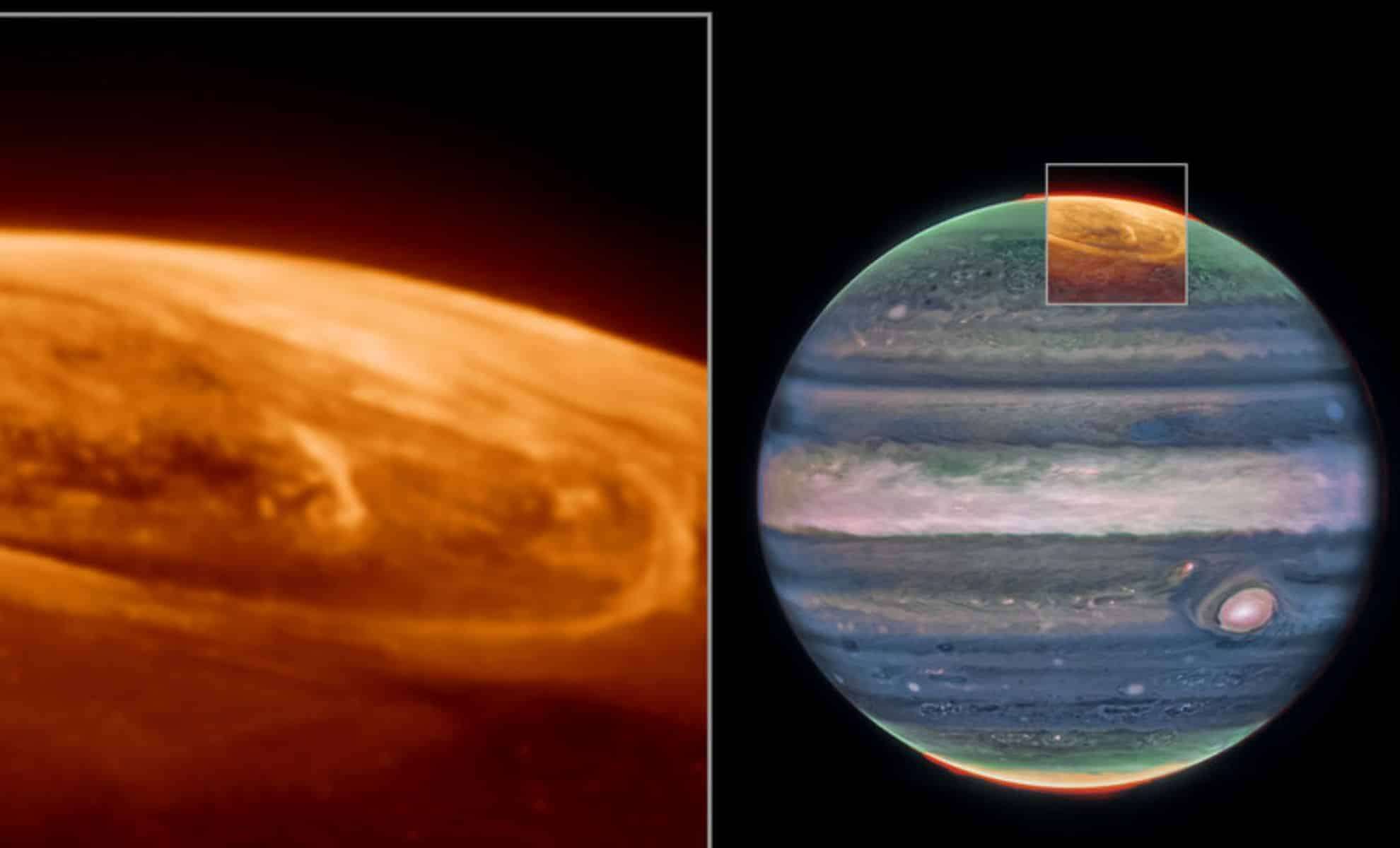
A pioneering investigation featured in Nature Communications, led by Jonathan Nichols from the University of Leicester, utilized the James Webb Space Telescope (JWST) to gain unprecedented insights into Jupiter’s auroral phenomena. These vivid light displays, far more intense than Earth’s, have been examined with remarkable clarity, revealing new complexities about the planet’s magnetosphere. This research, based on data collected in December 2023, challenges established understandings and raises fresh questions about gas giant auroras.
Exploring the Intensity Behind Jupiter’s Polar Lights
Jupiter’s auroras, dazzling at its magnetic poles, are generated when energetic charged particles originating from both the solar wind and volcanic emissions on its moon Io collide with the planet’s upper atmosphere. Unlike Earth’s auroras, which mainly stem from solar activity, Jupiter’s immense magnetic field also captures particles emanating from Io’s volcanic plumes, amplifying the scale and energy of the light shows across its poles.
Boasting one of the solar system’s largest magnetic fields, stretching millions of kilometers, Jupiter accelerates these particles to extraordinary speeds as solar wind interacts with its magnetosphere. Upon striking the planet’s atmospheric layers, the particles create luminescent auroras whose colors vary depending on particle energy. Webb’s advanced instruments have now unveiled fine structures within these auroral emissions, enabling scientists to examine their formation with unparalleled richness.

Rapid Auroral Shifts Captured by Webb
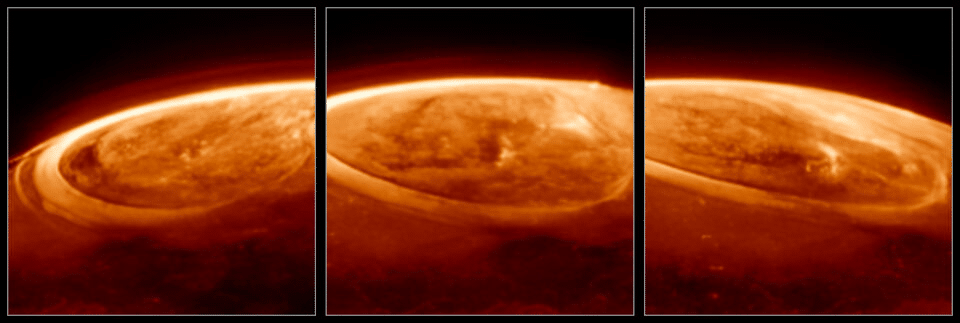
The Webb telescope team made a startling discovery while tracking the pace of Jupiter’s auroral variations. Contrary to expectations that these lights would evolve slowly over minutes or hours, observations revealed that large portions of the auroral display changed dramatically within just a single second.
"What a Christmas present it was – it just blew me away!" said Jonathan Nichols, describing his amazement at the findings. "We anticipated the auroras would fade in and out slowly, perhaps over several minutes. Instead, the entire region was alive with rapid flickering, updating second-by-second." This rapid variability challenges prior theories about auroral dynamics and suggests more complex interactions within Jupiter’s magnetic environment than previously thought.
Unraveling the Puzzle: Infrared vs. Ultraviolet Aurora Observations
Further intrigue emerged when comparing infrared data from Webb with ultraviolet imagery taken simultaneously by the Hubble Space Telescope. Surprisingly, the brightest infrared auroral features detected by Webb were not mirrored in Hubble’s ultraviolet images, puzzling researchers.
Jonathan Nichols added, "The simultaneous Hubble ultraviolet snapshots revealed a perplexing lack of counterparts to Webb’s brightest infrared lights. This suggests a strange phenomenon where vast amounts of low-energy particles bombard the atmosphere, resembling a gentle drizzle rather than a storm. We still don’t fully grasp how this occurs."
This contrast between the two observation methods points to unknown aspects of Jupiter’s auroral mechanics and indicates that our understanding of charged particle interactions with the gas giant’s atmosphere remains incomplete.
- Categories:
- News



0 comments
Sign in to Comment