
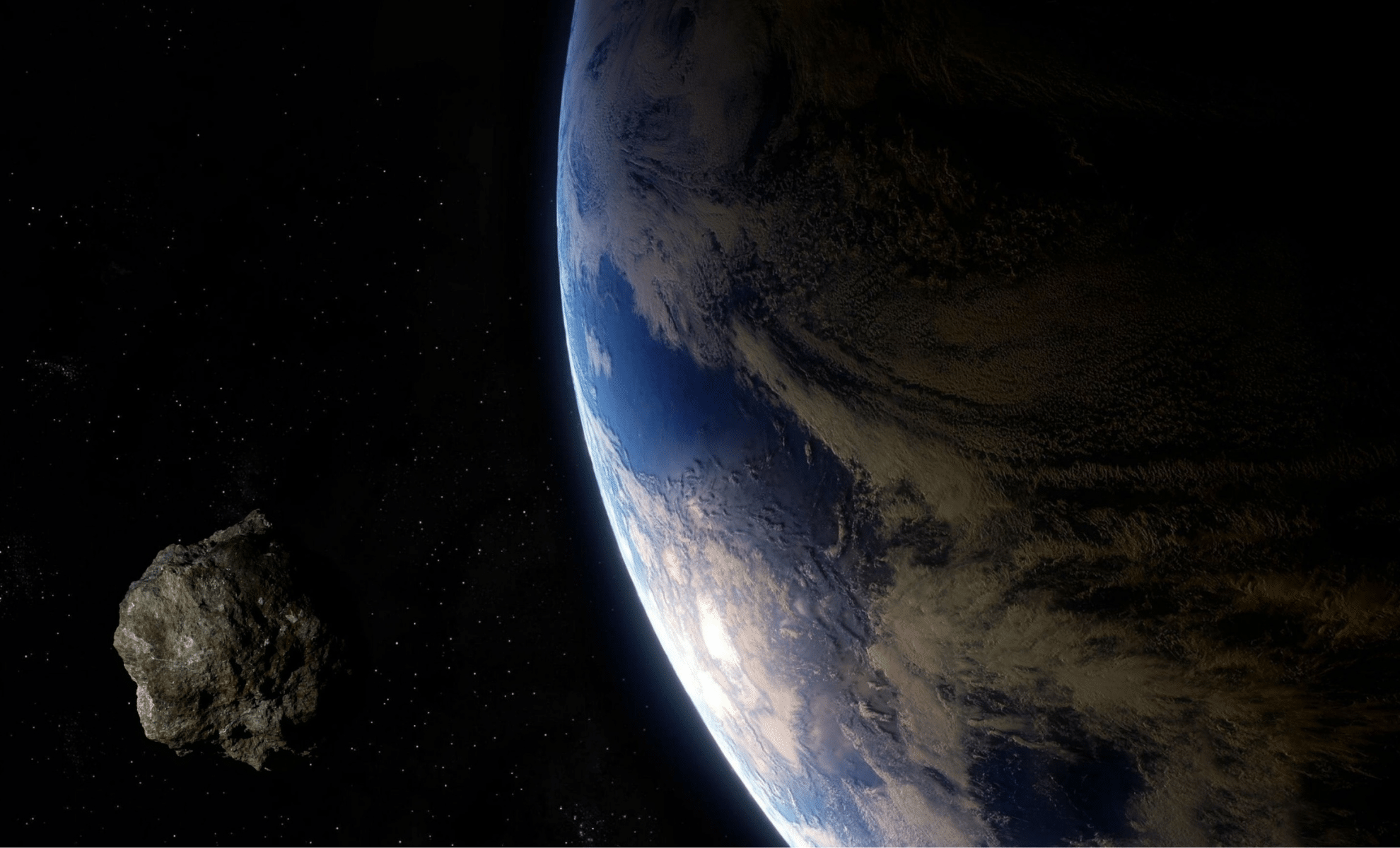
On September 3, 2025, an asteroid roughly the size of a passenger jet will make an exceptionally close approach to Earth, generating keen interest among astronomers and skywatchers. Identified as 2025 QD8, this near-Earth object is expected to pass within about one lunar distance from our planet. To let the public experience this event firsthand, The Virtual Telescope Project will stream the encounter live starting September 2, offering a unique, real-time glimpse of the approaching space rock. Traveling at speeds exceeding 28,000 mph (45,000 km/h), the asteroid will be visible as it zooms rapidly past Earth.
About Asteroid 2025 QD8
Asteroid 2025 QD8 is a recently identified near-Earth asteroid, estimated to be between 55 and 124 feet (17 to 38 meters) wide—comparable in size to a commercial aircraft. While such space rocks frequently orbit near Earth, the particularly close distance of 2025 QD8’s flyby makes it a noteworthy event worthy of attention from both scientists and the general public.
On the day of its closest approach, the asteroid will pass roughly 135,465 miles (218,009 kilometers) from Earth—just slightly over half the distance to the Moon. Despite appearing alarmingly near in cosmic terms, experts confirm that 2025 QD8 poses no impact threat to Earth or the Moon now or in the foreseeable future. Its well-tracked orbit highlights the ongoing need to monitor nearby space objects.

Watch the Flyby Live with The Virtual Telescope Project
The Virtual Telescope Project, spearheaded by astronomer Gianluca Masi, specializes in delivering live online coverage of astronomical phenomena. For this upcoming asteroid passage, the team will broadcast a free live event on YouTube beginning at 7 p.m. ET (23:00 GMT) on September 2. Via robotic telescopes located in Manciano, Italy, viewers will witness the asteroid’s approach as it unfolds in near real-time.
The streamed footage will offer an intimate look at 2025 QD8, enabling audiences to track its swift journey through space. The Virtual Telescope Project has previously imaged the asteroid from as far as 2.4 million miles (3.9 million kilometers) away, capturing faint glimpses with long exposures. As it nears Earth, the clarity will improve dramatically, revealing this fascinating celestial visitor in greater detail.
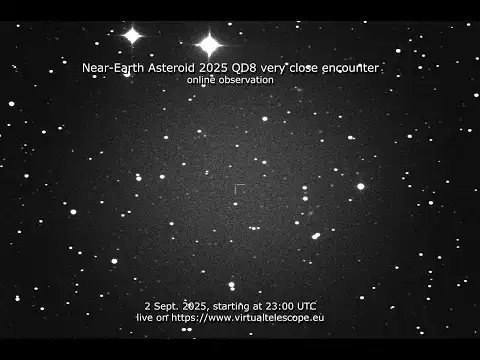
Just How Close Will It Get?
Although 2025 QD8 will be moving fast and is relatively small, astronomers have precisely calculated its path, confirming no collision risk. Its closest approach will occur on September 3 at 10:57 a.m. ET (14:56 GMT). This event offers a rare chance for observers to witness a near-Earth asteroid passing by at exceptionally close quarters.
At its nearest, the asteroid will be around 57% of the distance to the Moon, an astoundingly close proximity in astronomical terms. While it presents no danger, this encounter enables researchers to study how such objects behave under Earth’s gravitational influence.
The Impact of Robotic Telescopes
Robotic telescopes are pivotal in tracking near-Earth objects, offering remote and continuous observation capabilities. The Virtual Telescope Project utilizes advanced instruments, including a 17-inch telescope named “Elena,” to capture distant asteroids with great precision. These autonomous systems are revolutionizing astronomy by allowing scientists to gather detailed data without the need for on-site human operators.
During the 2025 QD8 flyby, telescopes based in Manciano will not only take still images but also provide real-time video streams, making it possible for a global audience to experience the asteroid’s passage as it happens, underscoring the critical role automation plays in modern space research.
- Categories:
- News







0 comments
Sign in to Comment