
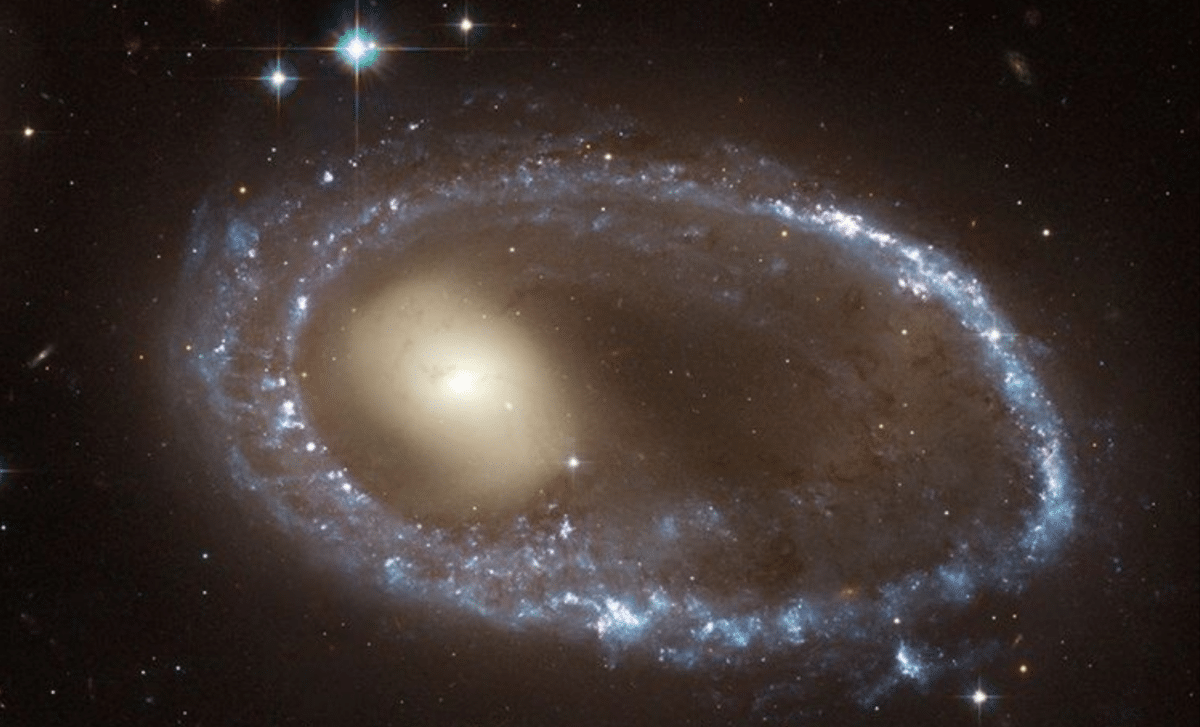
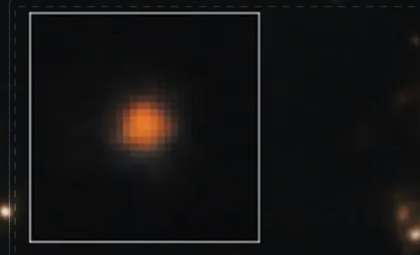
A global consortium of astronomers, led by Weichen Wang from the University of Milan, Italy, has identified a colossal galaxy dubbed the “Red Potato.” Utilizing the James Webb Space Telescope’s (JWST) cutting-edge instruments, this galaxy is situated within a gas-rich cosmic web node at a redshift near 3.25. The research highlights the galaxy’s unexpected dormancy in star creation, despite existing within an environment abundant in the cold gas typically essential for nurturing new stars.
Massive Galaxy Shows Unusual Star Formation Quiescence
Known as MQN01 J004131.9-493704, the Red Potato presents an immense stellar mass tallying 110 billion suns and spans roughly 3,260 light years in half-light radius. Remarkably, its rate of star birth is extremely low—just 4.0 solar masses per year—falling well below the anticipated star-forming main sequence for galaxies within this cosmic locale. The authors note,
“In this work, we present the discovery of a massive quiescent galaxy in a gas-rich environment of a cosmic web node or protocluster at z ∼ 3.2, identified and spectroscopically confirmed from a JWST program.”
Add Cosmo Herald as a Preferred Source

This anomaly of substantial mass yet little star formation has motivated deeper examination into the mechanisms stifling star production here.
The scarcity of star formation within such a gas-plentiful setting hints at an unconventional evolutionary history. Typically, cosmic web nodes or protoclusters brim with cool molecular gas that drives stellar growth. However, the Red Potato defies these norms, offering a rare window into the complex factors shaping galaxy development during the universe’s earlier epochs.
Surprisingly Low Molecular Gas Content
One pivotal revelation, presented on January 28 in an arXiv pre-print, is the galaxy’s unexpectedly minimal reservoir of molecular gas. Leveraging JWST’s Near Infrared Camera (NIRCam) and Near Infrared Spectrograph (NIRSpec), researchers established the molecular gas amount to be below 7 billion solar masses. This results in a molecular gas fraction under 0.06, strikingly low for an object of this magnitude. Moreover, signatures of carbon monoxide (CO) and sodium D absorption lines—typical markers of cold gas—were absent, implying the galaxy may have depleted its gas supply or is failing to draw in fresh gas effectively.
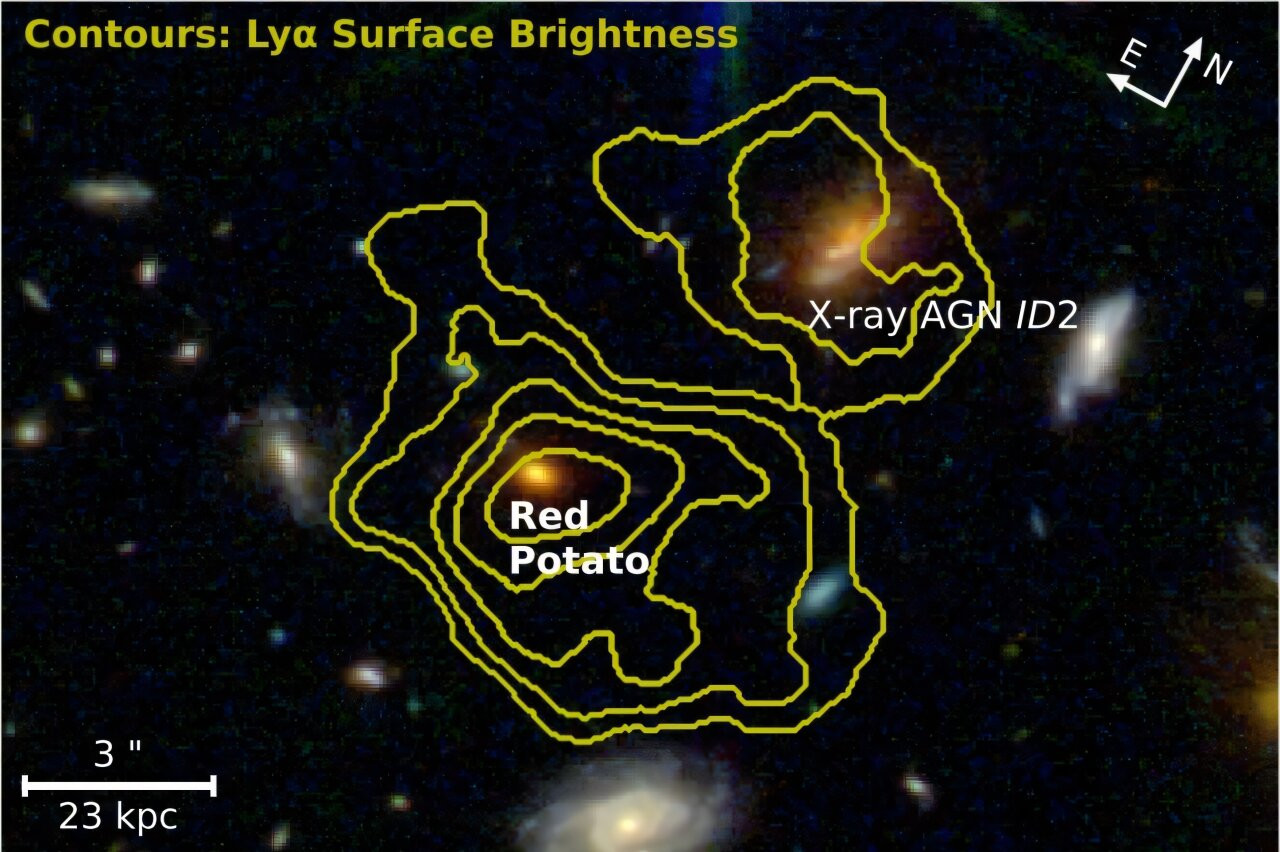
This deficiency in gas likely explains why the Red Potato exhibits such a low star formation rate compared to similar massive galaxies. The team infers that external influences could be obstructing gas inflow from the surrounding cosmic medium, halting the galaxy’s stellar production.
Impact of X-ray Jets on Gas Accumulation
A further key insight is the detection of an X-ray jet emitted by a nearby active galactic nucleus (AGN). Beyond its novelty, this jet may have a critical impact by stirring turbulence within the galaxy’s circumgalactic medium (CGM), the gaseous halo where star-forming material is usually accreted.
The AGN’s X-ray jet likely disrupts the smooth influx of gas, limiting the galaxy’s ability to gather the raw material for forming stars. This feedback mechanism energizes the surrounding medium, preventing gas from settling and thus inhibiting galactic growth. Observations of increased gas velocity dispersion through Lyα and Hα emission lines underpin this turbulent environment.
A Unique Window into Galaxy Evolution
The identification of the Red Potato offers important insights into the intricate dynamics of galaxy evolution during a pivotal, rapid-growth phase of the early universe at z ∼ 3.25. Despite its position in a gas-rich setting, the galaxy remains quiescent, potentially due to selective external influences like AGN-driven feedback. This case challenges conventional ideas about galactic assembly and the forces balancing gas inflow and feedback.
Thanks to JWST’s remarkable observational power, this research pioneers deeper understanding of how gas, stars, and energetic feedback interplay during formation of massive galaxies. Continued study of analogous systems will refine models for galaxy evolution when conditions were drastically different from the modern cosmos.
- Categories:
- Space




0 comments
Sign in to Comment