
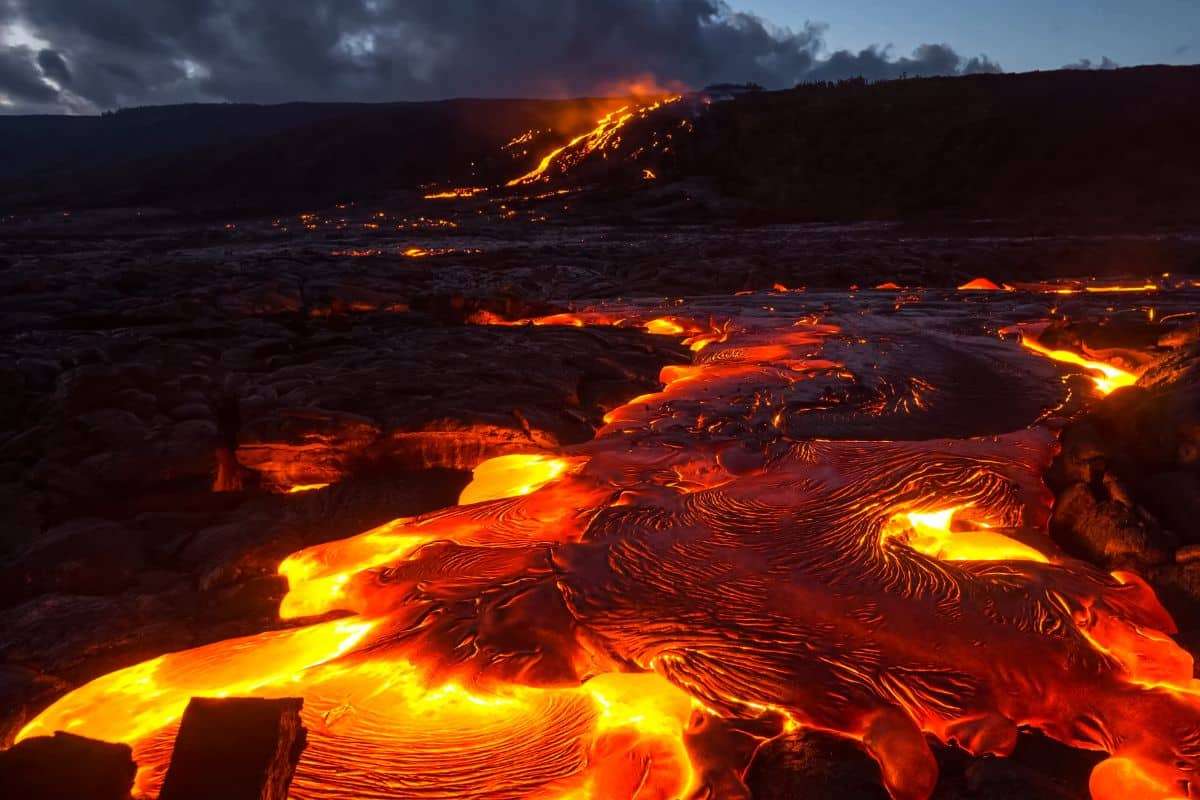
A colossal volcanic eruption approximately 135 million years ago could be the key factor behind the tectonic forces that separated Africa from South America, new geological insights suggest. Research illuminates how an intensely heated mantle plume deep within the Earth’s interior might have contributed to the disintegration of Pangaea, the ancient landmass.
The Fiery Origins of a Continental Split
The formation of the Atlantic Ocean basin as observed today likely resulted from immense magma flows spanning from 135 to 131 million years ago, peaking near 134.5 million years ago.
During this stretch, more than 3.8 million cubic miles (16 million cubic kilometers) of molten material erupted through Earth’s surface. This lava solidified into volcanic rock formations found across South America, Africa, and beneath the Atlantic seabed. Particularly in Namibia and Angola, volcanic layers exceeding 1 kilometer thick serve as remains of these ancient eruptions.
Clues Pointing to a Heat Anomaly
The research, led by Mohamed Mansour Abdelmalak, a geologist and geophysicist at the University of Oslo, argues this volcanic event was more than coincidental. By analyzing extensive geological data from both continental and oceanic measures, the team reconstructed the volcanic activities preceding the continental drift.
Their findings suggest a “thermal anomaly” — an abnormally hot zone beneath the crust — likely triggered this massive volcanic episode, consistent with the influence of a mantle plume. These upwellings of intensely hot rock can weaken and fracture the crust, initiating significant geological shifts.

Connections to Species Extinctions and Climate Changes
“We see evidence of extinctions and climatic disruptions” around 134.5 million years ago, Abdelmalak noted. Pinpointing this period helps link volcanic episodes with widespread ecological effects.
While volcanic eruptions commonly emit vast amounts of greenhouse gases that warm the atmosphere, paradoxically, Earth experienced a considerable cooling phase near 134 million years ago.
Volcanic Rock Weathering and Its Cooling Influence
This global cooling could stem from the chemical breakdown of volcanic rocks. New lava exposed to the atmosphere reacts with gases, especially carbon dioxide, effectively removing CO2 from the air.
The weathering of volcanic deposits can act as a natural climate moderator, balancing out the typical warming effects caused by volcanic gases.
Knowledge Gaps Beneath the Ocean Floor
Despite compelling evidence, uncertainties remain. “Limited sampling means we can’t definitively link this volcanism to a mantle plume,” Abdelmalak admitted.
Much of the gap lies under the deep ocean, particularly near Argentina and Uruguay, where drilling and rock retrieval are minimal. Further exploration could validate whether a mantle plume triggered this massive eruption.
Iceland Today: A Living Example of Mantle Plumes
To better understand ancient tectonic activity, scientists examine modern locales like Iceland, where the Mid-Atlantic Ridge continues to diverge the Earth’s crust.
The Iceland hotspot, driven by what is likely a deep mantle plume, pushes magma upward, generating new crust between tectonic plates. “Iceland provides a contemporary example of how mantle plumes contribute to large-scale magma outpourings,” Abdelmalak said, drawing parallels to the processes that shaped the Atlantic basin millions of years ago.
- Categories:
- Nature






0 comments
Sign in to Comment