
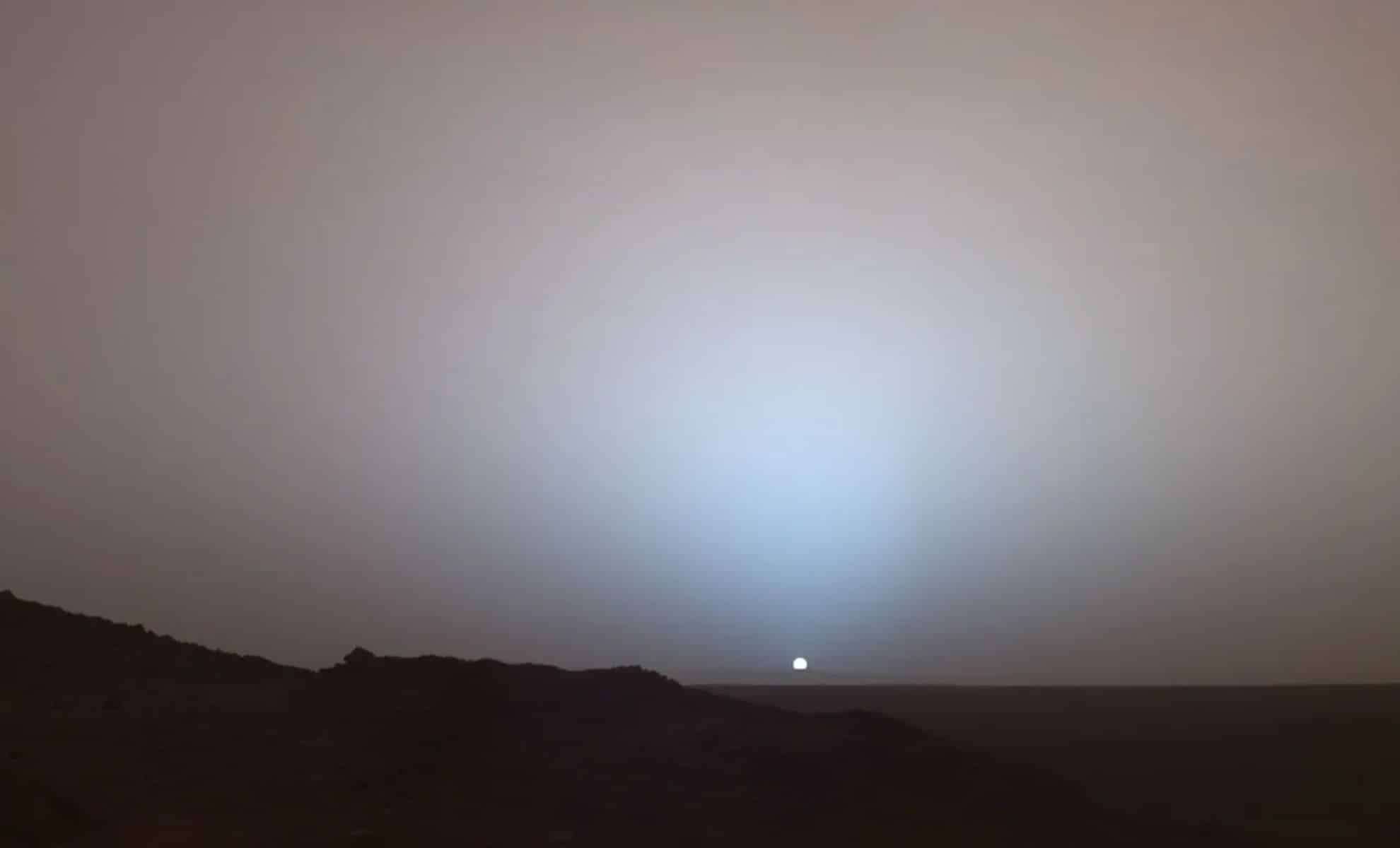
On May 19, 2005, NASA’s Spirit rover immortalized a breathtaking view of the sun descending beyond the edge of Gusev crater on Mars. Captured on the rover’s 489th Martian day—or sol—this panoramic shot provides both a stunning visual and key scientific insights into Martian twilight.
Detailed View of the Martian Sunset Panorama
The panorama was produced using the Spirit rover’s Panoramic Camera (Pancam) combined with color filters at wavelengths of 750, 530, and 430 nanometers. This filter combination created a false-color mosaic approximating human vision, though colors are slightly intensified. Of particular interest is the blue tint surrounding the sun, reflecting what an observer on Mars would see.
The sky farther from the sun shows a richer red tone due to the Pancam’s infrared imaging. Since Mars orbits farther from the sun than Earth, the sun appears roughly two-thirds its Earthly size. In the foreground is the rock formation dubbed Jibsheet, which Spirit had been examining over several weeks.

The vast expanse of Gusev crater stretches out, with the sun setting behind the crater’s wall about 50 miles (80 kilometers) away.
What Sets Martian Sunsets Apart from Those on Earth
Sunsets on Mars differ markedly from Earth’s due to several factors. Twilight on Mars can last for up to two hours before sunrise or after sunset, a duration far exceeding that on our planet. This prolonged twilight is caused by sunlight scattering around Mars’ night side via high-altitude dust particles suspended in its thin atmosphere.
This effect resembles Earth’s striking sunrise and sunset hues that sometimes occur due to volcanic dust scattering sunlight. Yet on the Red Planet, airborne dust is a constant presence, producing a sustained and extended twilight glow.
Why Scientists Study Mars’ Extended Twilight
The Mars Exploration Rover team occasionally instructs Spirit to capture images of sunsets and twilights to analyze how far the dust reaches into Mars’ atmosphere. These images also assist in detecting dust storms or ice clouds that influence Martian weather and climate.
Studying the twilight’s color and brightness furnishes important clues about atmospheric components, such as the size and distribution of dust particles. These insights are crucial for understanding Mars’ atmospheric behavior and for designing future exploration missions.
Spirit was commanded to stay powered on shortly after transmitting daily data to the Mars Odyssey orbiter, enabling the capture of this unique image just as the sun slipped below the crater’s horizon. This mosaic remains a treasured addition to Spirit’s portfolio of remarkable Martian vistas.
- Categories:
- Space








0 comments
Sign in to Comment