
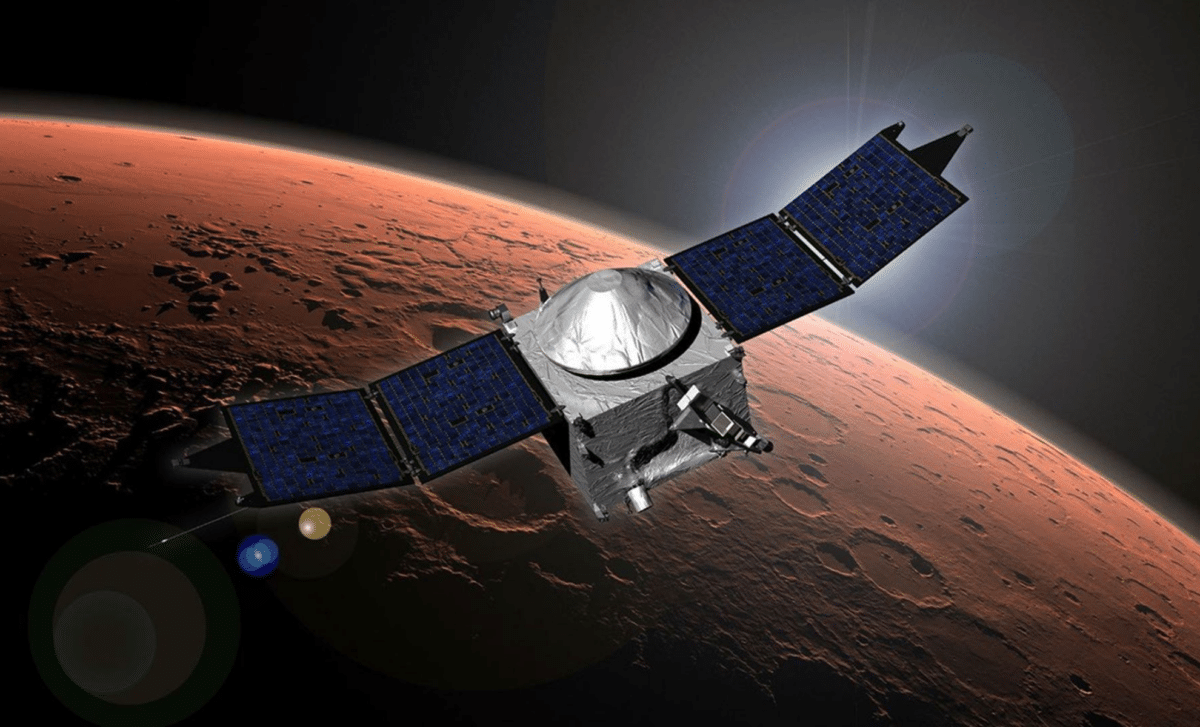
NASA’s MAVEN (Mars Atmosphere and Volatile Evolution) spacecraft, a key player in Mars research for over ten years, unexpectedly lost communication in December 2025. Despite extensive efforts by NASA scientists and engineers to restore contact, MAVEN has remained unresponsive. This loss has sparked concerns about the future trajectory of Mars exploration and the implications for missions relying on satellites like MAVEN that decode the Red Planet’s secrets.
An Unexpected Silence: MAVEN’s Sudden Communication Breakdown
NASA’s MAVEN spacecraft has stood as a fundamental asset in unraveling Mars’ atmospheric mystery. Launched in 2013 with a planned mission of just one year, MAVEN surpassed expectations by providing detailed insights into Mars’ climatic shifts, atmospheric loss, and its evolution into the cold desert observed today. However, after years of valuable data collection, the probe abruptly lost contact while orbiting Mars, leaving its status unknown to experts.
On December 6, 2025, MAVEN was scheduled to transmit data after emerging from Mars’ orbit shadow but failed to do so. Multiple attempts to reestablish communication via NASA’s Deep Space Network and collaborating facilities have proved unsuccessful so far. Louise Prockter, NASA’s planetary science division director, confirmed that although the situation is critical, the probe has not yet been officially declared lost.

“We haven’t officially said MAVEN is lost yet. We’re still looking for it,” Prockter said.
Efforts to recover MAVEN have involved a global network of observatories. Following the communication loss, NASA enlisted resources such as the National Science Foundation’s Green Bank Observatory and commanded the Curiosity rover to scan the skies for signals from MAVEN, though nothing was detected. Despite these hurdles, Prockter praised the team’s relentless dedication and perseverance.
“I did want to take a moment just to celebrate the entire MAVEN team for all they’ve achieved, and for their absolutely heroic efforts during the recent spacecraft recovery efforts.”
Crucial Insights and Communication: MAVEN’s Legacy on Mars
MAVEN has been instrumental in deepening our comprehension of Mars. Its data has illuminated how the planet lost its atmosphere, revealing the processes behind Mars’ shift from a potentially habitable environment to the arid terrain seen today. This knowledge not only enriches our scientific perspective but also aids the planning of future missions, potentially involving human exploration.
Moreover, MAVEN has played a vital role in maintaining communication channels between Earth and Mars surface missions. Approximately one-fifth of all transmissions to and from Mars rovers like Curiosity and Perseverance rely on MAVEN’s relaying capacity. This communication lifeline is critical, making the current silence a significant operational setback for ongoing Mars missions.
Reflecting on MAVEN’s longevity, Prockter remarked, “We know that they’re not all going to last forever.” NASA is already evaluating strategies to sustain Mars communications infrastructure, including the prospect of deploying a replacement orbiter should MAVEN’s silence persist.
Looking Forward: The Next Chapter in Mars Exploration
NASA remains active in its search for MAVEN but acknowledges the chance the probe may never be recovered. Despite this uncertainty, the agency is targeting new goals for Mars exploration. Prockter stated that NASA is preparing for what lies ahead beyond MAVEN’s mission: “The agency is thinking about what is next for Mars.” Space exploration has a history of overcoming adversity by learning from setbacks and advancing technology.
Plans are underway for a new Mars telecommunications orbiter designed to replace and surpass MAVEN’s role in facilitating data communication. Funding of $700 million has been secured via a recent budget bill to develop this high-capacity orbiter, expected to be a cornerstone for Mars mission communication infrastructure. With MAVEN’s status unresolved, this upcoming orbiter will be critical to ensuring that Mars surface operations maintain a reliable connection with Earth.
NASA’s proactive planning underscores its commitment to Mars exploration through innovation and resilience, adapting its capabilities to ensure the continuation of groundbreaking discoveries on the Red Planet.
- Categories:
- Nasa










0 comments
Sign in to Comment