
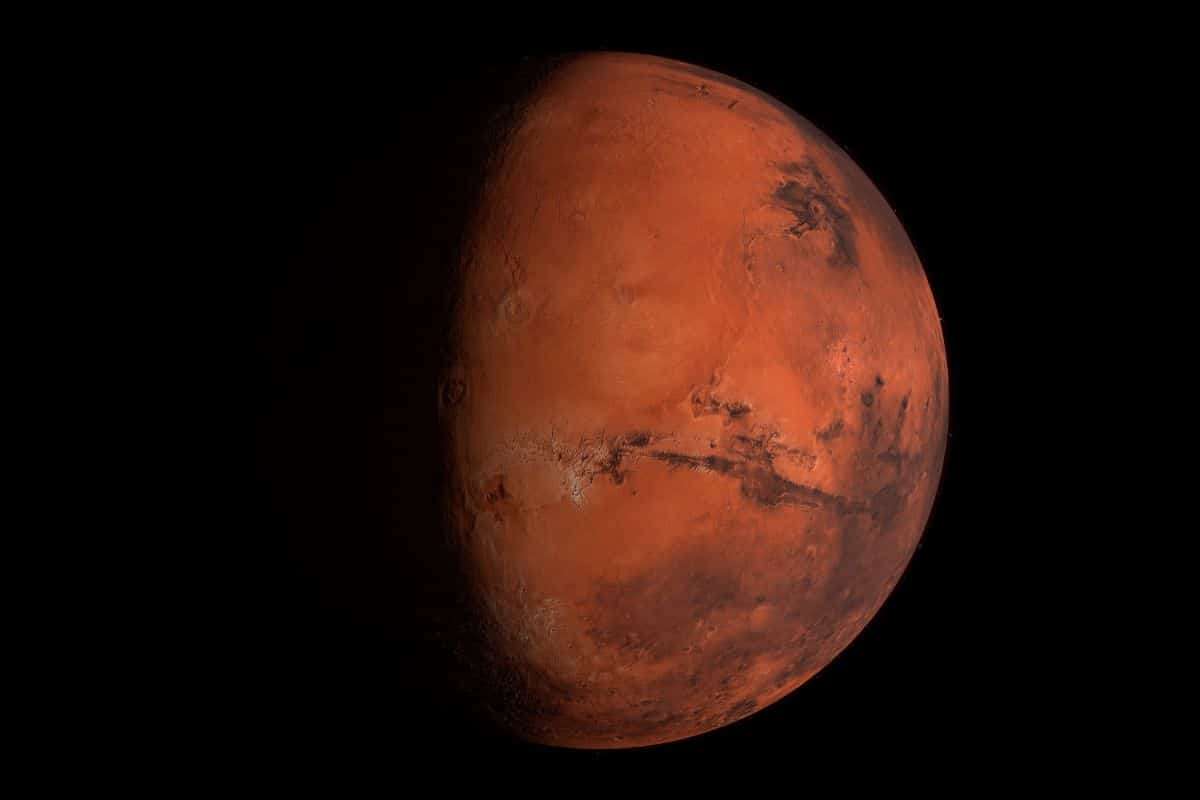
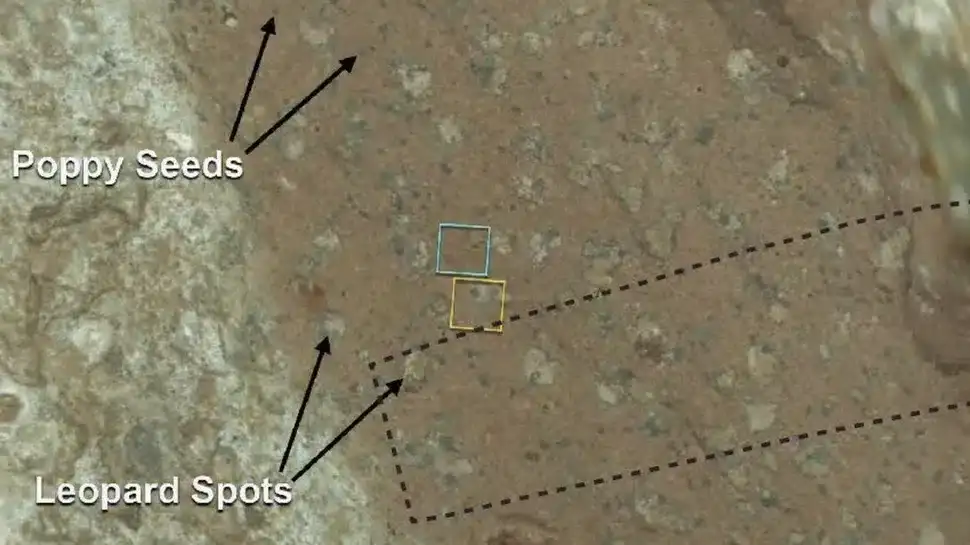
A perplexing Martian rock has sparked fresh questions about the existence of past microbial life on the Red Planet. NASA’s Perseverance rover has uncovered this intriguing rock, named Cheyava Falls, in Jezero Crater, which displays unusual black, blue, and greenish spots that resemble “poppy seeds,” along with dark-edged “leopard spots.”
The unique patterns, coupled with the rock’s elemental makeup, hint that water and organic chemistry may have contributed to its formation—possibly indicating biological activity from billions of years ago.
An Ancient River’s Legacy Encoded in Rock
Cheyava Falls is situated along the boundary of Neretva Vallis, an old river valley that once funneled water into Jezero Crater. This region is believed to preserve some of the most well-maintained signs of Mars’ watery history, making it a prime candidate for detecting biosignatures.

“The rocks we examined seem to fill the Neretva Vallis channel,” said Joel Hurowitz, deputy principal investigator for the PIXL instrument aboard Perseverance.
Using Perseverance’s PIXL tool, scientists discovered the distinct spots and markings relate to variations in iron oxidation, a process typically associated with microbial activity on Earth.
Signs of Water and Chemical Interactions
Deeper analysis uncovered calcium sulfate veins penetrating the rock, reinforcing the idea that liquid water once traversed it. This supports the possibility that Mars may have had habitable conditions in the past.
“On our planet, such chemical reactions often correspond with organic matter respiration by microbes,” Hurowitz remarked during a Lunar and Planetary Science Conference presentation in Texas.
While some propose that these peculiar features might stem from abiotic processes like volcanic events, Perseverance found no evidence of extreme heat exposure, making volcanic influence unlikely. Instead, the rock’s chemistry seems to have evolved through cooler temperature reactions.
Is This Mars’ Best Hint of Past Life?
Although this finding is thrilling, experts urge careful interpretation. Perseverance lacks the capability to confirm life directly, so the only definitive way to determine if biology shaped these unusual features is by studying samples on Earth.
NASA’s Mars Sample Return (MSR) mission aims to bring back about 30 selected rock specimens, including Cheyava Falls, for comprehensive investigation. However, the mission faces budget and schedule challenges. Initially budgeted at $11 billion, it is currently being revised, with NASA pursuing new strategies for sample retrieval. Successful return of Martian samples is projected between 2035 and 2039.
A Landmark Discovery in the Making
Should analysis confirm that these distinctive poppy seeds and leopard spots were formed by microbial life, it would rank among the most transformative scientific breakthroughs ever achieved. Such evidence would prove that life exists beyond Earth, profoundly altering our understanding of life’s origins throughout the cosmos.
Astrobiologists advocate rigorous validation before announcing such claims. Amy Williams, a planetary scientist at the University of Florida, underscored the enormity of the discovery: “Finding life outside Earth is so paradigm-shifting, you have to be absolutely certain. Once that line is crossed, there’s no going back.”
- Categories:
- News











0 comments
Sign in to Comment