
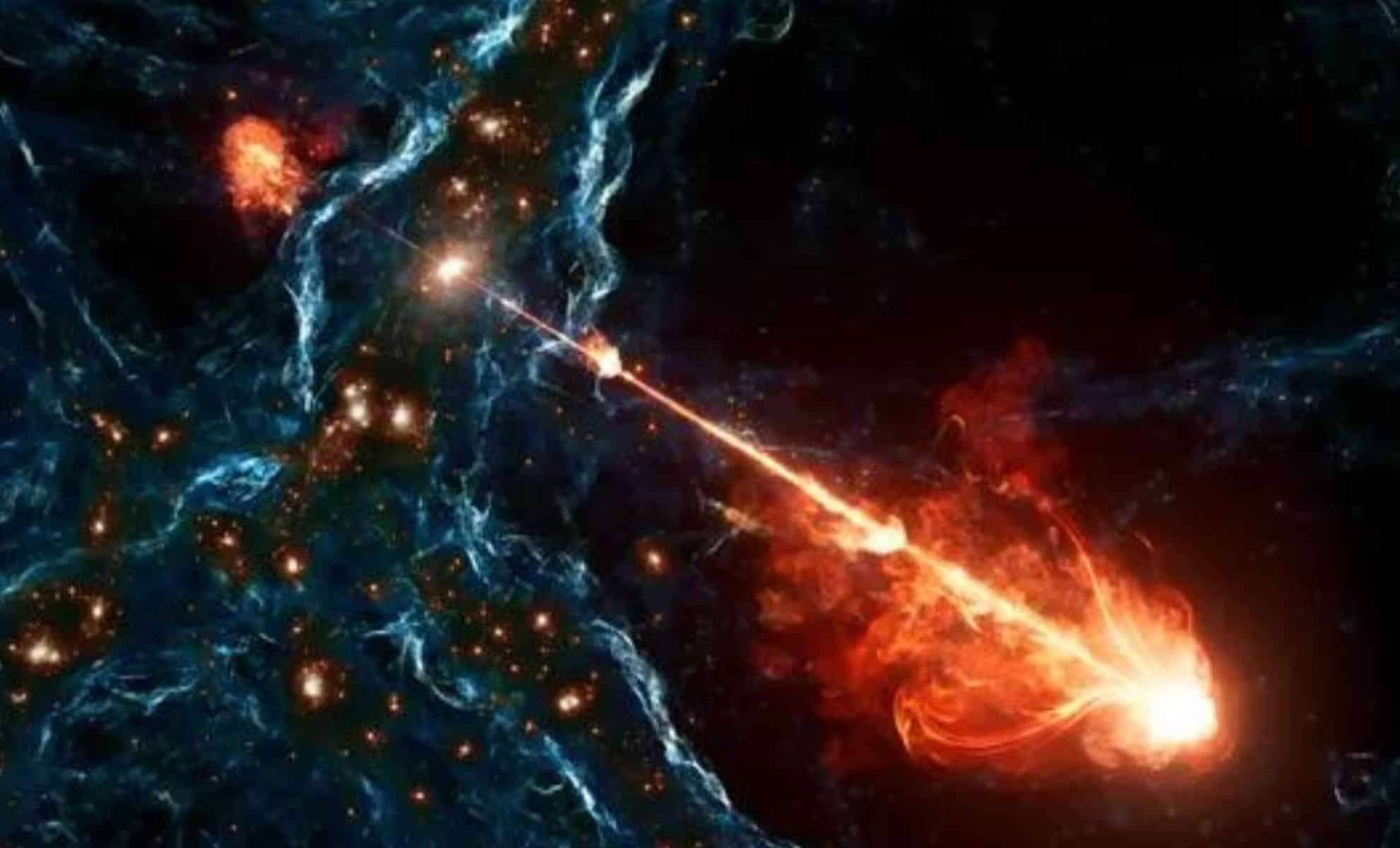
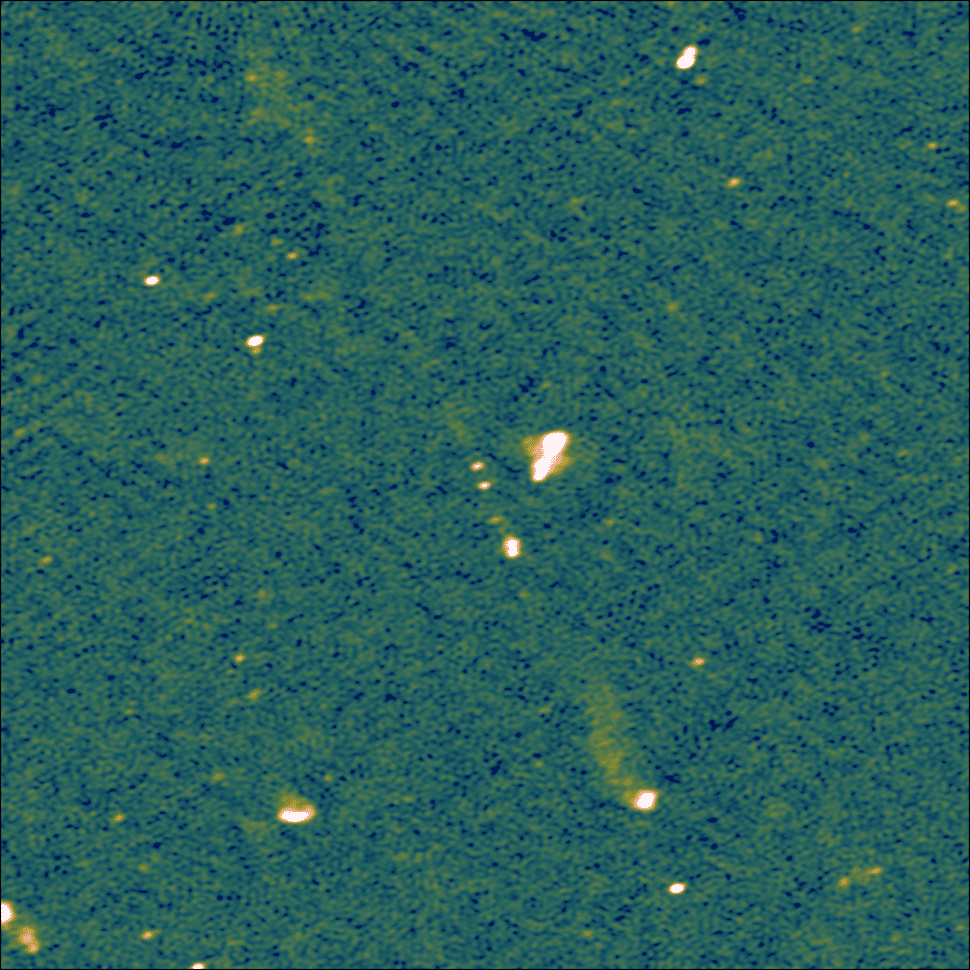
Scientists have identified the longest jets emitted by a black hole, stretching an incredible 23 million light-years.
Termed Porphyrion, these jets come from a supermassive black hole situated 7.5 billion light-years from Earth. Their immense scale rivals roughly 140 Milky Way galaxies lined up end to end. This breakthrough sheds light on the immense power of black holes and their role in sculpting the cosmic web that arranges matter throughout the universe.
Origins and Endurance of Black Hole Jets
The creation of black hole jets continues to captivate astrophysicists. They arise when matter swirling in the accretion disk around a supermassive black hole is propelled along magnetic fields at nearly light-speed. What sets the Porphyrion jets apart is not just their gargantuan length but their extraordinary longevity. Hardcastle notes this source as “one of the most energetic known, fueled by a rapid inflow of material toward the black hole.” This flow rate is essential for sustaining these extensive and powerful jets.

To expand to such monumental proportions, black hole jets must remain coherent over immense timescales. The Porphyrion jets have endured for about a billion years, an exceptional accomplishment given the chaotic conditions present in the early universe. Back then, intergalactic space was far denser, likely causing instabilities that could have dismantled the jets. Astronomer Martijn Oei from Leiden University and Caltech, who led the investigation, explained, “Both pen-and-paper calculations and computational models suggest jets should be unstable—once disrupted, disturbances tend to grow rather than fade.” Yet, Porphyrion has remarkably conserved its integrity over vast stretches of space and time.
The jets’ prodigious scale and composure also raise pivotal questions about the interaction between black holes and their environments over cosmic epochs. Oei offered a vivid analogy: “Compressing the jets down to Earth’s size and scaling the black hole accordingly, the black hole would measure about 0.2 millimeters—roughly the size of an amoeba or a tiny skin mite.” This highlights the sheer contrast in scale between the jets and their source.
Black Hole Jets’ Influence on the Cosmic Web
The significance of Porphyrion extends beyond its extraordinary magnitude, offering clues about the cosmic web—the vast network of dark matter and gas filaments connecting galaxies across the universe. These jets reach far beyond their parent galaxy, potentially affecting the development of neighboring galaxies and larger cosmic formations. Oei remarked, Porphyrion demonstrates “how the smallest and largest cosmic entities are intertwined. We observe a solitary black hole generating a structure comparable in scale to cosmic filaments and voids.”
The cosmic web consists of extensive dark matter strands with galaxies at intersection points, separated by immense voids. Researchers hypothesize that the Porphyrion jets may have heated gases in these voids and helped generate the magnetic fields detected there. Oei proposed, “Such jets might explain the unusually high temperatures and magnetic field arrangements observed in these regions.”
This finding also indicates that enormous jets like Porphyrion were likely more common early in the universe’s history, significantly contributing to the cosmic web’s current structure. Spanning 66 percent of the void radius it occupies, Porphyrion highlights how these jets may have dispersed energy and magnetic influence across intergalactic space, shaping galaxy formation to a far greater extent than previously assumed.
Consequences for Black Hole and Galactic Growth
The unveiling of Porphyrion jets provides fresh perspectives on the intertwined evolution of galaxies and their supermassive black holes. It is well established that galaxies and their black holes develop in tandem, with energy from black hole jets regulating growth within the host and surrounding galaxies. George Djorgovski of the California Institute of Technology commented, “This discovery reveals that black hole effects reach far beyond prior expectations.”
What adds intrigue is that Porphyrion was produced by a radiative-mode black hole, which typically emits intense radiation rather than focused jets. This contradicts previous beliefs that such black holes couldn’t launch jets on this scale. The jets’ persistence for billions of years despite this mode suggests unknown mechanisms might sustain long-lived, giant jets. Hardcastle remarked, “Perhaps this object simply had optimal conditions for remarkable longevity.”
Looking Ahead: Exploring Black Hole Jets Further
The discovery of Porphyrion marks a key advance in understanding black hole jets and their cosmic influence. However, experts anticipate many more colossal jets remain undetected. Oei stated, “Gigantic jet-emitting galaxies are more prevalent than realized… With improving instruments in the next few years, I expect to uncover numerous others.” Upcoming observatories, like the Square Kilometer Array, promise to reveal additional jets, enabling scientists to probe their roles in the cosmic web and galaxy evolution.
As technology progresses and studies of systems like Porphyrion continue, researchers aim to unravel key mysteries about jet stability, their impacts on intergalactic space, and their place in the universe’s grand history. The prodigious scale and endurance of Porphyrion jets offer an extraordinary window into the intense forces shaping galaxies and supermassive black holes across billions of years.
- Categories:
- Astronomy ,
- News ,
- Science ,
- Space






0 comments
Sign in to Comment