
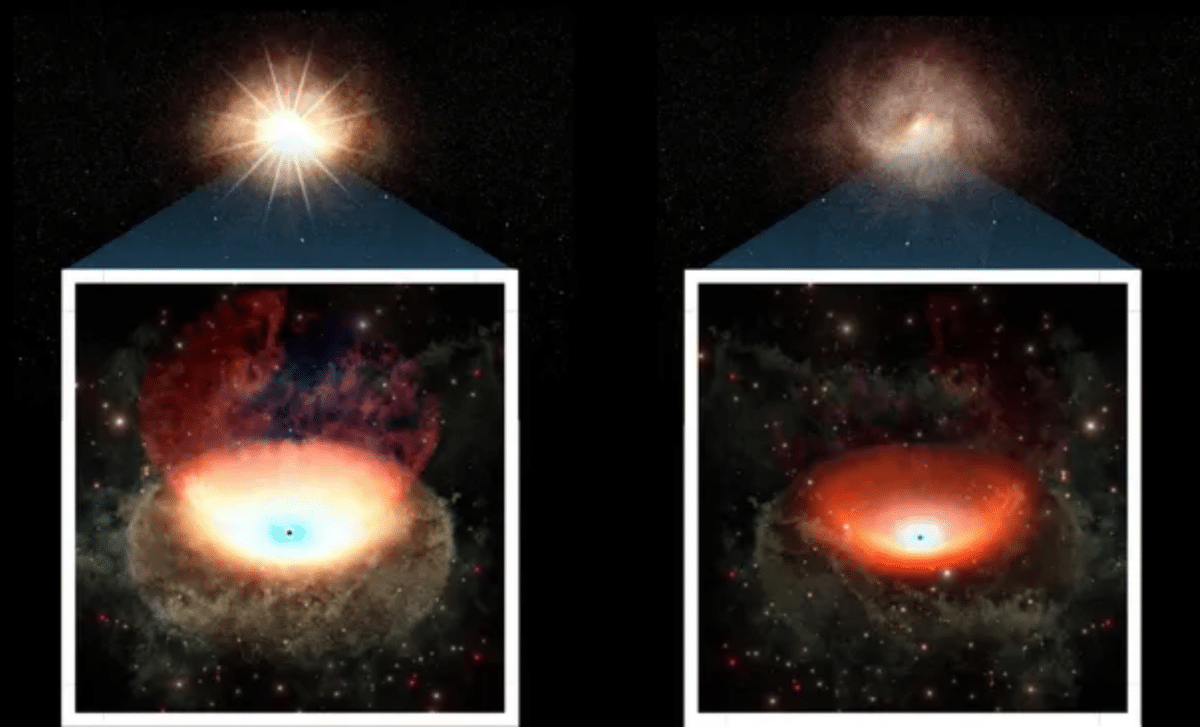
Astronomers have detected a remarkable event in a far-off galaxy where a supermassive black hole drastically dimmed, losing an astounding 95% of its luminosity in just 20 years. Reported in the Publications of the Astronomical Society of Japan (PASJ), this observation marks the first known instance of such rapid depletion in a black hole’s fuel supply, offering fresh insights into the dynamics of these cosmic behemoths.
The Enigma Behind the Rapid Dimming
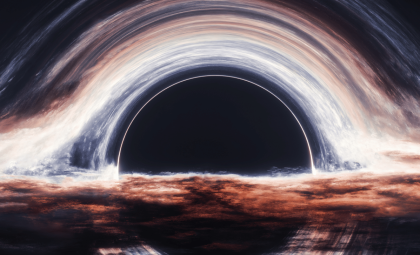
Supermassive black holes reside at galaxy centers, encircled by brilliant accretion disks made up of gas and dust spiraling inward. These disks shine intensely, often surpassing the combined stellar brightness of their host galaxies. Until recently, scientists assumed the luminosity of these black holes remained relatively steady over long periods. The discovery of galaxy J0218−0036, however, where the black hole’s glow diminished by 95%, reveals a far more volatile process than previously imagined.
The significant decrease in brightness occurred after the black hole’s gas supply to the accretion disk sharply dwindled. Over two decades, the black hole's radiant emission sharply faded, contradicting prior beliefs that such changes take millennia to unfold.

“It is fascinating that an active galactic nucleus can change its brightness so dramatically over such a short period of time, and that this fading appears to be caused by a large change in the accretion rate onto the supermassive black hole,” explained team leader Tomoki Morokuma of Chiba Institute of Technology. “Using wide-field survey data, such as those from Hyper Suprime-Cam, we hope to discover more objects like this and learn how the activity of supermassive black holes shuts down and restarts.”
Gas Supply and the Function of Accretion Disks
Supermassive black holes form integral parts of their galactic environments and depend on a steady influx of gas and dust to sustain their luminous accretion disks. As this material spirals inward, it heats and emits an intense glow spanning many wavelengths. When the inflow diminishes, the disk's radiance drops as well, exactly what was observed in J0218−0036.
To analyze this dimming process, astronomers combined observations from several instruments, such as the Sloan Digital Sky Survey (SDSS) and the Subaru Telescope’s Hyper Suprime-Cam. Archival imagery from 2002 and 2018 allowed researchers to determine precisely when the black hole started to fade.
By scrutinizing light across different spectra—from X-rays to infrared—the team revealed that the gas feeding the accretion disk was cut off by an incredible 98% within just seven years. Published in Publications of the Astronomical Society of Japan (PASJ), these findings raise compelling questions about the mechanisms behind such rapid starvation.
A Phenomenon Challenging Existing Black Hole Models
The underlying cause for the black hole's sudden lack of fuel remains a mystery. The research team excluded the possibility that a gas cloud was obscuring the accretion disk’s light, since multi-wavelength observations showed no evidence of such obstruction. This unusual case challenges current theoretical models of black hole accretion and activity cycles.
“This object shows rapid variability that cannot be explained by standard models. It provides an important test case for developing new theoretical models,” said team member Toshihiro Kawaguchi of the University of Toyama. “We will investigate what physical conditions could reproduce the observed behavior.”
- Categories:
- Astronomy







0 comments
Sign in to Comment