
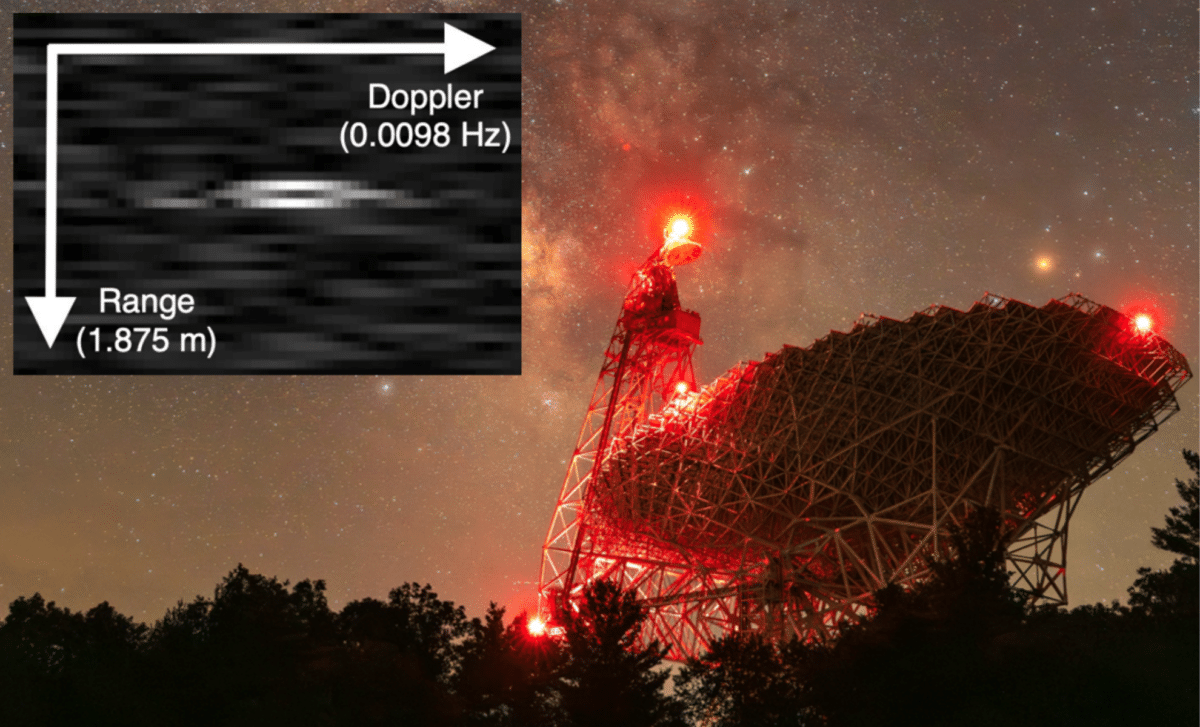
A giant radio telescope located in West Virginia has captured an extraordinary view of NASA’s Artemis 2 spacecraft as it orbits the Moon, tracking its exact path from a distance exceeding 200,000 miles. Released by the National Radio Astronomy Observatory (NRAO), these observations showcase the impressive precision of contemporary radio astronomy in monitoring space missions, offering fresh insights into human spaceflight.
Unmatched Tracking of Artemis 2’s Journey
The Green Bank Telescope (GBT), recognized as the largest fully maneuverable radio telescope on Earth, observed the Orion spacecraft continuously for five days during its lunar orbit. With a towering height of 485 feet and a weight of 17 million pounds, the telescope’s vast dish covers more than 2.3 acres, enabling it to collect intricate data from immense distances. Anthony Remijan, the director at the observatory, remarked on the accomplishment:
“With the GBT, we were able to track the movement of the spacecraft within 0.2 millimeters per second of what NASA calculated in its projections,” he said in a May 6 statement. “It’s like having a speedometer in your car that can track your speed within 0.0004 decimal places per hour,” he continued.
Add Cosmo Herald as a Preferred Source

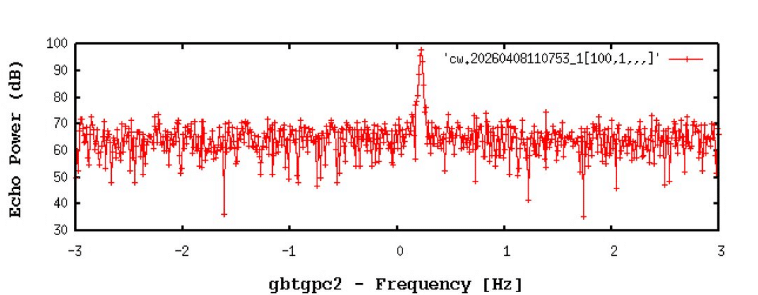
Beyond pinpointing location, the telescope’s data reveals the speed and flight path of the spacecraft in real time, providing detail that far surpasses what traditional optical telescopes can achieve. This information is vital for mission adjustments, trajectory planning, and future explorations deep into space.
Seeing the Human Side in Pixels
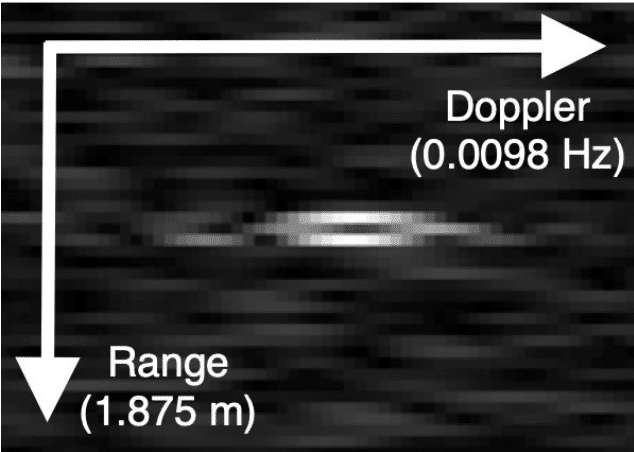
Although the image appears grainy, each pixel encodes authentic measurements of the Orion spacecraft and its astronauts. Will Armentrout, an NSF GBO scientist, poignantly noted, “There are four people in those pixels,” highlighting the human lives behind the electronic signals and metal framework engaged in a pioneering journey beyond Earth.
The black-and-white grid depicts a faint light form against the vast darkness of space but symbolizes the intersection of technology, astronomy, and human creativity. The image’s vertical axis represents the distance to the capsule, named Integrity by the Artemis 2 crew, with distance increasing downward. Each pixel encodes both position and motion, effectively mapping the spacecraft’s continuous voyage over five days.
Green Bank Telescope’s Role in Space Exploration
Besides Artemis 2, the GBT has played a significant part in NASA’s and the aerospace sector’s efforts. The NRAO points out that these observations reinforce the telescope’s role in enhancing spacecraft tracking and navigation for missions beyond Earth orbit. NSF’s Chief Officer for Research Facilities, Linnea Avallone, stated, “It’s exciting when projects like this put our NSF facilities in national headlines. Being able to offer inter-agency support to our colleagues at NASA makes the most of all our capabilities.”
In 2022, the telescope was crucial in supporting NASA’s Double Asteroid Redirection Test (DART), a mission evaluating the ability to adjust an asteroid's path. The GBT’s radar functions were integral for gauging the collision impact on Dimorphos, underscoring the potential of radio telescopes in both science and planetary defense.
Advancing Space Tracking into a New Frontier
The Artemis 2 mission marks not only a renewed focus on lunar exploration but also a breakthrough in accurate space tracking. By converting minute spacecraft movements into highly detailed data, instruments like the GBT provide NASA and its aerospace partners with exceptional awareness essential for mission safety and success. As ambitions for deep-space endeavors grow, radio astronomers and mission teams will deepen collaboration, unlocking novel tools for discovery.
Moreover, these observations encourage public participation through innovations like smart telescopes that follow spacecraft light curves, inviting citizen scientists to contribute. This technology convergence heralds an era marked by increased transparency and engagement in space exploration efforts.
- Categories:
- Space



0 comments
Sign in to Comment