

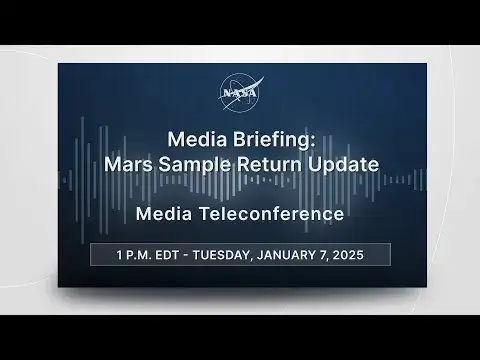
On Tuesday, January 7, at 1:00 pm EST, NASA will hold a pivotal teleconference to share critical updates concerning the ambitious Mars Sample Return (MSR) mission. Administrator Bill Nelson and Associate Administrator Nicky Fox are set to detail how NASA intends to tackle the challenges currently affecting this joint project with the European Space Agency (ESA). The insights shared during this briefing could influence the trajectory of planetary exploration efforts for years to come.
Perseverance’s Ongoing Mission: Unlocking Mars’ Secrets
Since its touchdown in Jezero Crater on Mars in February 2021, the Perseverance rover has been at the forefront of uncovering Mars' past. Equipped with state-of-the-art instruments, its primary goal is to search for evidence of ancient microbial life, a key element in piecing together the planet’s history.
Beyond conducting experiments, Perseverance has collected numerous samples of Martian rock and loose soil, storing them in specially designed titanium tubes. These samples are invaluable for in-depth analysis of Mars’ geological layers and potential biological signatures. The original strategy involved retrieving these materials through collaboration between NASA and ESA, aiming for a return mission by the early 2030s.


Concerns Endangering the Mission’s Progress
An independent evaluation conducted in 2023 highlighted serious issues jeopardizing the MSR mission:
- Escalating Costs: Project expenses have surpassed initial estimates, prompting doubts about budget viability.
- Timeline Risks: The targeted completion date before 2040 is viewed as overly ambitious.
- Program Management Difficulties: The organizational framework was criticized as cumbersome and inadequate for the mission's scope.
Further complicating matters, the House and Senate Appropriations Committees proposed a drastic $454 million reduction to NASA’s 2024 funding, with a significant impact on the MSR mission. This financial cutback has resulted in layoffs at NASA’s Jet Propulsion Laboratory (JPL), casting uncertainty on the mission’s timely execution.
NASA’s Approach to Overcoming Obstacles
NASA remains dedicated to advancing the Mars Sample Return mission despite these setbacks. In April 2024, both Nelson and Fox reassured the public that the endeavor remains active but underscored the need for cost efficiencies and organizational restructuring. NASA launched a thorough reassessment aimed at developing a more cost-effective strategy without compromising the mission’s science goals.
By October 2024, NASA established a dedicated task force to reevaluate the mission's direction. The group's report, likely a key highlight of the coming briefing, intends to outline a streamlined and sustainable plan moving forward.
The Scientific Significance of Mars Samples
Samples gathered by Perseverance stand as a monumental opportunity for planetary science. Analyzing these materials on Earth with advanced technology could shed light on several fundamental questions:
- Ancient Life Possibility: Did microbial organisms once exist on Mars?
- Planetary Evolution: What shaped Mars’ transformation into its current barren state?
- Solar System Context: How does Mars’ history inform our understanding of the broader solar system’s development?
Recovering these samples could revolutionize our knowledge of both Mars and the origins of life on Earth.
Technical, Financial, and Political Hurdles Ahead
Despite a refreshed approach, the MSR mission still faces significant hurdles involving complex technologies and fiscal realities:
- Sample Retrieval Lander (SRL): A spacecraft designed to collect cached samples on Mars and launch them into orbit.
- Earth Return Orbiter (ERO): Operated by ESA, this orbiter will intercept the samples in Martian orbit and bring them back home.
- Robotic Precision: Critical coordination is necessary for the safe handoff of samples between spacecraft.
These technological challenges, combined with budget constraints, require NASA to balance innovation with cost-effectiveness while preserving its leadership in planetary exploration.
What Lies Ahead at the January 7 Update
The upcoming briefing is expected to cover:
- Results from the October 2024 review panel.
- A new mission blueprint featuring updated timelines and budget-conscious strategies.
- Plans for enhanced collaboration with the European Space Agency.
- Consideration of alternative approaches to meet mission objectives under tighter funding.
NASA may also address concerns regarding layoffs at JPL and reaffirm its long-term dedication to exploring Mars.
- Categories:
- Space













0 comments
Sign in to Comment