
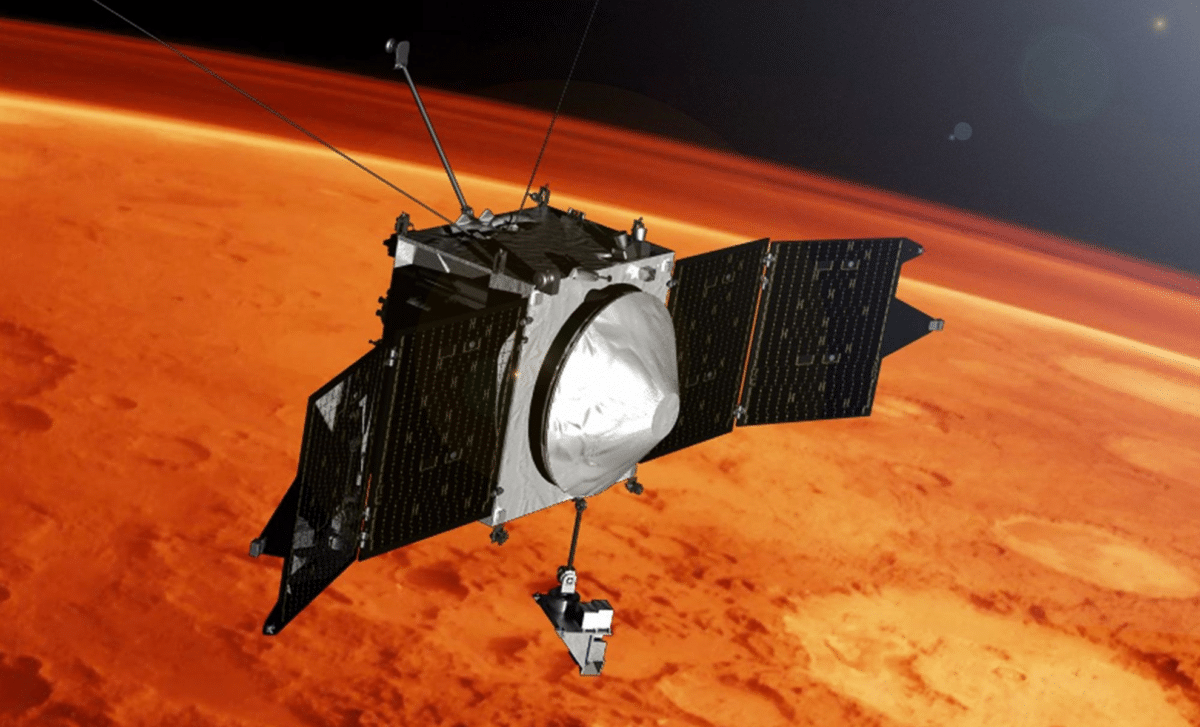
NASA is nearing a pivotal decision regarding a Mars communications orbiter that may significantly influence upcoming robotic and human missions. As reported by Ars Technica, the agency faces pressure to decide swiftly between launching a specialized communications satellite or broadening the mission to include science instruments, all while navigating political, budgetary, and scheduling challenges.
The Mars Orbiter Debate: Policy, Funding, and Strategic Goals
The core issue revolves around NASA’s interpretation of recent congressional directives related to Mars infrastructure allocation. The legislation promotes a commercial-driven strategy limited to firms that have received Administration funding in fiscal years 2024 or 2025 for commercial concept studies connected to Mars Sample Return and proposed a standalone Mars telecommunications orbiter supporting the sample return mission.
This stipulation restricts the competitive pool and constrains the mission’s scope. Within NASA, some officials advocate for prioritizing communications alone, thereby largely excluding additional scientific payloads. Others warn that overly limiting the mission could forfeit a unique opportunity to incorporate valuable science objectives at a relatively modest extra cost.

Time is a critical factor. Procurement deadlines, launch windows, and budgetary timelines mean postponing the decision risks delaying the project by several years.
Budget Constraints: What Does a Mars Comms Orbiter Actually Cost?
Budget estimates remain a contentious topic. The Senate’s proposal earmarks about $700 million for the mission, with $500 million frequently cited as a realistic target for the orbiter’s development. Industry experts suggest that this budget provides ample flexibility.
“$500 million is plenty for a communications payload, satellite bus, and launch,” one knowledgeable industry official told Ars. “I actually think those functions could be provided for well below $500 million.”
Should this estimate prove accurate, NASA might feasibly include extra capabilities without surpassing the funding limit, strengthening arguments for integrating smaller, low-risk scientific instruments designed for rapid deployment.
Balancing Science and Mission Simplicity
Supporters of augmenting the orbiter with science instruments argue that the incremental cost is worth the significant scientific return. Casey Dreier, head of space policy at The Planetary Society, sees the choice as straightforward.
“To me, it seems like an easy decision,” Dreier said. Adding science instruments to a mission already headed to Mars aligns with NASA’s broader goals of maximizing science output and testing low-cost experimental technologies. “This project is already going to Mars, and science would add real value.”
However, critics warn that expanding the mission’s scope risks complicating procurement, causing delays, and increasing technical challenges. This debate highlights a core question of whether the Mars communications orbiter should serve solely as infrastructure or function as a dual-purpose platform.
NASA’s Public Stance and Emphasis on Commercial Collaboration
NASA stresses the importance of reliability, mission continuity, and partnerships with private companies. In a statement cited by Ars Technica, the agency reiterated that maintaining strong communications remains the primary focus.
“NASA will procure a high-performance Mars telecommunications orbiter that will provide robust, continuous communications for Mars missions,” a spokesperson said. “NASA looks forward to collaborating with our commercial partners to advance deep space communications and navigation capabilities, strengthening US leadership in Mars infrastructure and the commercial space sector.”
This reflects a strategic shift toward trusting commercial entities to deliver essential services instead of NASA managing every aspect internally.
Rocket Lab’s Perspective: Prioritizing Mars Communication Infrastructure
Among contenders, Rocket Lab has been notably outspoken. CEO Pete Beck stresses that communications infrastructure is fundamental, not optional.
“We’re pushing hard on the MTO,” Beck told Ars Technica. “The reality is that if you’re going to do anything on Mars, whether it’s scientific or human, you’ve got to have the comms there.”
He describes the orbiter as essential infrastructure that underpins every future Mars endeavor, including crewed missions.
“Everybody expects the communication just to be there, and you’ve got to put the foundations in first,” Beck said, adding that Rocket Lab sees the mission as a direct contribution to the first humans on Mars.
The Long-Term Impact of NASA’s Decision
The upcoming choice will have lasting implications for Mars exploration. Launching a communications-only orbiter could speed timelines and reduce risks, while a more comprehensive craft might reshape how NASA integrates infrastructure development, science, and private sector cooperation.
Ultimately, this decision will reflect NASA’s approach to balancing prudence with ambition as Mars becomes a hub for sustained and interconnected missions.
- Categories:
- News










0 comments
Sign in to Comment