
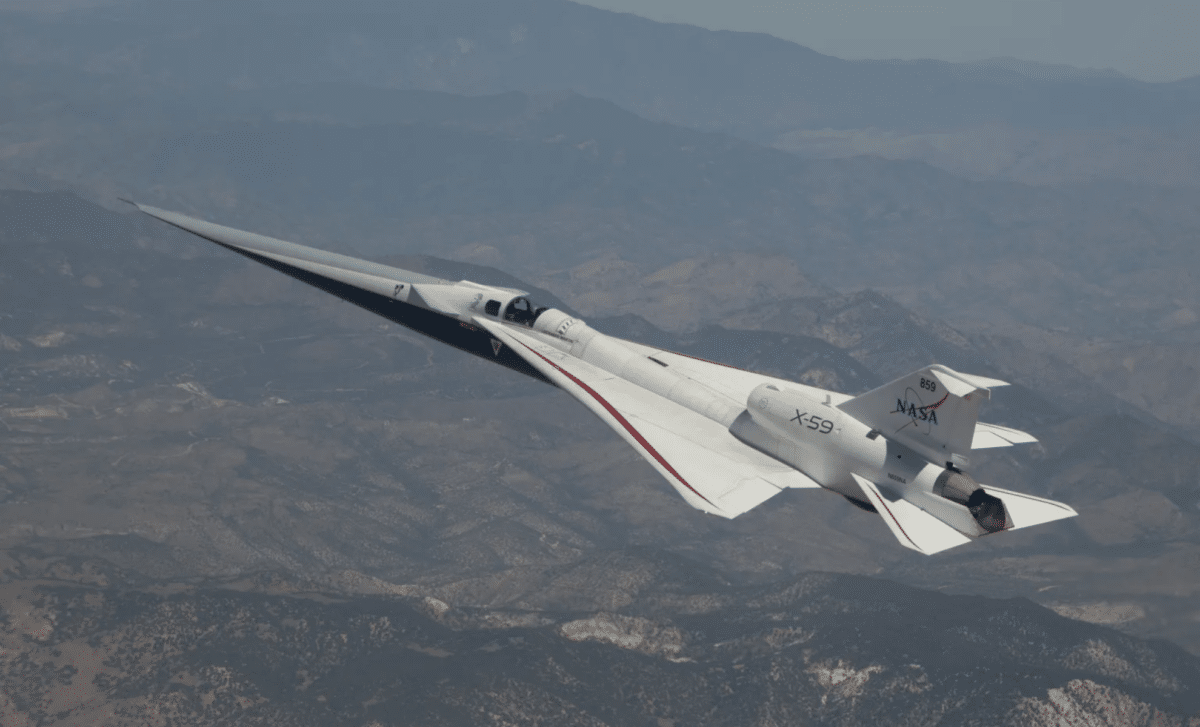
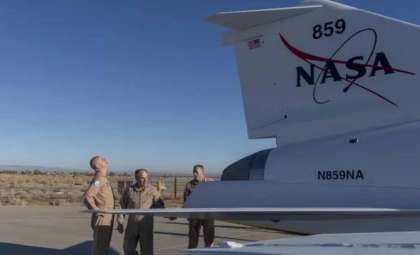
The innovative X-59 by NASA is nearing a major milestone as it gears up for its initial supersonic flight tests. The agency’s quiet supersonic research aircraft is entering a critical phase, set to surpass previous performance thresholds and demonstrate the potential for commercial jets to fly faster than sound without generating disruptive sonic booms that have limited overland supersonic flights for decades.
Advancing Toward Silent Supersonic Journeys
This upcoming series of tests is more than just reaching supersonic speeds. Designed as part of NASA’s Quesst Mission, the X-59 targets a longstanding challenge in aviation: minimizing sonic boom disturbances. Traditional supersonic jets produce loud shock waves that have prevented supersonic travel over populated regions. NASA aims to overturn this restriction with the X-59’s innovative design.
The aircraft is slated to exceed speeds of 630 mph at an altitude near 43,000 feet, officially crossing into supersonic territory. Soon after, the X-59 will conduct a mission-mode flight at around Mach 1.4 (approximately 925 mph) at about 55,000 feet. These parameters aren’t arbitrary; they represent the specific conditions the aircraft will operate under during future flights over U.S. communities to collect public feedback on its uniquely quiet sonic signatures.

“This will be the first supersonic flight for this one-of-a-kind aircraft,” stated Cathy Bahm, project manager of NASA’s Low Boom Flight Demonstrator. “We are fundamentally progressing toward the test conditions that X-59 has been designed to meet.”
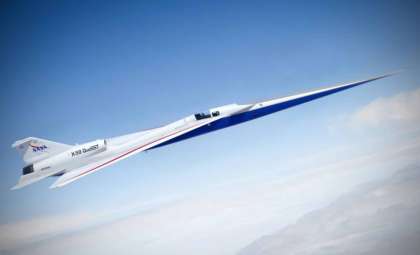
In contrast to standard supersonic planes, the X-59 incorporates a long, slender nose and an airframe meticulously shaped to reshape shock waves and reduce their severity. Instead of a loud sonic boom, NASA anticipates a softer, subtler thump, paving the way for future commercial planes that could cross continents much faster without noise disruption.
Building Reliability Through Fifteen Flights
Prior to this landmark phase, the X-59 has undergone an extensive testing regimen that gradually expanded its flight capabilities. After a successful inaugural flight in October 2025 and a planned maintenance period, the jet resumed flights in March 2026. It has since completed fifteen missions, systematically verifying its systems and flight performance.
One highlight was safely demonstrating landing gear retraction to evaluate in-flight aerodynamics. The aircraft also reached altitudes of 43,000 feet and neared supersonic speed at Mach 0.95 (~627 mph), just shy of the sound barrier. Testing also included dual-flight days and a diverse range of flight profiles to assess performance thoroughly.
Throughout these exercises, engineers monitored critical onboard systems such as hydraulics, fuel management, environmental controls, and the advanced eXternal Vision System. Lacking a conventional front windshield, the pilot is guided by high-resolution video feeds from external cameras displayed inside the cockpit. Additionally, structural strain sensors have provided valuable data about aerodynamic loads and stress responses throughout the airframe.
“Flying at supersonic speeds is a major milestone for the X-59 team,” Bahm said. “Every step of envelope expansion brings us closer to demonstrating the quiet supersonic capability that is at the heart of the Quesst mission. Completing the first mission-conditions flight is especially meaningful – it’s the moment where we begin validating the aircraft in the environment it was designed for.”
Next Up: Capturing the X-59’s Subtle Shock Waves
Although upcoming flights will debut supersonic speeds, their primary goal is not yet to confirm the effectiveness of the aircraft’s quiet design. The X-59 will be accompanied by a conventional supersonic chase jet whose own sonic boom will overshadow any sound from the experimental plane.
These runs focus on gathering technical measurements. An F-15 research aircraft equipped with specialized sensors will track the X-59’s shock wave characteristics, providing vital data to prepare for a rigorous testing phase later in the year.
NASA officials say these probing flights form a bridge from demonstrating basic supersonic flight to rigorously assessing whether the aircraft meets its low-boom performance goals. Analysis will cover atmospheric shock wave behavior, comparison to computational models, and validation needed for future operational demonstrations.
“These tests will deepen our understanding of the X-59’s capabilities and move us closer to the phases that will define the future of supersonic travel,” Bahm emphasized.
Reaching for Mach 1.6 and Redefining Commercial Air Travel
The current testing phase still targets important milestones. Beyond the Mach 1.4 mission-mode flight, the X-59 should reach its peak design speed of Mach 1.6 (around 1,218 mph) and climb to about 60,000 feet. These achievements will yield comprehensive insights into the aircraft’s full flight envelope.
This forms Phase 1 of the overall Quesst mission, concentrating on proof of safety, performance, and flightworthiness. Upon fulfilling these criteria, NASA will transition to Phase 2, emphasizing acoustic validation. During this stage, teams will verify the soft sonic signature predicted by simulations through direct measurements.
“Otto Lilienthal once said, ‘To design a flying machine is nothing. To build one is something. But to fly is everything.’ The 15 flights we’ve completed since March have meant everything to this team and mission,” Bahm reflected. “Each flight extends what’s possible and bolsters our trust in the X-59.”
A Mission Set to Transform High-Speed Flight
The impact of the X-59 project extends beyond NASA’s own evaluation efforts. Should it successfully validate low-boom supersonic flight, regulators may reconsider decades-old bans on supersonic travel over land. This could reshape commercial aviation, enabling aircraft to halve travel times while minimizing noise disruption for communities.
For NASA and its partners, the coming period is critical to realizing years of development, testing, and innovation. Progress achieved with every flight brings the X-59 closer to proving that supersonic travel and public acceptance can coexist.
“Looking ahead, we are ready to push boundaries further and reach the milestone this craft was meant for,” Bahm said. “Achieving supersonic flight is not just progress — it’s the outcome of years of dedication and collaboration. Each step moves us nearer to Phase 2 and the future of supersonic commercial aviation.”
- Categories:
- News






0 comments
Sign in to Comment