
Utilizing an advanced radiocarbon dating technique, scientists have determined the most accurate age yet for the Lapedo Child, a prehistoric skeleton exhibiting characteristics of both Neanderthals and modern humans. Discovered in Portugal’s Lapedo Valley in 1998, the remains have captivated researchers for many years, though previous dating attempts were complicated by contamination problems.
Recently, experts applied a refined method that isolates specific amino acids, enabling a precise determination of the child's era and providing new perspectives on early human dynamics and cultural exchanges.
Unraveling the Mystery of a Hybrid Ancient Child
Found inside a rock shelter, the Lapedo Child was laid to rest alongside ochre-marked bones, ornamental shells, and animal bones. The remains belonged to a young child around four or five years old, exhibiting a remarkable mix of Neanderthal robustness merged with traits typical of modern humans, sparking debate about interbreeding between these two groups.
Previous efforts to establish the child's precise age were hindered by deterioration and contamination of the bone samples. Traditional radiocarbon dating requires collagen, the organic component of bone, but degradation made accurate dating impossible. Without an exact timeframe, the child's cultural and genetic context remained elusive.

Innovative Dating Techniques Bringing Clarity
To address these challenges, researchers from the Oxford Radiocarbon Accelerator Unit employed compound-specific radiocarbon dating. This method targets hydroxyproline, an amino acid found solely in bone collagen, allowing direct dating of bone material while minimizing contamination risks inherent in traditional bulk collagen analyses.
Lead scientist Bethan Linscott noted, “Since only limited collagen could be extracted and contamination could not be fully eliminated, previous dating efforts were unreliable.”
By isolating hydroxyproline, the team established that the child lived around 27,780 to 28,850 years ago, situating the burial firmly within the Gravettian culture, known for its sophisticated tools and iconic Venus figurines.
Implications for Human Evolution and Migration
This refined dating enhances our understanding of Gravettian groups inhabiting the Iberian Peninsula. The Gravettian culture spanned Europe between 32,000 and 24,000 years ago, but genetic data suggests populations were diverse despite shared cultural traits. Pinpointing the Lapedo Child's era adds a critical data point for examining early human movements and interactions.
Additionally, the new findings reinterpret aspects of the burial context. Charcoal deposits beneath the skeleton, once believed to indicate ritual fires, actually predate the burial, suggesting site reuse. Likewise, red deer bones thought to be offerings are now understood to be significantly older.
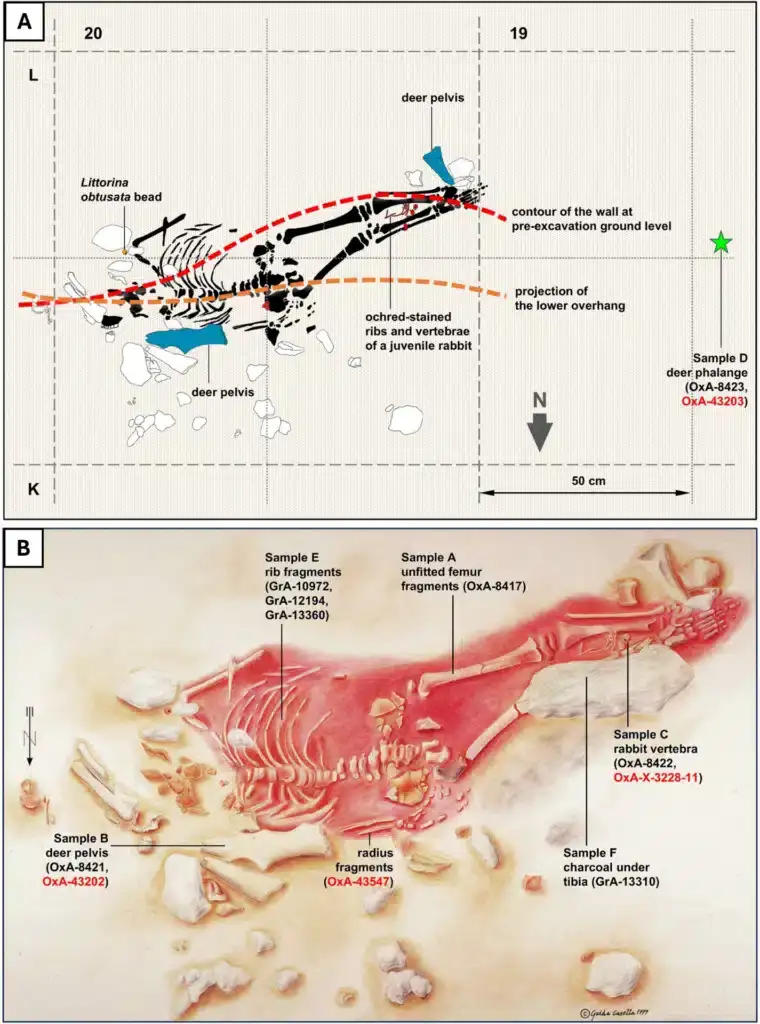
Illustration depicting the child's burial arrangement
Transforming the Study of Human and Neanderthal Ancestors
The hydroxyproline dating technique has also refined dates for other Neanderthal fossils, such as those from Vindija Cave in Croatia, where remains previously thought to be younger than 40,000 years were reassessed to an older timeframe.
With this method’s success on the Lapedo Child, it promises to become a vital tool for revisiting important prehistoric sites worldwide.
By improving chronological accuracy, this approach could revolutionize our understanding of human migration routes and interbreeding episodes throughout prehistory.
- Categories:
- News











0 comments
Sign in to Comment