
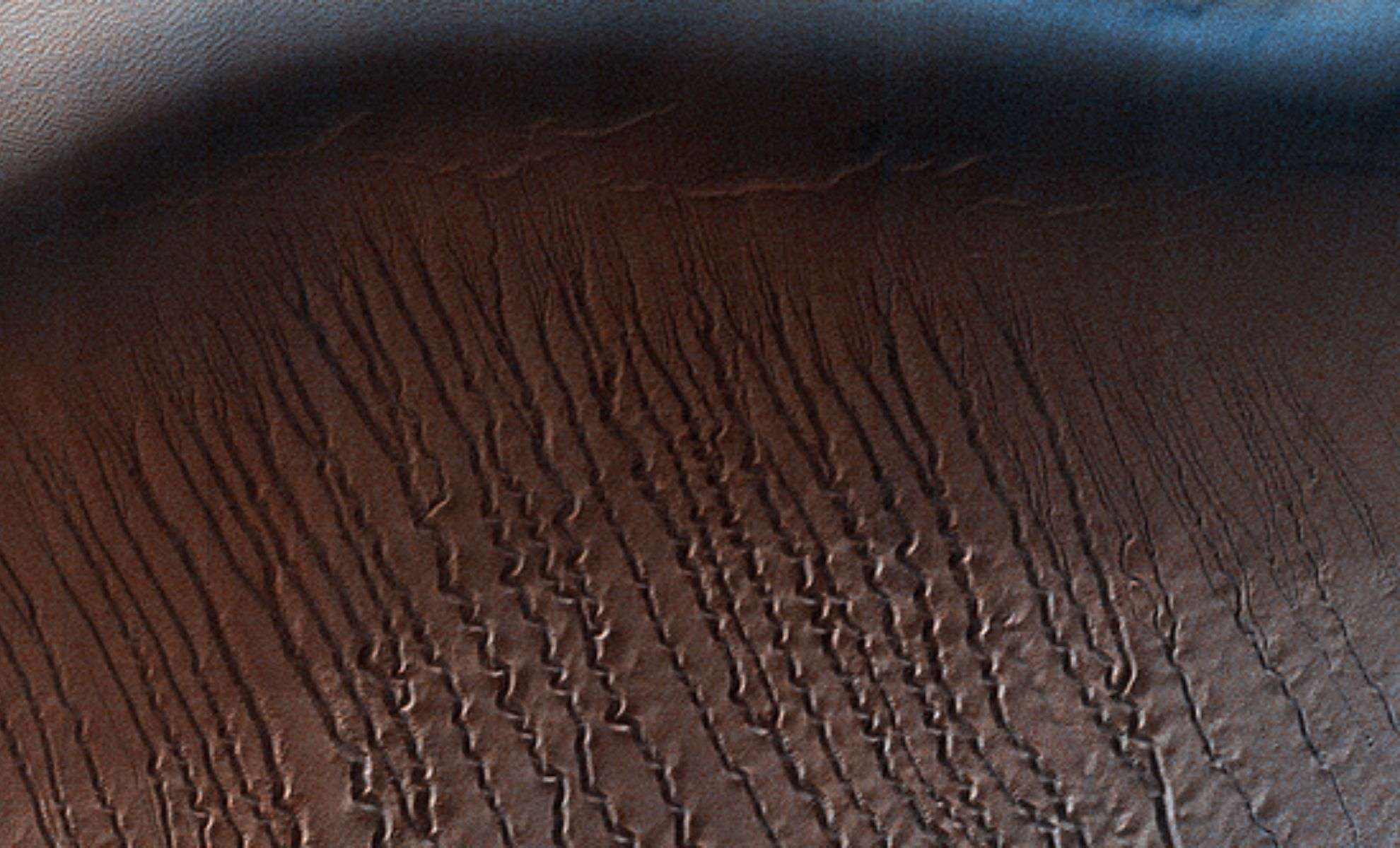
For decades, researchers have been intrigued by the winding grooves stretching across Mars's sandy dunes. These patterns, found at mid-latitude regions of the planet, appear similar to erosion caused by flowing fluids, stirring debate over their origin.
Recent findings published in Geophysical Research Letters challenge the idea that liquid water is responsible, proposing instead that a far more fleeting agent is at work.
Reevaluating an Enigma
Discovered in 1999 through detailed orbital imagery, these twisting gullies puzzled scientists with their distinct shapes and raised edges. Initial hypotheses favored seasonal flows of melting water, fueling hopes about Mars’s past habitability.

However, Mars’s current frigid and arid conditions make stable liquid water on the surface virtually impossible. Despite decades of observation, no direct signs of flowing water have emerged in the gully regions.
An alternative idea surfaced in 2013, suggesting that blocks of dry ice might be sliding down slopes, transforming directly from solid to gas and reshaping the sand. Yet, certain unique features such as the gullies’ winding forms and sharply raised boundaries defied full explanation.
Recreating Martian Surface in the Lab
Lonneke Roelofs and colleagues at Utrecht University conducted lab experiments simulating Martian environmental conditions. Utilizing a Mars simulation chamber at the UK’s Open University, they replicated the planet’s thin atmosphere and cold temperatures.
They dropped chunks of solid CO₂ onto slopes covered with sand while recording how the ice responded under different angles and textures.
Surprisingly, on gentler inclines, the dry ice didn’t merely glide downhill; it partially embedded itself into the sand. This burrowing action, combined with gas escaping beneath, eroded channels strikingly similar to those on Mars.
The Role of Sublimating CO₂ in Gully Formation
This phenomenon hinges on sublimation—the transition of dry ice directly from solid to gas. Because CO₂ ice lets sunlight through, solar rays warm the sand beneath, trapping heat under the ice block. Pressure builds until the gas forcefully escapes.
The emerging gas blasts grains of sand outward, carving out twisting, winding channels reminiscent of the gullies observed on the planet’s dunes. The irregular motion explains the distinctive snake-like patterns that past models struggled to duplicate.
Furthermore, large dry ice blocks up to one meter thick can eject sand particles as far as 13 meters thanks to Mars’s weaker gravity.
The Influence of Seasonal Changes
Seasonality is crucial to this process. During the Martian winter, CO₂ from the atmosphere condenses, forming a dry ice layer that can be as thick as 70 centimeters.
When spring arrives, rising temperatures cause this frozen layer to sublimate. Remaining pieces of dry ice, often resting on dune crests, fracture and slide downhill. Even after halting, the sublimation continues below, generating gas that forces against the sand and leaves distinctive hollows at slope bases.
This mechanism explains why these gullies are exclusive to fine-grained dune regions rather than scattered across the globe.
“Conducting research into the formation of landscape structures of other planets is a way of stepping outside the frameworks used to think about the Earth,” Roelofs explained. “This allows you to pose slightly different questions, which in turn can deliver new insights for processes here on our planet.”
Roelofs’s group aims to expand their investigations with larger ice blocks and varied types of sand to deepen understanding of these alien landscapes.
- Categories:
- Space


0 comments
Sign in to Comment