
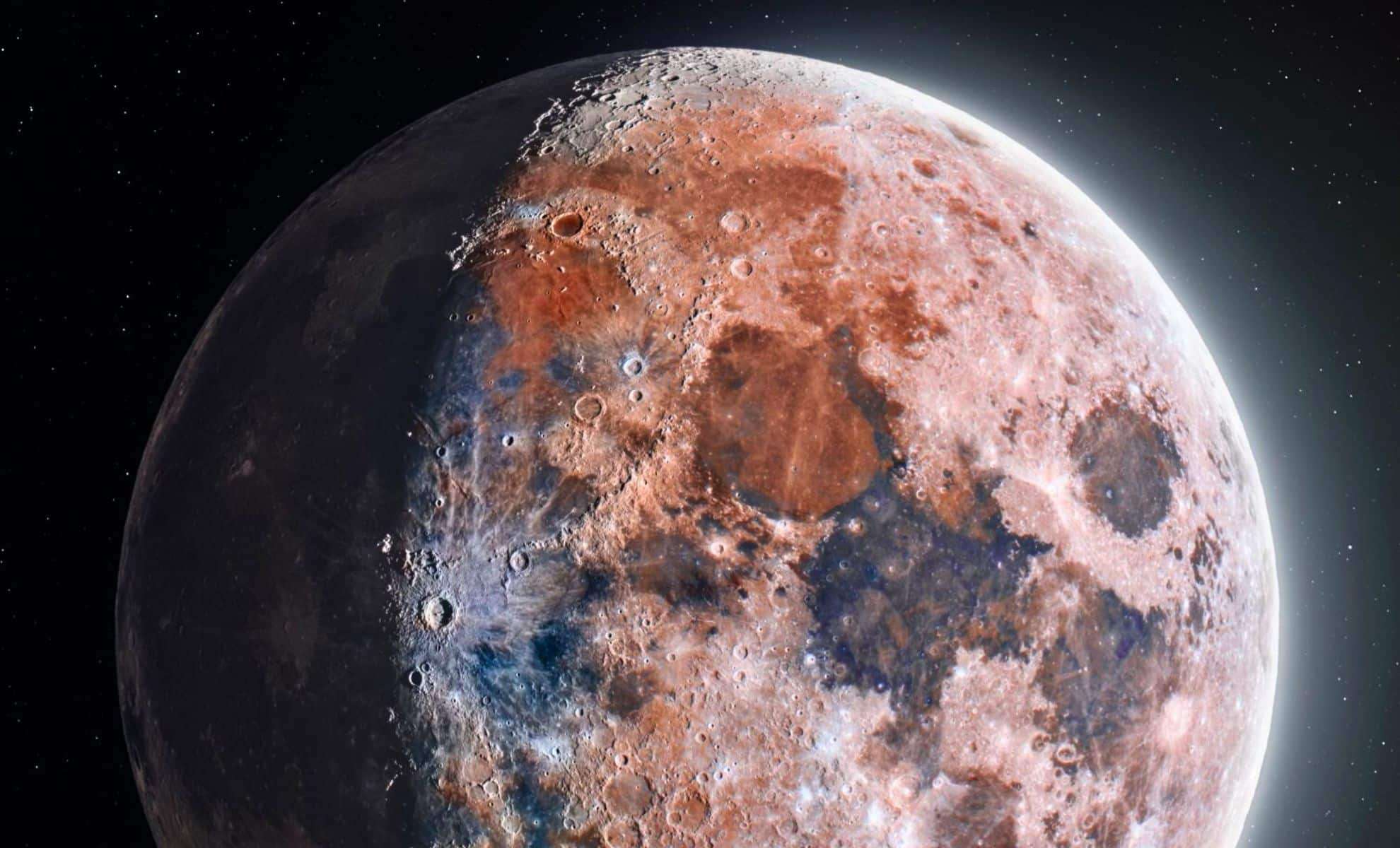
For ages, the characteristics of the Moon’s core have remained elusive. Was it entirely liquid like Earth’s early core, or did it contain a solid inner core encased by molten material? Recent research published in Nature now delivers the most conclusive evidence to date.
Innovative Techniques to Decode the Lunar Interior
Exploring the composition beneath a planetary surface presents significant challenges. While terrestrial scientists rely on seismic wave data to map Earth’s inner layers, replicating these methods on the Moon has proven complicated.
During the Apollo missions, astronauts installed seismometers on the lunar surface, gathering critical seismic measurements. However, this data’s limited resolution left ambiguity; both a completely molten core and a solid inner core with a molten outer shell matched the observed signals, preventing a definitive conclusion.

To clarify Moon’s core structure, a scientific team led by Arthur Briaud at the French National Centre for Scientific Research integrated data from multiple lunar missions and laser-ranging studies.
They concentrated on how the Moon flexes under Earth’s gravitational forces, variations in its orbital distance, and insights from its density to test different core models. Comparing simulations with real data allowed them to pinpoint the most probable structure.
Verification of a Solid Inner Core Among Fluid Layers
The research confirmed that the Moon’s core resembles Earth’s, featuring a liquid outer core enveloping a solid inner core. Researchers estimated the outer core’s radius at 362 kilometers (225 miles), with the solid inner core extending about 258 kilometers (160 miles), roughly 15% of the Moon’s overall radius.
Most compelling is the inner core’s density, approximately 7,822 kilograms per cubic meter, which closely matches iron’s density. This strongly implies the Moon’s center is primarily composed of solid iron, paralleling Earth’s core composition.
Implications for Lunar Geology and Volcanic Activity
Beyond core composition, the study provides fresh insights into mantle overturn, a process where denser materials sink toward the Moon’s core while lighter elements rise toward the surface.
Previously hypothesized to explain certain elemental patterns in volcanically active lunar regions, direct confirmation of mantle overturn had been lacking until now.
These new conclusions underscore mantle overturn’s vital role in sculpting the Moon’s surface and advancing our understanding of its geological evolution.
The Mystery of the Moon’s Vanishing Magnetic Field
The findings also provide clues about the Moon’s magnetic history. While it once had a robust magnetic field, it began to wane approximately 3.2 billion years ago.
Since planetary magnetism arises from movements within a molten core, understanding the Moon’s interior makeup is essential to explaining the decline of its ancient magnetic shield.
Interestingly, these results are consistent with a2011 study by NASA’s Renee Weber, which utilized Apollo seismology data to hypothesize a solid inner core roughly 240 kilometers (150 miles) in radius and with a density near 8,000 kg/m³.
This breakthrough settles a prolonged scientific debate and enhances our understanding of the Moon’s internal composition, its geological and magnetic past, and offers broader perspectives on Solar System history.





0 comments
Sign in to Comment