

An innovative global investigation has uncovered that Earth’s geological timeline is far from being a random sequence of mass extinctions, evolutionary bursts, and climate events. Instead, these transitions between epochs, periods, and eras follow a distinct and recurring pattern that spans hundreds of millions of years.
Reevaluating Geological Time
Previously, many scientists thought that key moments in Earth’s history—such as mass extinctions, rapid evolutionary changes, and global climate disruptions—happened without a predictable structure. However, a new paper led by Professor Andrej Spiridonov of Vilnius University published in Earth and Planetary Science Letters challenges this view. The team’s findings indicate that the planet’s deep past is governed by a precise mathematical framework characterized by groupings rather than randomness.
“Although geological time scales appear orderly in textbooks, their dividing lines tell a more complex story,” says Spiridonov. “Our research reveals that what once seemed like irregularity actually uncovers how Earth’s transformations operate over vast stretches of time.”

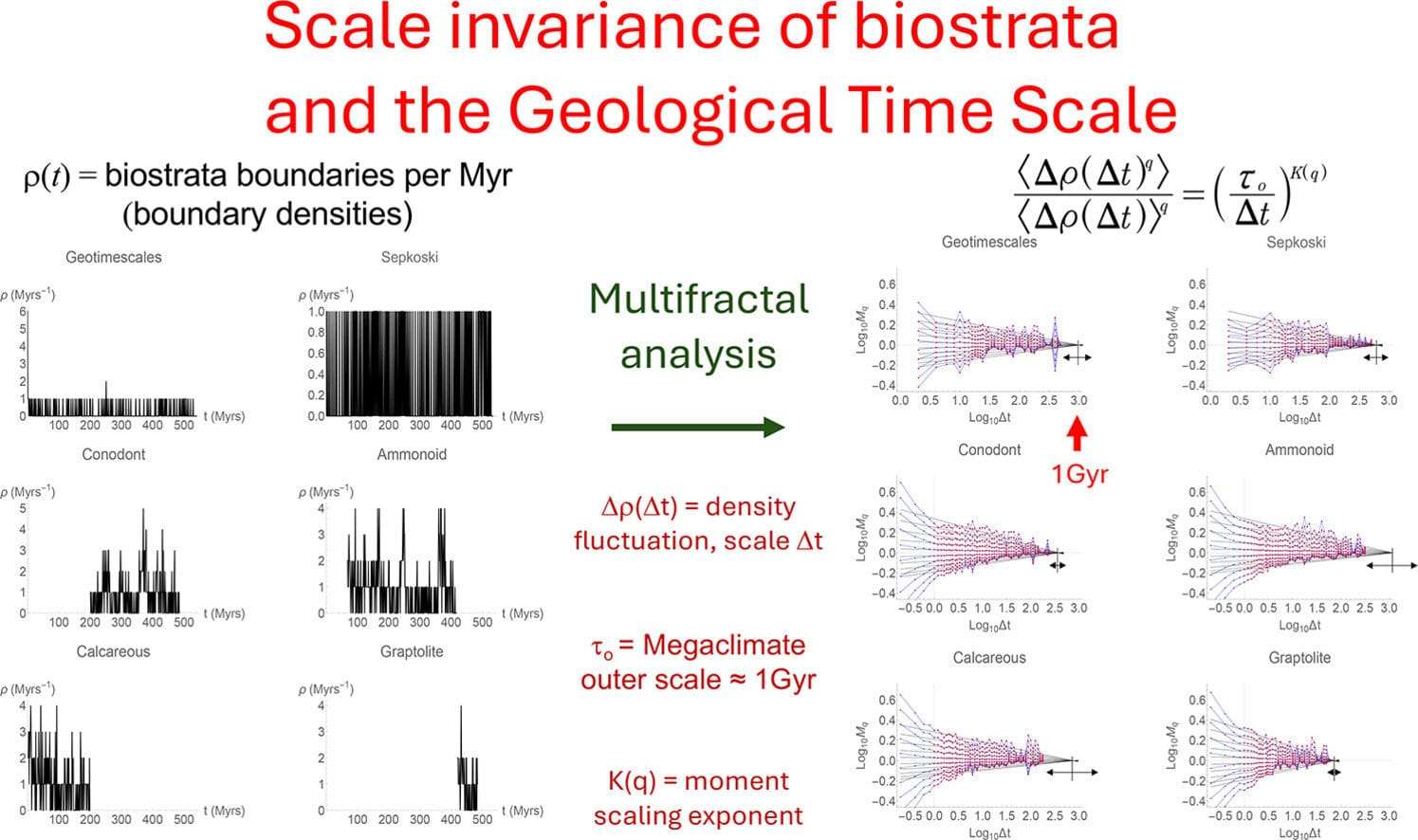
The researchers analyzed several geological datasets, including the International Geochronological Chart and fossil-based timelines featuring species like graptolites, ammonoids, and conodonts. Their investigations revealed distinct clusters where geological boundaries congregate, separated by extended intervals of relatively little activity.
Unveiling the Mathematical Framework
These clusters align with the concept of multifractals, mathematical phenomena where patterns replicate across different scales. The team demonstrated that intervals between significant geological events adhere to multifractal principles. Spiridonov explains, “The timing of Earth’s major occurrences, from extinctions to evolutionary booms, is not random but fits a multifractal pattern, illuminating how variations cascade over geological time.”
To capture this complexity, the scientists introduced the Compound Multifractal-Poisson Process, a new theoretical model that portrays large geological events as nested within smaller ones in a hierarchical fashion, spanning immense periods. This suggests even Earth’s most dramatic changes are part of a larger, predictable system.
Such patterns have previously gone unnoticed due to the immense timescales involved, requiring extensive data and precise modeling techniques to detect.
Decoding the Planet’s “Outer Timescale”
Among the most significant findings is the concept of an outer timescale, representing a limit on earth’s observable variability within a given timeframe. The research suggests this window must be at least 500 million years, optimally approaching a billion years, to capture the full gamut of planetary stability and upheaval.
“Understanding Earth’s full spectrum of behaviors requires geological data extending back at least half a billion years, ideally a billion,” Spiridonov notes.
This perspective also clarifies why models focused on shorter intervals fail to account for major planetary shifts. Without examining data across these immense scales, researchers risk overlooking the extremes that have directed Earth’s evolution and surface changes.
Looking Ahead: Broader Impacts
Rather than viewing phenomena such as asteroid impacts or volcanic activity as isolated, the study places them within a broader cyclical framework. Earth’s past contains long-lasting rhythms that produce discernible patterns throughout geological history.
This profound insight could enhance climate modeling and planetary science by providing a richer understanding of past upheavals. Recognizing these deep-seated patterns may help scientists forecast future planetary changes with greater accuracy.
- Categories:
- News




0 comments
Sign in to Comment