
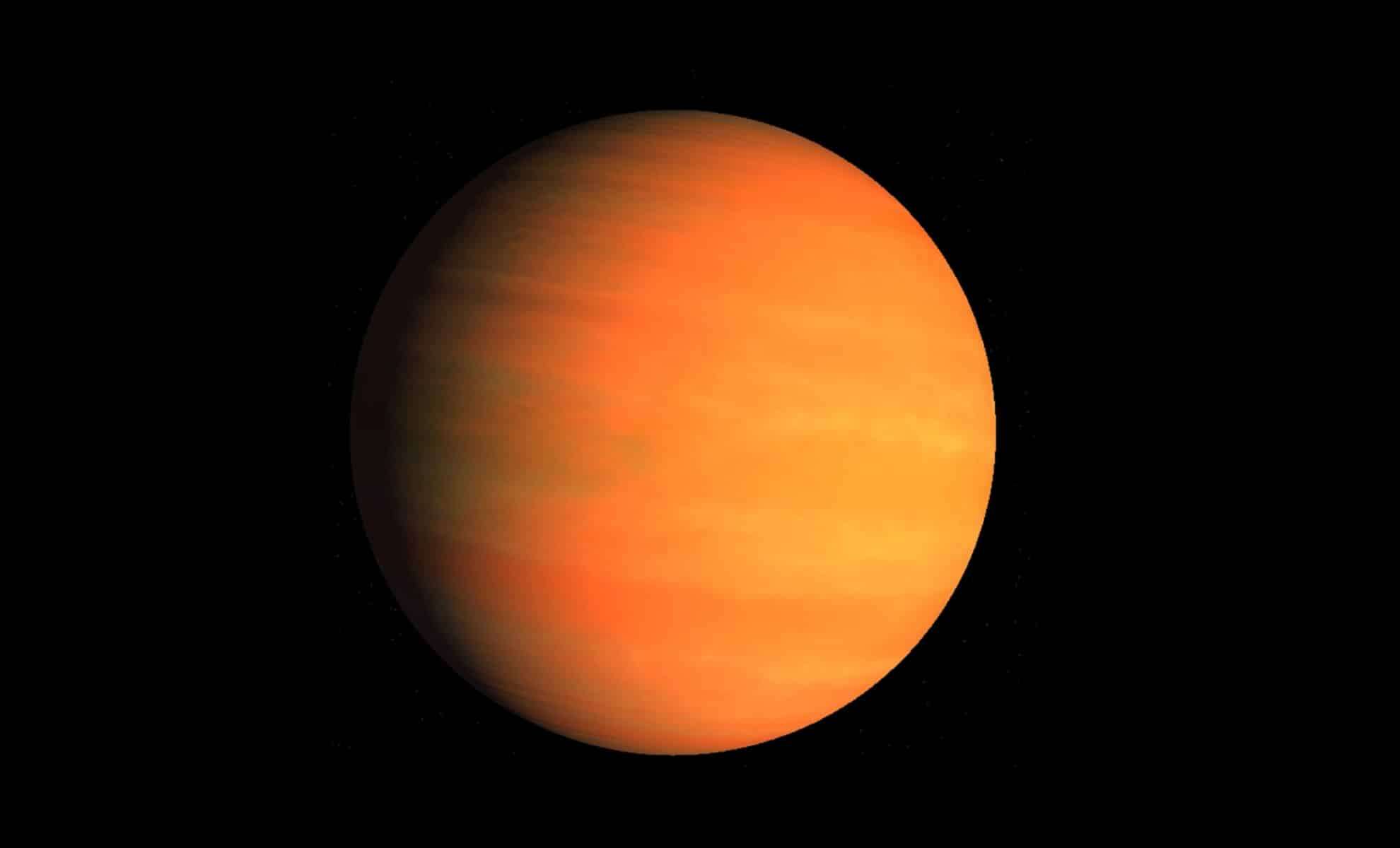
A recently identified exoplanet presents a unique opportunity for astronomers to explore the early stages of planetary transformation, showing how young planets rich in hydrogen can evolve into either gas-enveloped mini-Neptunes or solid super-Earths. This planet, known as V1298 Tau b, is thought to represent a crucial “transitional phase” in planetary evolution, according to recent observations from the James Webb Space Telescope (JWST).
A Transitional World with an Uncertain Outcome
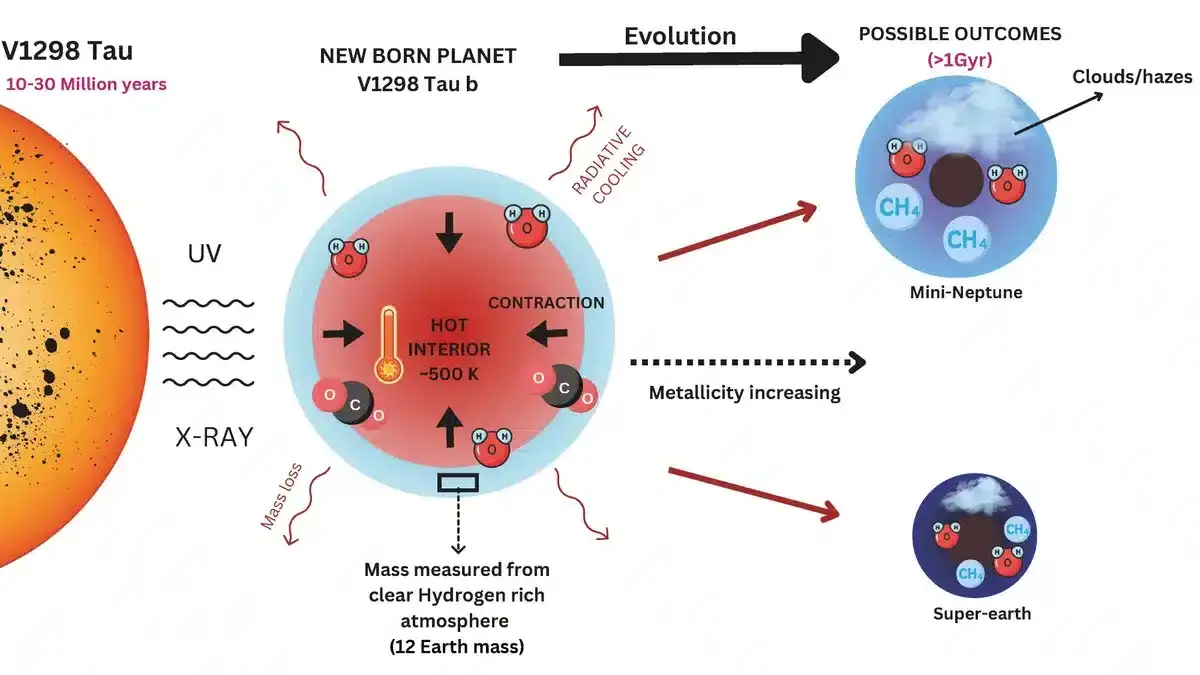
Situated within a nascent star system between 10 and 30 million years old, V1298 Tau b is currently experiencing significant changes in its physical structure and atmospheric makeup. Researchers suggest that the planet may eventually evolve into one of two types: a sub-Neptune with a thick gaseous atmosphere similar to Neptune, or a super-Earth, characterized by a rocky composition larger than Earth.
With a mass estimated to be multiple times that of Earth but still less than Neptune’s 17 Earth masses, the planet’s size places it in a category familiar to astronomers, yet its internal heat and atmospheric elements imply a distinct path of evolution.

Clear Atmosphere with Surprisingly Low Metallicity
Using the JWST’s advanced infrared capabilities, scientists analyzed the planet’s atmospheric molecules, including water vapor (H₂O), methane (CH₄), carbon dioxide (CO₂), carbon monoxide (CO), and sulfur dioxide (SO₂). Their data revealed a notably clear atmosphere dominated by hydrogen, with methane levels 100 times lower than anticipated and an overall metallicity considerably below that observed in mature sub-Neptunes.
In astrophysical terms, “metals” encompass all elements heavier than helium. While mature sub-Neptune atmospheres tend to be metal-rich, V1298 Tau b deviates from this pattern, potentially indicating an early formation phase or a fundamentally different evolutionary route.
Saugata Barat, the lead scientist from the University of Amsterdam, noted in the report that the planet’s evolution “is ongoing and may significantly alter its atmospheric composition as it ages.” Barat also highlighted the JWST’s near-infrared sensitivity as pivotal for accurately determining the planet’s mass and atmospheric properties.
Possibility of Swift Changes or Atmospheric Shedding
The team’s simulations propose that V1298 Tau b could follow multiple evolutionary paths. One outcome envisions the planet gradually becoming a typical sub-Neptune, whereas another predicts rapid loss of its gaseous envelope within about 7.5 million years, resulting in a rocky core akin to a super-Earth.
This range of potential endings underscores the turbulent and unpredictable nature of planetary development, particularly in the formative stages. Co-author Jean-Michel Désert from the University of Amsterdam remarked that “these discoveries challenge existing ideas on how sub-Neptune planets form and mature.” He stressed that young planets like V1298 Tau b can possess atmospheres quite unlike those of far older, billion-year-old planets.
Expanding the Survey to More Young Exoplanets
The researchers are also spearheading an extensive JWST initiative to examine seven young exoplanets aged between 20 and 200 million years. This survey aims to monitor how atmospheres evolve over time and illuminate the diverse evolutionary trajectories of young worlds.
- Categories:
- News









0 comments
Sign in to Comment