

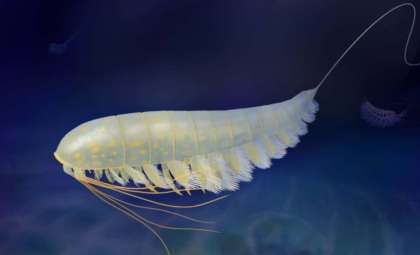
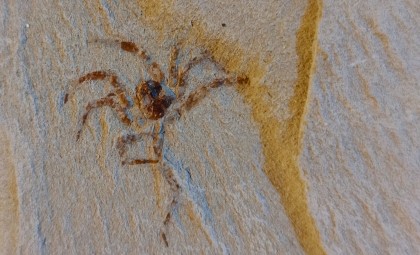
Researchers have uncovered a fossilized larva from over 500 million years ago showcasing exceptionally preserved internal anatomy, including its brain, digestive tract, and nervous system. This minute organism, an ancient precursor to arthropods, provides a rare window into the early evolution of complex animal structures.
Discovered in China and analyzed with advanced 3D imaging, the fossil marks a significant breakthrough in evolutionary research. The study, featured in Nature, allowed scientists to explore not only the external morphology but also the intricate inner components rarely retained in such old fossils.
A Brain Preserved for Over Half a Billion Years
The larval specimen belongs to the evolutionary line leading to modern arthropods—an incredibly diverse group encompassing insects, crustaceans, and others. While soft tissues like brains and internal organs rarely survive fossilization, this rare find defies those odds, illuminating evolutionary connections between ancient and present-day species.

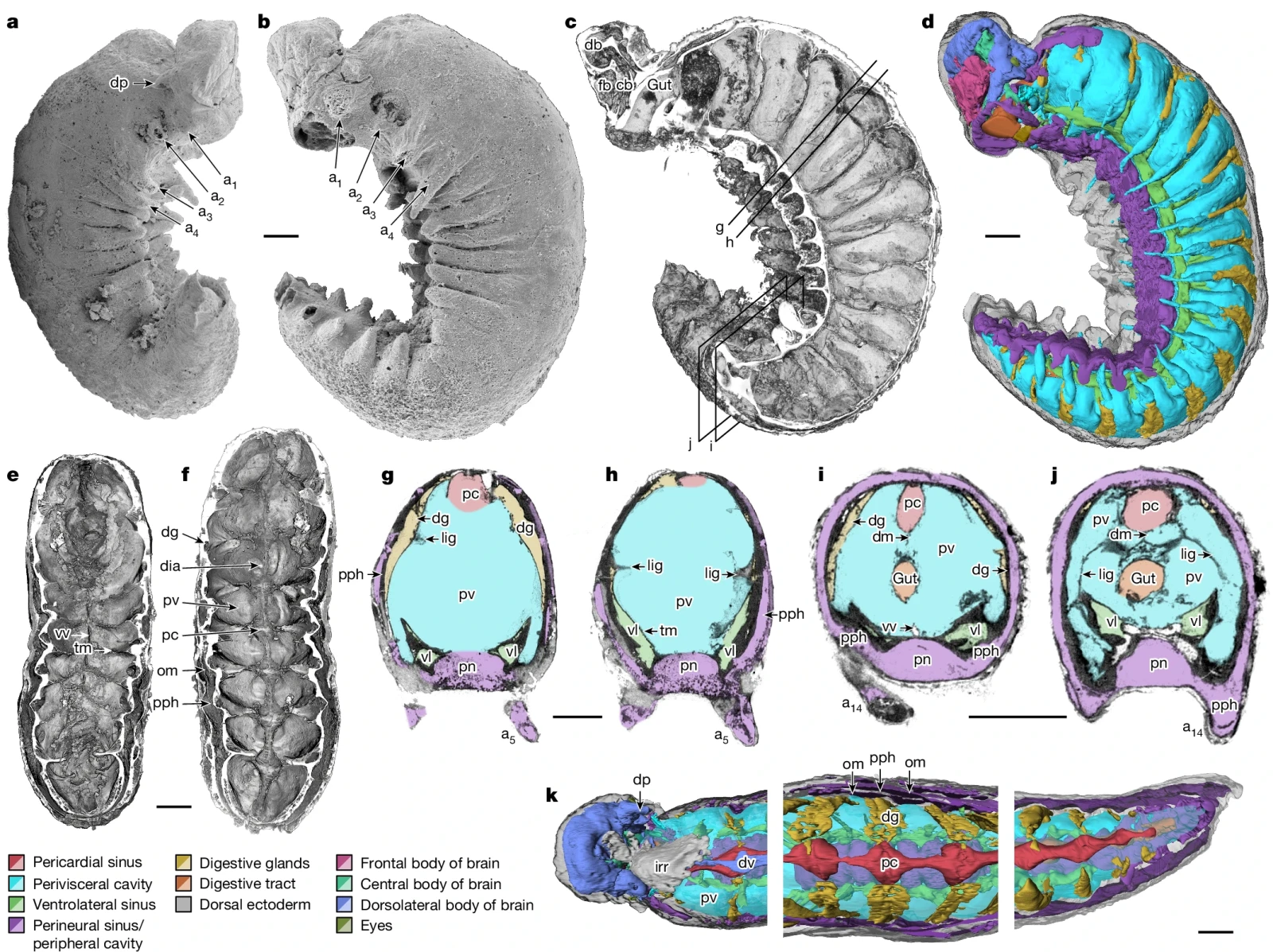
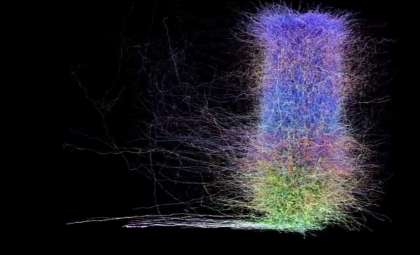
Fossil records usually capture only hard anatomical parts such as shells and exoskeletons, leaving soft tissue anatomy mostly lost. The preservation of this 520-million-year-old larva is thus exceptional. Using synchrotron X-ray tomography, scientists produced detailed 3D reconstructions of internal structures without compromising the specimen, as reported in a press announcement.
The imagery exposed a well-defined brain, digestive glands, traces of circulatory pathways, and nerve extensions reaching the eyes and limbs. Co-author Katherine Dobson noted, “the fossilization process resulted in nearly perfect preservation of these delicate tissues.”
Evolutionary Insights Fossilized in Detail
A notable discovery within the fossil was the protocerebrum, a brain region crucial for sensory processing and movement coordination in today’s arthropods.
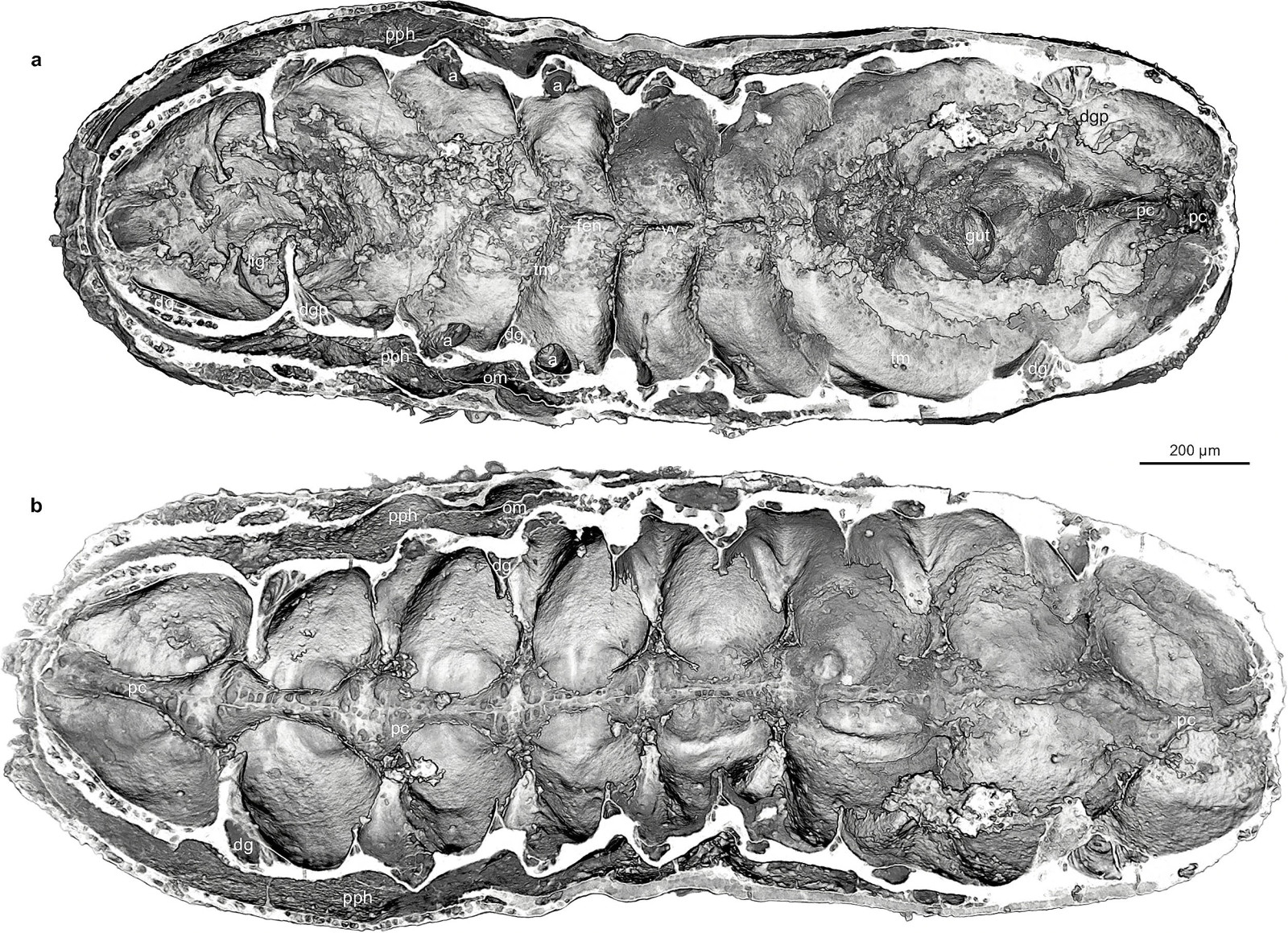
Finding this brain structure in such a primordial creature suggests that key components of arthropod brains have been conserved for hundreds of millions of years. Lead scientist Martin Smith remarked that the complexity revealed challenges earlier views of early arthropod simplicity.
“I already knew that this simple worm-like fossil was something special, but when I saw the amazing structures preserved under its skin, my jaw just dropped—how could these intricate features have avoided decay and still be here to see half a billion years later?” Smith said.
Unprecedented Discovery of Delicate Larval Fossil
Due to their tiny size and delicate nature, larval fossils are exceptionally scarce in the fossil record. The survival of this specimen’s soft tissues after more than half a billion years is thus extraordinary.
Such outstanding preservation opens new avenues for comparing ancient and modern anatomical patterns with remarkable detail. It reveals that even early arthropods exhibited intricate internal anatomy, which could reshape our understanding of their evolutionary development.
- Categories:
- Science

0 comments
Sign in to Comment