
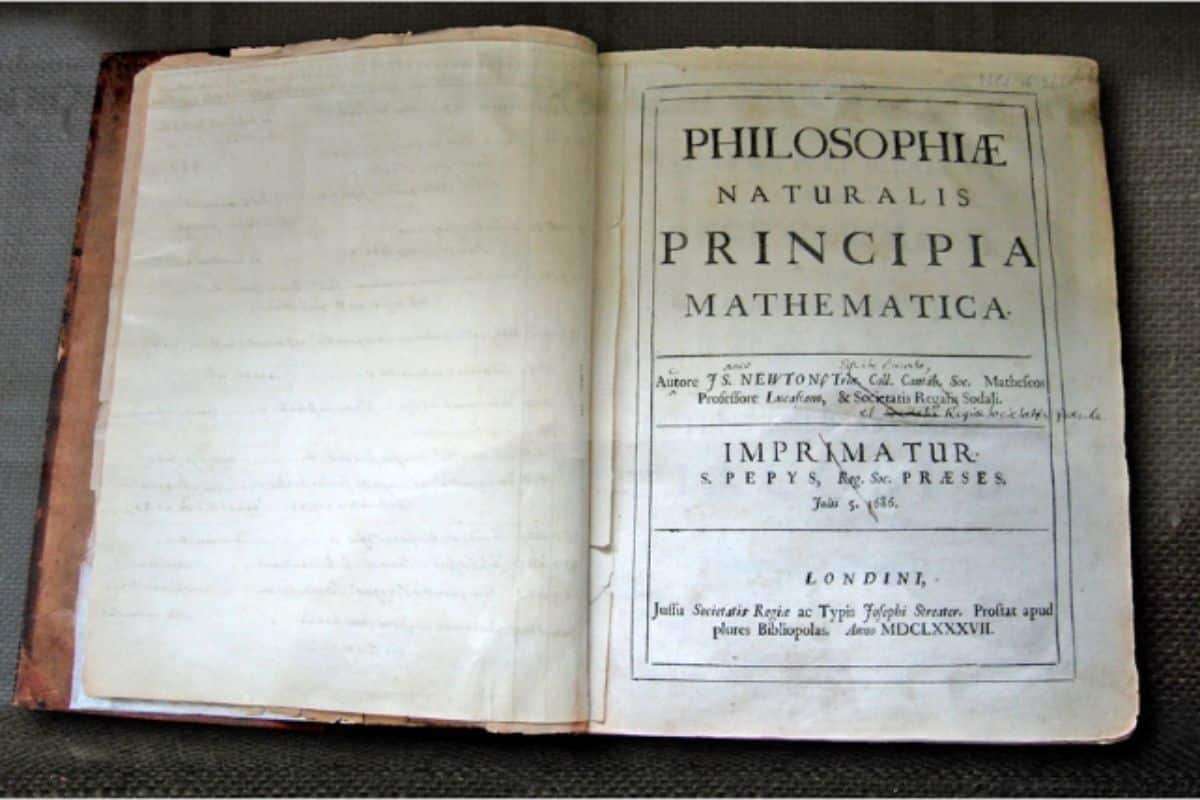
For almost three centuries, Isaac Newton’s first law of motion has stood as a cornerstone of classical physics. Yet, a recent investigation suggests that a subtle mistranslation in the original English edition might have led to widespread misconceptions about its actual meaning.
An Overlooked Translation Slip in Newton’s Text
Known as the law of inertia, Newton’s first law asserts that an object will maintain its state of rest or uniform motion along a straight path unless an external force intervenes. This interpretation stems from an early English translation of Newton’s Latin manuscript, which has long influenced physics education.
However, researcher Hoek identified a critical flaw in this translation. The Latin term “quatenus,” which accurately conveys the concept of “insofar as”, was mistakenly rendered as “unless.” Though it might seem trivial, this error profoundly shifts how Newton’s law is understood.

The Impact of Revisiting the Translation
At face value, the correction might appear insignificant since Newton’s mathematical framework remains flawless. Nonetheless, this nuance can reshape how we interpret and teach his foundational principles.
The prevailing interpretation of Newton’s first law suggests that objects will move uninterrupted unless forces act upon them. Hoek’s revised reading proposes that Newton was actually highlighting that all real-world motion is continuously influenced by forces, challenging the notion of entirely force-free movement.
Why Has This Error Stayed Hidden So Long?
This translation oversight was originally uncovered in 1999 by two academics, yet it failed to gain significant traction until now. Hoek aims to bring this subtlety into broader academic discussions.
Reactions from the scientific community vary widely. According to Hoek, “Some consider my interpretation too radical to be credible, while others find it so evidently accurate that debate seems unnecessary.”
The True Essence of Newton’s Law
Newton’s law revolutionized science by demonstrating that terrestrial and celestial motions follow the same physical principles. His laws unified our understanding of phenomena from falling objects to planetary orbits.
A classic illustration used by Newton was a spinning top that slows down due to air resistance. “Newton clearly illustrates that his First Law applies to accelerating bodies under force—meaning it pertains to real-world scenarios,” explained the Virginia Tech philosopher.
If Newton’s original phrasing means objects remain in steady motion only insofar as no forces act on them, it implies he recognized that all actual motion is subject to continuous external influences.
Hoek’s new interpretation actually deepens our appreciation of Newton’s insights, emphasizing that motion never occurs without external forces, whether it’s friction gradually halting a car or gravity maintaining a planet’s orbit—as explored in recent gravity studies.
- Categories:
- Physics













0 comments
Sign in to Comment