
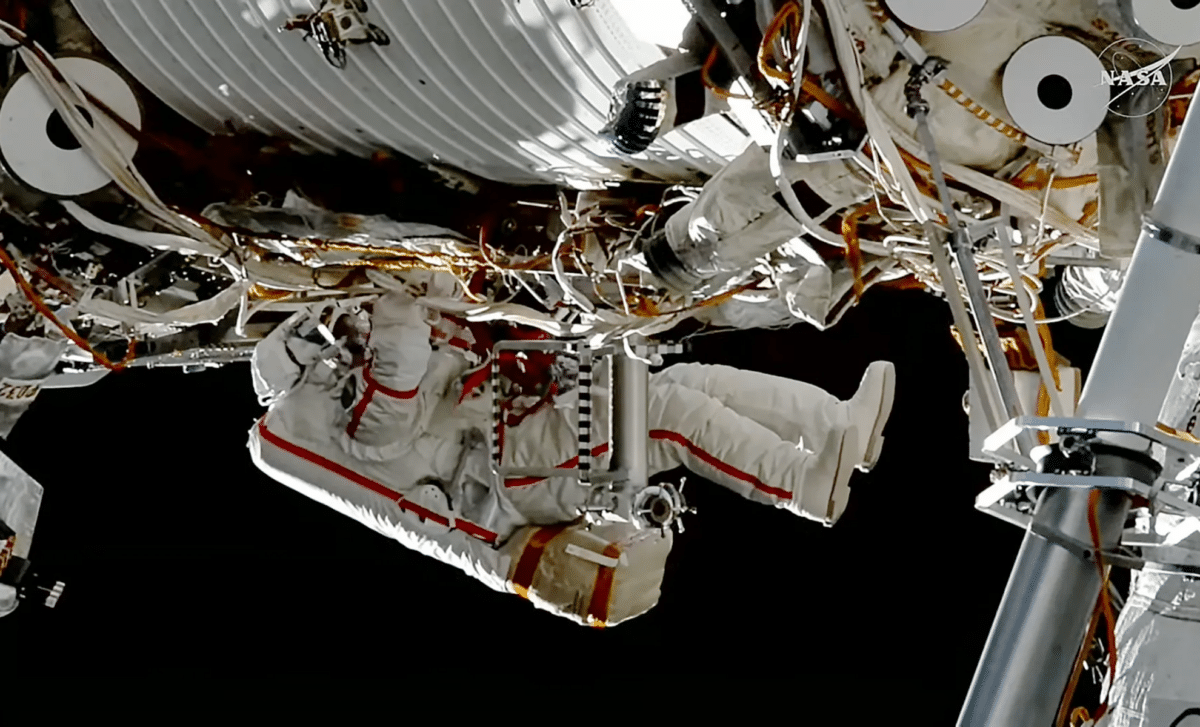
On Wednesday, two cosmonauts safely returned to the International Space Station (ISS) after completing a carefully orchestrated spacewalk that achieved several key scientific milestones, according to NASA. This mission underscored the continuous commitment to enhancing research capabilities in microgravity while supporting the station’s critical infrastructure.
Key Scientific Achievements During the Spacewalk
Over a duration of 6 hours and 5 minutes, Sergey Kud-Sverchkov and Sergei Mikaev executed a range of essential experiments aimed at advancing knowledge in life sciences and materials research aboard the ISS. They successfully removed a microorganism experiment from the Poisk module, which will provide valuable data on microbial behavior in the space environment. Additionally, the cosmonauts retrieved a cassette from the Nauka module containing data on semiconductor formation in microgravity, potentially influencing future developments in electronics both on Earth and in space.
Two cosmonauts are over five hours into their spacewalk installing a solar radiation experiment and removing physics and microbiology research gear. Watch on @NASA+. https://t.co/zWXIG7gD62 https://t.co/zWXIG7gD62
— International Space Station (@Space_Station) May 27, 2026Add Cosmo Herald as a Preferred Source

The duo also installed a novel instrument on the Zvezda service module that is designed to monitor bursts of solar radiation triggered by solar flares. These phenomena interfere with satellite signals and pose health risks for space crews. Data gathered will improve our understanding of solar particle activity and aid in forecasting hazardous space weather conditions.
Resolving ISS Hardware Issues
The spacewalk additionally addressed a technical issue involving the Progress 94 cargo vehicle. One of its Kurs rendezvous antennas did not deploy properly following its March launch. Kud-Sverchkov and Mikaev photographed the antenna and fastened it with a tie-down strap, securing it to prevent future complications. This maintenance work is vital for operational safety and highlights how spacewalks combine scientific and engineering tasks.
This mission was Kud-Sverchkov's second spacewalk and Mikaev's inaugural EVA, contributing to the ISS’s extensive legacy of 279 spacewalks focused on assembly, repairs, and upgrades. These activities demonstrate the high level of coordination between astronauts and mission control essential to maintaining the station’s scientific output.
NASA Emphasizes Ongoing ISS Research Endeavors
NASA states that this spacewalk exemplifies the ISS's enduring role as an orbiting research laboratory, enabling groundbreaking experiments unfeasible on Earth. The agency highlights that the installation and retrieval of scientific instruments are crucial to advancing knowledge in areas such as microbiology, materials science, and space weather. Through frequent social media updates, NASA keeps the public informed about the crew's work and the station's continuing scientific contributions.
- Categories:
- Space



0 comments
Sign in to Comment