
The notion that multiple universes might exist side by side has captured the imagination of thinkers across science and philosophy for years. Recent breakthroughs in quantum physics have provided new support for the many-worlds interpretation (MWI), a theory closely linked to Schrödinger’s cat thought experiment. This framework investigates how quantum superpositions work and suggests that every quantum event or choice could cause the universe to divide into numerous parallel realities.
An Unconventional Theory: The Many-Worlds Interpretation
Fundamentally, the many-worlds theory posits that quantum phenomena progress without external measurement interference, a principle called unitary evolution. This leads to the implication that all potential quantum outcomes result in different, branching universes. This perspective envisions our cosmos not as a single entity but as an immense multiverse where countless realities unfold in parallel.
Unlike other multiverse models, such as those stemming from string theory or cosmic inflation, MWI does not imagine these universes as spatially segregated. Instead, they occupy the same spacetime continuum, layered in a way that renders them invisible to each other. Each branch evolves independently depending on quantum results, yet is intrinsically connected within the underlying universal structure.

The perplexing question that emerges is why we don’t directly detect these parallel realities if they truly exist. Scientists at the Autonomous University of Barcelona have investigated this puzzle, presenting new understanding into how our classical world arises from quantum complexity.
From Quantum Uncertainty to Classical World
One of the greatest hurdles for many-worlds interpretation is clarifying how the orderly, single reality we experience emerges amid countless quantum possibilities. Schrödinger’s renowned paradox — depicting a cat that can be both alive and dead inside a sealed box — perfectly illustrates this challenge. It hinges on the principle of quantum superposition, where particles exist in multiple states simultaneously until observed.
The Barcelona researchers studied the entanglement mechanisms that help stabilize classical phenomena. Their work indicates that interactions among particles within an isolated quantum system can inhibit quantum uncertainty, resulting in a single definite outcome. This effect arises internally from the system's own properties rather than relying on external disruptions like environmental interference.
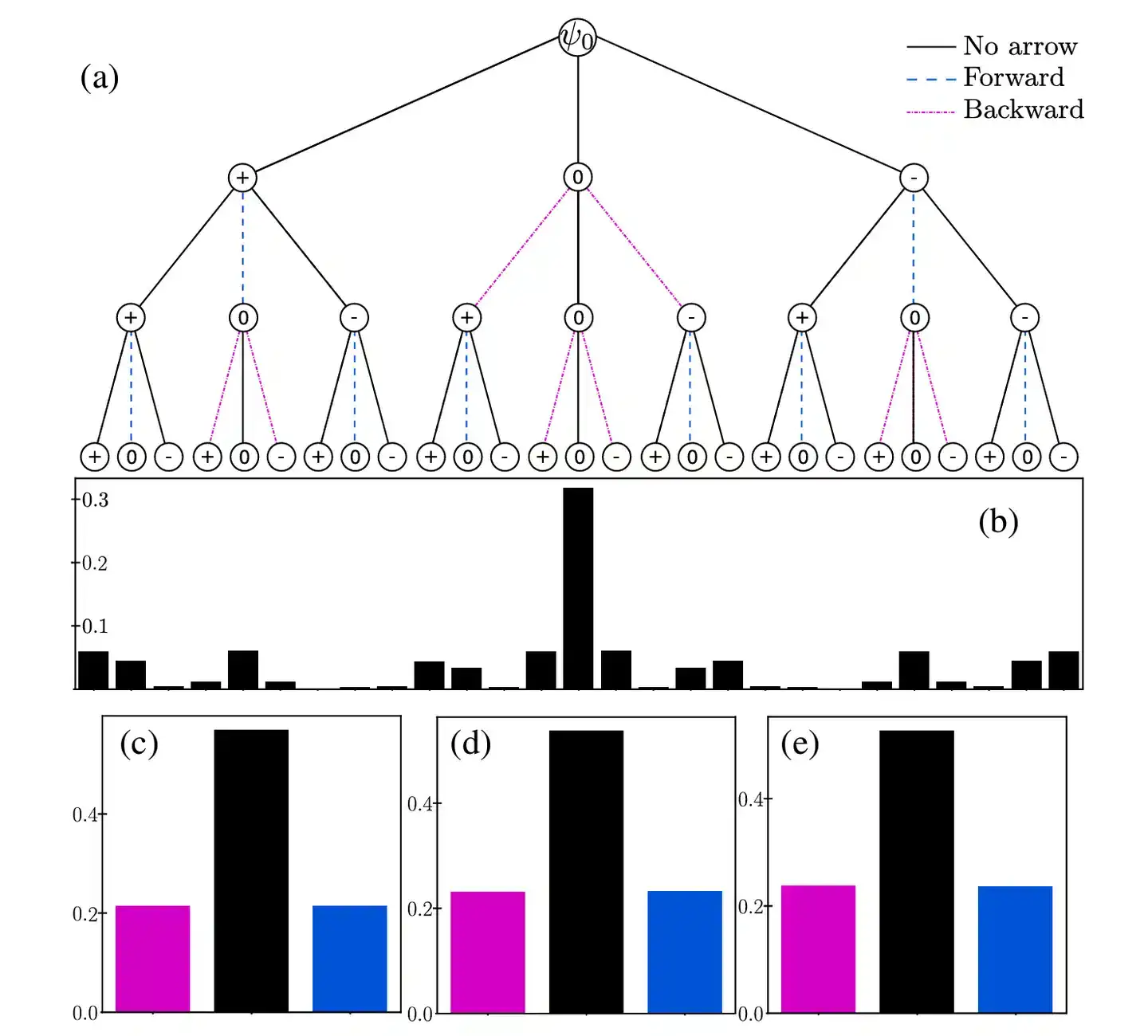
The team revealed that as particle interactions intensify, quantum randomness rapidly decreases, leading to a stable, singular reality. When applied to Schrödinger’s cat experiment, this implies that the cat’s condition — either alive or dead — becomes fixed as the system evolves. This stabilization depends on the presence of what the scientists refer to as slow and coarse observables.
Revisiting Schrödinger’s Cat Through a New Lens
These discoveries bring fresh nuance to Schrödinger’s famous thought experiment. The research highlights how complex interactions within the cat’s immediate environment—the box, its components, and the broader universe—actively select one definitive reality.
This suppression of quantum phenomena also clarifies why we fail to perceive other universes. As classical beings, immersed in intricate systems with countless particles, observing alternate branches of reality directly is effectively impossible.
Quantum Decoherence: Insights and Boundaries
A key part of the discussion centers on decoherence, the mechanism where quantum states lose their coherence due to environmental influences. Although decoherence has been a leading explanation for how classical states arise from quantum systems, the team suggests it doesn’t fully explain the emergence of classical outcomes within MWI.
They emphasize the role of the decoherence functional, a tool for evaluating the consistency of quantum paths. Investigating systems with various particle counts and dimensions, the study found that classical-like behavior appears naturally in systems exhibiting nonintegrability, where dynamics behave unpredictably.
Advancing Multiverse Investigations
While the findings from Barcelona illuminate important aspects of the many-worlds interpretation, they also underscore its current limitations. Notably, MWI does not incorporate effects from general relativity nor fully address the influence of quantum randomness at macroscopic scales. Moreover, the model treats time symmetrically, leaving open questions about causation and the directionality of time.
Despite these challenges, the many-worlds framework remains a powerful perspective for probing the fundamental nature of existence. This research emphasizes the depth of quantum theory and its potential to reshape how we understand the cosmos.
- Categories:
- Astronomy







0 comments
Sign in to Comment