
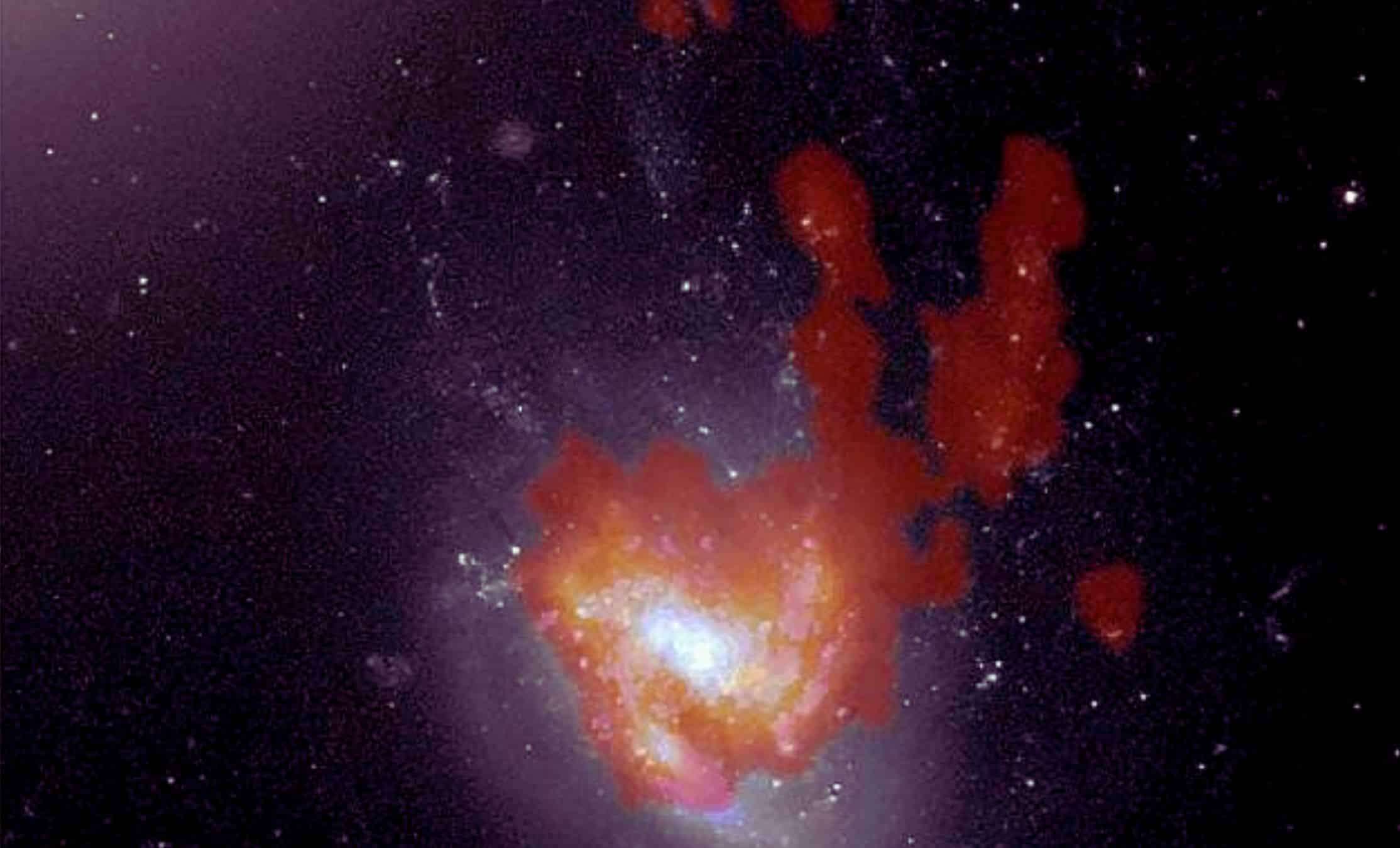
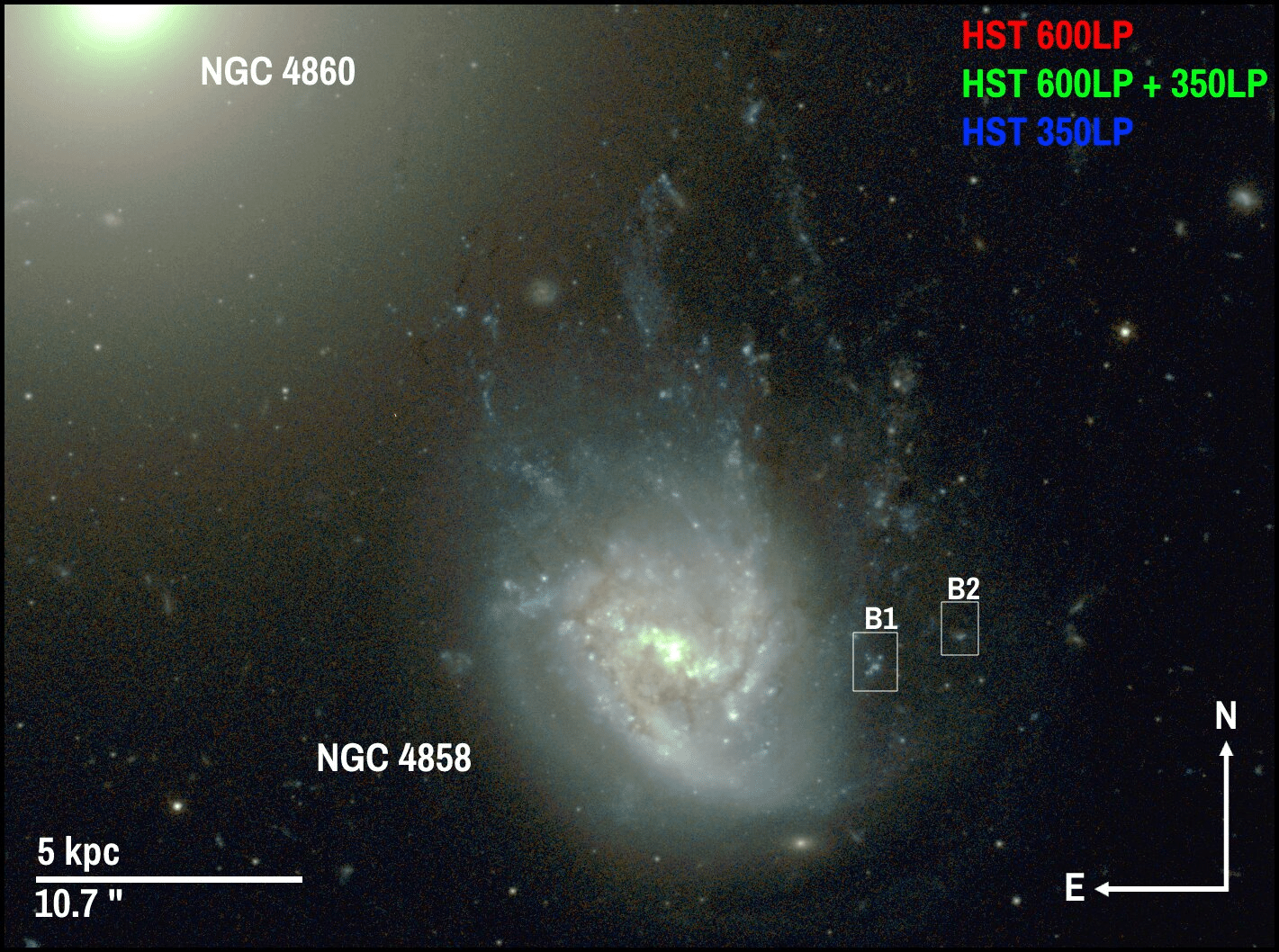
Researchers have identified a remarkable characteristic in the galaxy NGC 4858, a “jellyfish” galaxy situated over 300 million light-years away within the Coma Cluster. This investigation, spearheaded by Yale scientists Harrison Souchereau and Jeffrey Kenney, examines both internal mechanisms and external pressures influencing the galaxy’s peculiar shape and behavior. Utilizing advanced data collected from the ALMA observatory and the Hubble Space Telescope, the study, published on the arXiv preprint server, unveils striking characteristics like the galaxy’s so-called "rabbit ears" and an elongated gas tail, shedding light on how environmental forces sculpt galaxies in the dense Coma Cluster environment.
Decoding the Jellyfish Morphology of NGC 4858
The distinct “jellyfish” silhouette of NGC 4858 arises from powerful environmental pressures exerted as the galaxy speeds through the thick atmosphere of the Coma Cluster. Such galaxies encounter a process named ram pressure stripping, where rapid movement through the cluster’s hot ionized gas strips away portions of the galaxy’s own gas. This results in trailing streams reminiscent of jellyfish tentacles, which inspired the galaxy’s nickname.
“NGC 4858 is moving at very high velocity through the Coma cluster,” stated Souchereau, a Yale doctoral candidate and lead author. “It’s like the galaxy is inside a wind tunnel, with gas being peeled away by this intense wind.” This observable change in structure offers invaluable data for understanding galaxy behavior under extreme external pressures and their consequent evolutionary paths.

The Curious ‘Rabbit Ears’ Spiral Arms
Beyond its jellyfish form, NGC 4858 exhibits a striking feature dubbed the “rabbit ears,” identified through detailed imaging of its molecular gas. The intense ram pressure disrupts the galaxy’s spiral arms, bending them into two prominent protrusions that resemble ears on either side of the central disk.
“This effect likely stems from the combined influence of the external wind acting on the gas and the galaxy’s own spin,” explained Souchereau. The interplay between these forces distorts the spiral arms, resulting in the distinctive "rabbit ear" shapes, which offer deep insights into the mechanics of galaxy alteration in high-pressure settings.
These “rabbit ears” are more than just visually unique structures; they illustrate the ongoing interactions between the galaxy’s gas and external environmental forces. Studying these features is critical for grasping how galaxies evolve and adapt within massive clusters.
Revealing the Fallback Effect
An especially intriguing aspect uncovered by this research is the detection of a phenomenon called fallback. This process happens when gas stripped from the galaxy doesn’t achieve escape velocity to permanently leave but instead returns, flowing back onto the galaxy in a cycle reminiscent of a fountain.
Kenney, the project’s senior scientist, noted, “Ram pressure stripping is often seen simply as gas being removed from galaxies, which is crucial since gas fuels star formation.” Still, he emphasized that sometimes the expelled gas doesn’t escape entirely but falls back, accumulating in the distorted spiral arms. This "galactic fountain" phenomenon plays an important role by potentially enabling star formation to continue, even as the galaxy loses some of its gas due to environmental forces.
Observations detailing this fallback mechanism in NGC 4858 provide a richer perspective on how galaxies and their surrounding environments interact. The findings mark a significant advancement in understanding the evolutionary influences on galaxies within dense clusters.
- Categories:
- News




0 comments
Sign in to Comment