
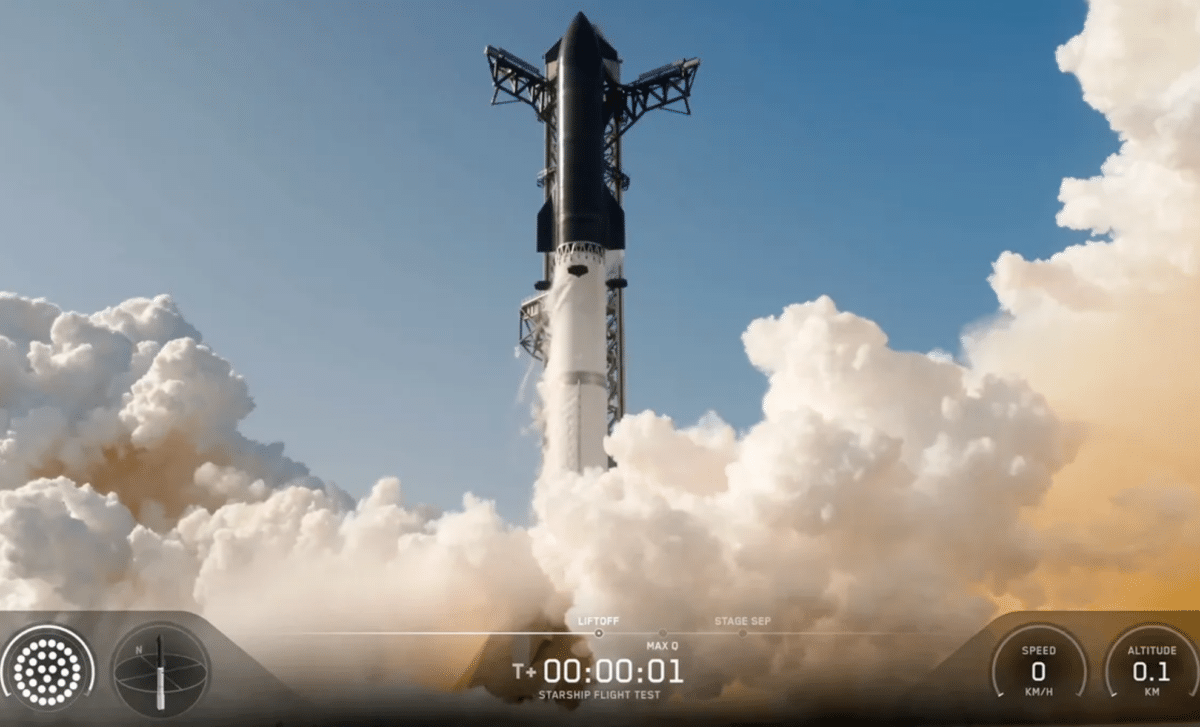
SpaceX’s Starship spacecraft recently completed a groundbreaking trial mission, showcasing its gentlest ocean landing to date, as reported by Space.com. This event provided essential data to enhance future deep space expeditions and the development of reusable spacecraft technology.
Starship Hits New Benchmarks in Its 13th Test Flight
The recent integrated flight test of Starship offered engineers at SpaceX a critical chance to evaluate the performance of the globe’s largest functional rocket system in preparation for missions that will extend beyond Earth’s orbit.
On this 13th flight, the rocket carried advanced Starlink satellites, marking progress in broadening the reusable spacecraft’s capabilities.
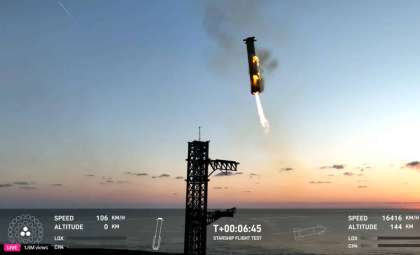
Upon completing its orbital task, the upper stage made a deliberate descent into the Indian Ocean for a planned splashdown.
The spacecraft remained undamaged upon water impact, enabling the collection of important telemetry and sensor data.
SpaceX CEO Elon Musk promptly shared updates on the vehicle’s status following splashdown.
”Starship is intact, floating in the ocean and transmitting telemetry!” Musk announced via X.
This successful recovery of flight information offers valuable insights into the spacecraft’s behavior during the challenging phases of atmospheric reentry and touchdown.
Each test flight aims to uncover new details about the heat shield’s endurance, propulsion mechanics, and the vehicle’s structural integrity.

Results from this mission highlight enhancements in Starship’s capacity to withstand the severe conditions of Earth return, informing the design of future models aimed at lunar missions and eventual crewed Martian exploration.
Starship is intact, floating in the ocean and transmitting telemetry! pic.twitter.com/hLVXJqkHSA
— Elon Musk (@elonmusk) July 25, 2026
SpaceX Records Its Softest Starship Splashdown to Date
The splashdown emerged as a standout segment of the flight after live video revealed Starship calmly floating on the ocean surface post-descent.
According to Space.com, this unique landing presented engineers with an infrequent opportunity to witness the spacecraft intact after reentry.
Aerial drone footage captured the vehicle gently bobbing in the water while still transmitting critical data after executing the landing.
“This is just the first time we’ve put a Starship into the water,” SpaceX spokesperson Dan Huot said during live commentary.
He described the event as SpaceX’s “softest splashdown” ever and said the mission created an ideal situation for gathering heat shield information.
“This is a dream scenario for this team that’s trying to get this heat shield data,” Huot said during the broadcast.
Understanding how the spacecraft endures the harsh conditions of atmospheric reentry remains a primary objective of these flight demonstrations. Future Starship missions will need robust thermal protection capable of withstanding repeated launches and returns. The controlled ocean landing exemplifies the significant advances made compared to earlier trials, which concluded without achieving smooth recovery.
Each successful test adds confidence in the design strategies behind SpaceX’s fully reusable rocket vision.
Engine Function Under Scrutiny Following Landing
Though the splashdown was a pivotal success, engineers noted some unexpected details during the descent’s final moments. The engine ignition sequence during landing did not fully align with the original plan, presenting key insights for further review.
“This is a first,” Dan Huot added in live commentary as a drone beamed stunning views of Starship bobbing in the waves.
“That is the softest splashdown we have ever had with Starship in the Indian Ocean.”
Huot explained that the final approach differed from the original expectations during the landing maneuver.
“It didn’t look like we lit all 13 engines that we were planning for that initial landing burn,” Huot said.
“We were targeting a softer splashdown and, as you saw, it came in with quite a bit of velocity.”
Data collected during this critical phase will help refine upcoming flight software, engine protocols, and descent methods.
The evolution of Starship relies on extensive iterative testing, given its integration of complex technologies within one reusable design.
This flight demonstrated both significant progress and areas requiring enhancement.
SpaceX will utilize telemetry from this mission to optimize future flights as the development moves toward more challenging goals.
Implications of the Starship Test for Space Exploration’s Future
This latest flight reinforces SpaceX’s ongoing commitment to establishing a reusable space transport system capable of supporting large-scale extraterrestrial endeavors.
A thriving Starship program could unlock new ways to deliver payloads, launch satellites, and back crewed missions. The spacecraft is also slated to contribute significantly to NASA’s Artemis program, where adapted Starship units may assist lunar surface operations.
Beyond lunar ambitions, Starship is being advanced as a promising carrier for human and cargo missions to Mars. Insights from flight 13 will enhance thermal shielding, flight navigation, propulsion, and recovery techniques.
The intact ocean landing offered a unique chance to analyze the vehicle after surviving one of the toughest mission segments.
Rather than focusing solely on space access, Starship’s testing emphasizes mastering repeated launches and recoveries of a massive spacecraft.
This recent demonstration adds substantial knowledge that will influence successive Starship iterations. As SpaceX pursues its aggressive testing schedule, each trial deepens understanding of the challenges in crafting a fully reusable interplanetary transport.
This milestone marks another key chapter in reshaping how humanity might explore distant worlds.
- Categories:
- News







0 comments
Sign in to Comment