
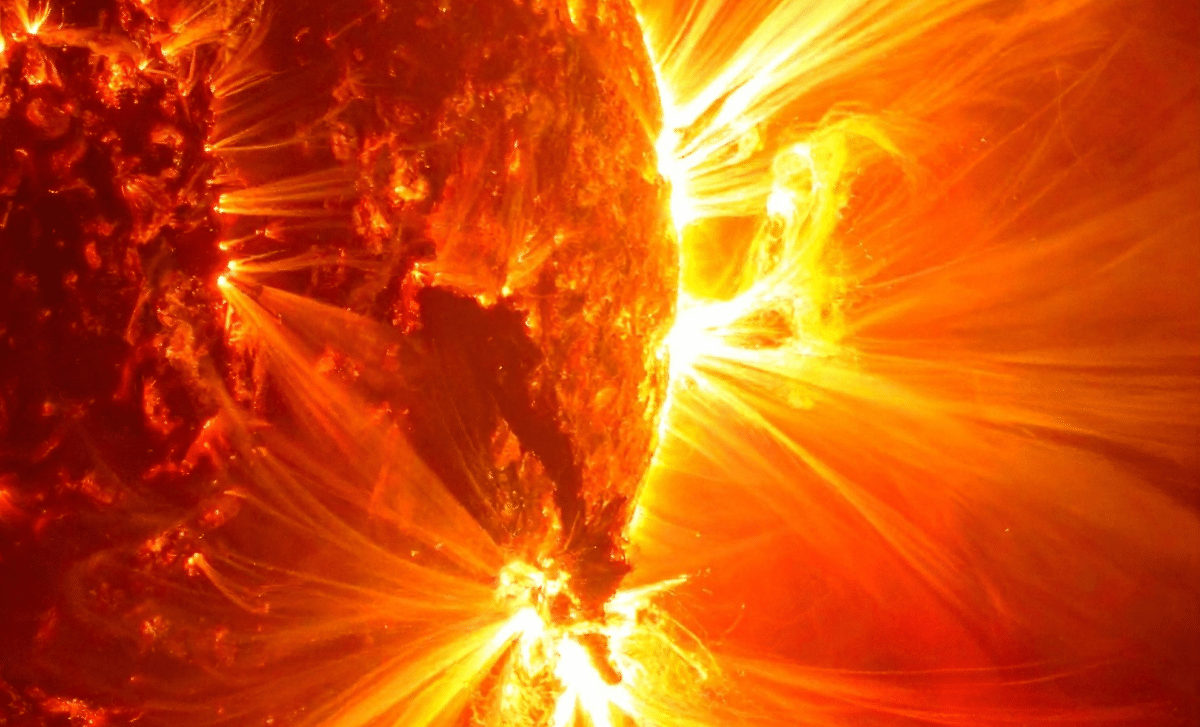
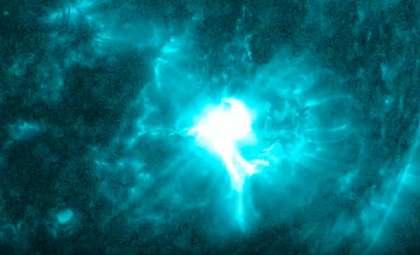
Following a period of relative calm, the sun has unleashed a substantial M5.1-class solar flare from a newly surfaced sunspot area, disturbing the quiet in space weather forecasts. Detected by the GOES-19 satellite managed by NOAA, this burst briefly interfered with radio signals over the Pacific and indicates that solar unrest is intensifying.
Rapid Shift from Quiet to Active Solar Conditions
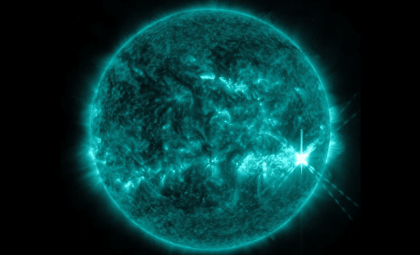
Solar observers noted minimal flare activity for several days until sunspot region AR4323 suddenly generated a significant flare on December 27, 2025, at approximately 1:50 UTC. This M5.1 event, while powerful, is not among the strongest but signifies a sharp rise in solar disturbances, elevating space weather conditions swiftly from “low” to “high.”
An M5.1 flare occurred at 27/0150 UTC. This event appears to have originated from an unnumbered region just NW of AR 4323, which will be evaluated for sunspot classification for the 1230 UTC forecast. pic.twitter.com/E9Ju6NXS7W
— NOAA Space Weather Prediction Center (@NWSSWPC) December 27, 2025Add Cosmo Herald as a Preferred Source

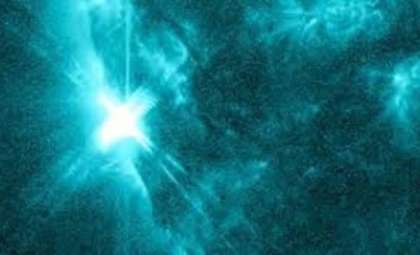
Observed in the 131-angstrom channel by NOAA’s GOES-19 SUVI instrument, the flare illuminated the solar corona with plasma temperatures soaring beyond 10 million degrees Celsius. This eruption emitted radiation intense enough to induce a moderate R2 radio blackout near the Coral Sea, temporarily impacting aviation and maritime communications in the affected zone.
The solar area responsible, AR4323, recently became visible as it rotated into view from the sun's southeastern edge. Its appearance fits a larger trend of escalating instability on the solar surface, reinforcing predictions that Solar Cycle 25's peak will bring more frequent and vigorous solar events.
Hidden Solar Activity May Signal Future Flares
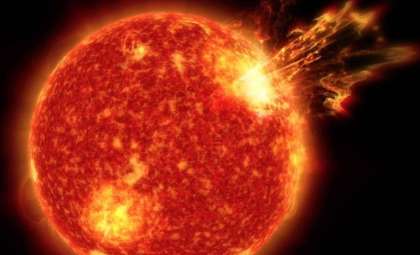
While AR4323 is currently the focus, the sun’s far side could be harboring stronger activity. NOAA imagery has displayed immense prominences erupting at the sun’s northern pole, pointing to significant magnetic unrest beyond Earth’s immediate view.
Solar researchers anticipate the return of two volatile sunspot regions, AR4294 and AR4296. Before moving out of sight over the sun’s western limb, these zones generated a total of 19 M-class flares. As they rotate back into sight, NOAA forecasts roughly a 50% chance of additional M-class flares, with about a 10% probability of an X-class flare, representing the highest flare intensity.
This forecast implies potential interruptions to satellite systems, radio signals, and the possibility of enhanced auroral activity near the Arctic, where geomagnetic disturbances are already being monitored.
Shifting Solar Wind and Magnetic Environment
Space weather instruments record solar wind velocities varying from 470 to 590 km/s, impacted by magnetic fluctuations in the interplanetary space. The interplanetary magnetic field remains steady around 5.5 nT, with the Bz component occasionally shifting southward.
Southward Bz orientation can open magnetic pathways between Earth’s magnetosphere and the solar wind, enabling energy transfer that triggers brief geomagnetic events. Although no Earth-directed coronal mass ejections have been detected recently, these magnetic field shifts sustain moderate auroras in northern countries such as Canada, Iceland, and Scandinavia.
According to NOAA’s Space Weather Prediction Center (SWPC), Earth's magnetic activity has mostly stayed subdued (Kp index near 2), but minor changes in solar wind direction might soon spark more vivid auroral displays.
Unusual Magnetic Configuration in Sunspot AR4321
Sunspot region AR4321 has attracted interest due to its rare magnetic alignment. Unlike typical sunspots with north-south polarity, AR4321’s magnetic poles are twisted approximately 90 degrees, defying Hale’s polarity law.
This distortion suggests accumulation of magnetic stress beneath the solar surface, akin to a tensioned coil that could release significant energy if triggered. Though currently quieter, solar scientists warn that such an arrangement often precedes sudden, strong solar flares.
Images from NASA’s Solar Dynamics Observatory (SDO) reveal the tangled magnetic field structure of AR4321, highlighting the inherently volatile and complex character of solar magnetism.
Implications for Earth and Space Weather Preparedness
At present, Earth's near-space environment remains largely stable, though the situation can shift quickly. Even an M-class flare of moderate intensity can disrupt aviation, satellite GPS, and communication networks if its radiation is Earth-directed. More powerful X-class flares or Earth-bound CMEs could carry higher risks, affecting power infrastructure and causing spectacular auroras visible farther from the poles.
With ongoing monitoring from NOAA and global space weather organizations, the upcoming days will be crucial in determining whether solar activity continues to accelerate. The reappearance of flare-prone regions combined with solar wind variability signals that the sun's quieter spell might be ending.
- Categories:
- Space





0 comments
Sign in to Comment