
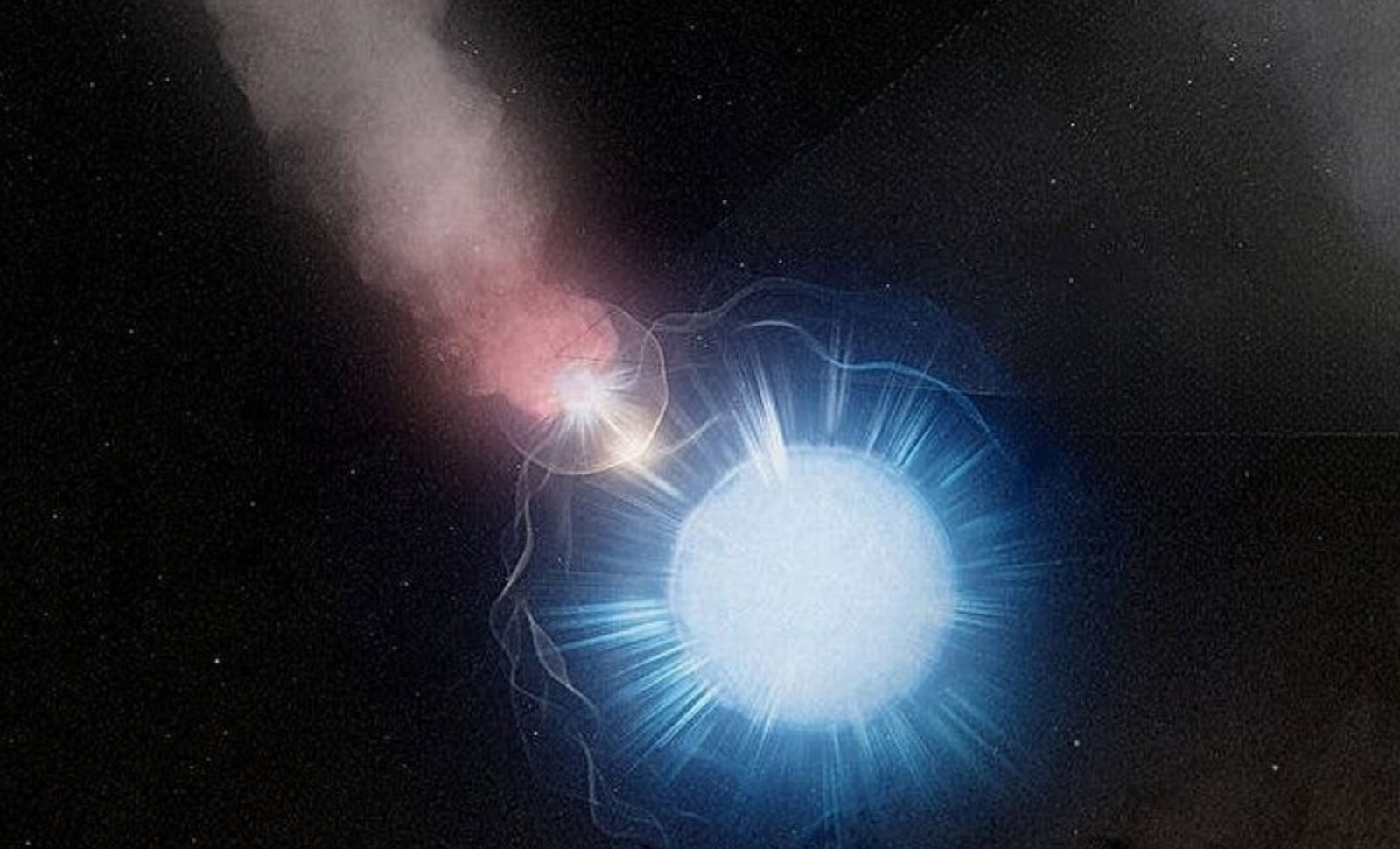
A unique pair of colossal stars is generating some of the tiniest solid particles ever detected around such celestial bodies. By integrating observations from the James Webb Space Telescope and ALMA, scientists uncovered that the binary star system WR 112 emits carbon dust particles only a few nanometers in diameter.
The findings, featured in The Astrophysical Journal, reveal a fascinating discrepancy between the enormous scales of these dying stars and the minuscule sizes of dust they release into the cosmos. The study’s lead author, Yale undergraduate Donglin Wu, highlighted the staggering ratio between the star’s size and its dust, nearly one quintillion to one.
Wu pursued this research during a summer program at the California Institute of Technology alongside Héctor Arce and Daisuke Nagai. WR 112 hosts a rare and short-lived Wolf-Rayet star, known for its exceptional spectral features and intense stellar winds.

Investigating an Uncommon Wolf–Rayet Binary
WR 112 stands out as more than an average binary system. It contains an extraordinarily hot, dying Wolf-Rayet star paired with a companion star. These stars are known for being massive yet brief in lifespan, producing powerful winds that sculpt their environment.
According to research published inThe Astrophysical Journal, the collision of winds within WR 112 forms dense, cooling regions where carbon-rich dust forms and is subsequently dispersed by the stellar radiation. Prior mid-infrared images captured by the James Webb Space Telescope showed vivid spiral dust arcs, indicative of ongoing and patterned dust creation.
Wu emphasized the rarity of observing such systems in astronomy.
“Astronomy and astrophysics connect to something very romantic. You look up at the night sky and think about how immense it is. There are so many things that are still unknown—things that are difficult to observe, things that are rare.”
Contrasting Views from Powerful Observatories
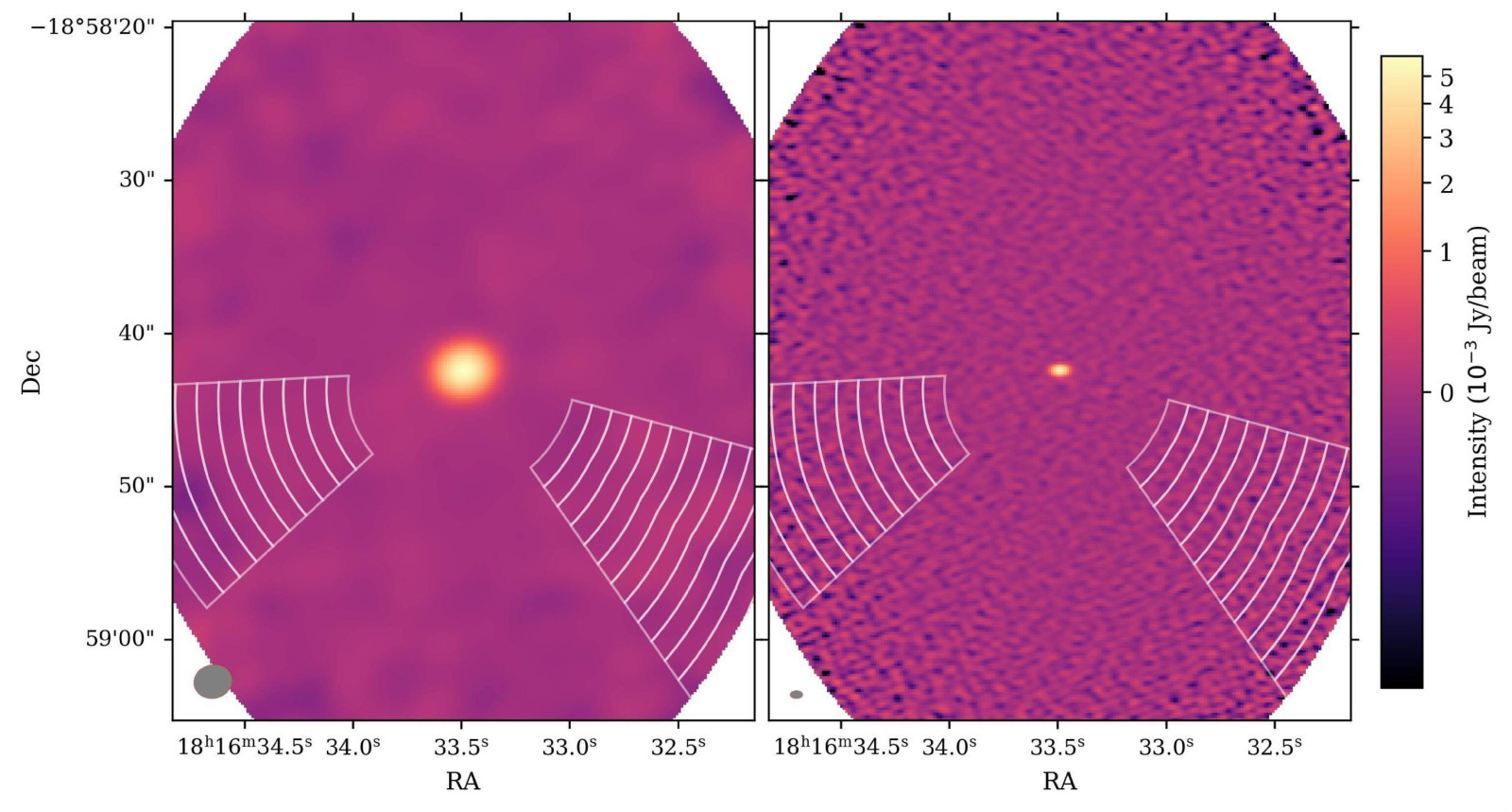
The team juxtaposed mid-infrared data from JWST with millimeter-wave observations from the Atacama Large Millimeter/submillimeter Array to better characterize the dust in WR 112. The results were revealing.
While JWST captured the extensive spiral dust shells in the mid-infrared band, ALMA registered no millimeter emission from dust. Since ALMA is highly sensitive to larger dust grains, this absence was significant.
This lack of millimeter detection led researchers to conclude that only tiny, warm dust particles remain undetected by ALMA, as bigger grains would have shown up clearly.
A Dual Population of Nanometer-Scale Dust Particles
The investigation determined that most dust grains in the spiral formations around WR 112 are smaller than one micrometer. The paper states:
“our results also suggest that the majority of grains in the system have radii below one micrometer, and the extended dust structures are dominated by nanometer-sized grains.”
Two distinct groups of dust grains emerged from the data: a prevalent population of nanometer-sized particles and a secondary group approximating 0.1 micrometer. This differentiation provides clarity to long-standing debates about grain sizes in similar binary star systems, which previously indicated either ultra-small or relatively larger grains.
The researchers further explored the mechanisms by which dust might fragment or evaporate under harsh stellar radiation. They found that specific processes preferentially eliminate medium-sized grains, offering a physical rationale for the observed dust size distribution.
- Categories:
- Astronomy







0 comments
Sign in to Comment