
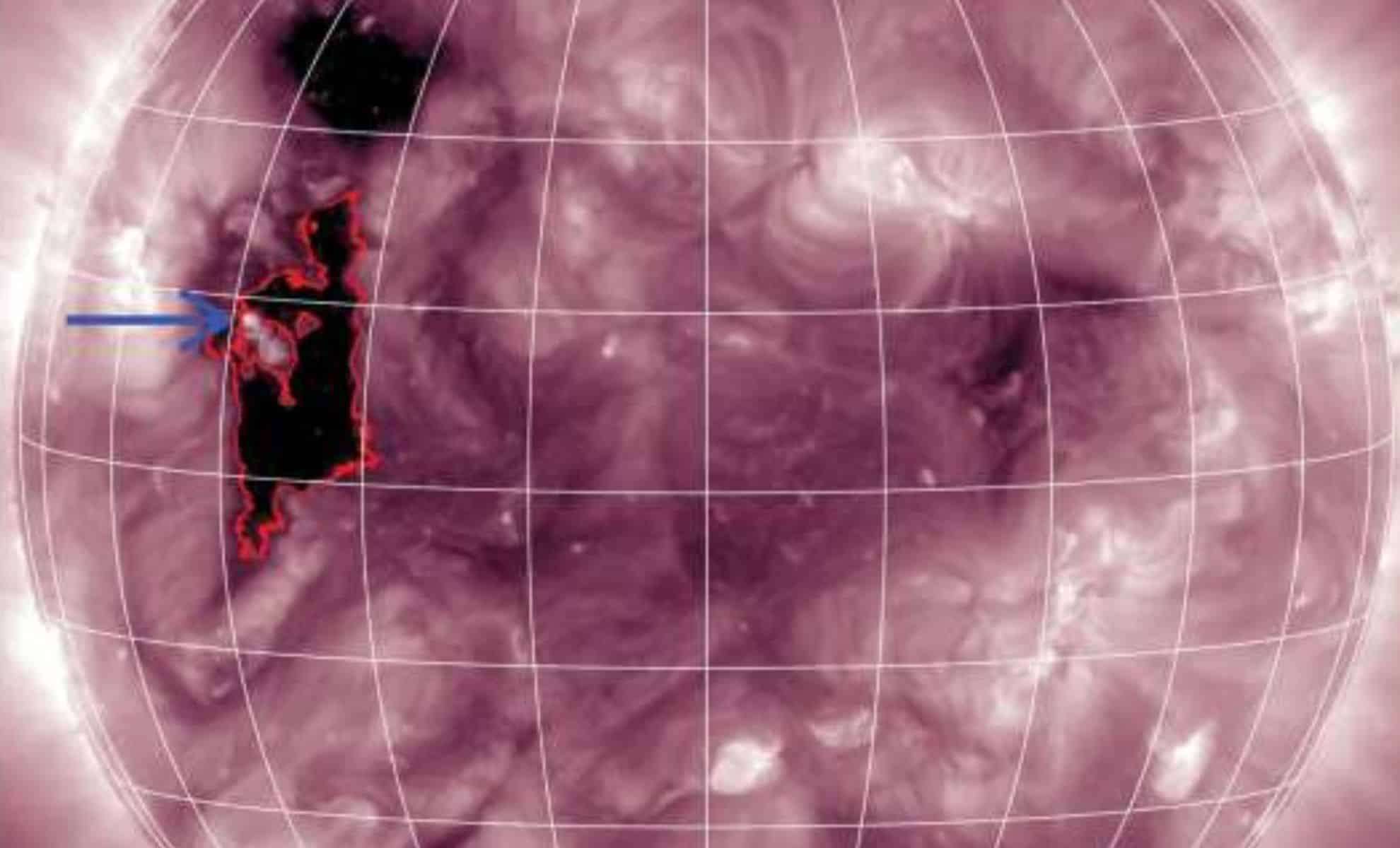
Scientists have pinpointed the source of the most intense concentration ever recorded of a rare helium isotope (³He) emitted by the Sun, representing a significant advancement in understanding solar energetic particle behavior. Published in The Astrophysical Journal, research led by the Southwest Research Institute (SwRI) traced this anomaly to a minuscule solar jet located at the margin of a coronal hole — areas with relatively low magnetic activity on the Sun’s surface. This minor phenomenon triggered an extraordinary 200,000-fold increase in ³He, far surpassing any previously observed measurements.
An Exceptional Helium-3 Spike Never Recorded Before
The NASA/ESA Solar Orbiter was responsible for detecting this remarkable surge of ³He, an uncommon helium isotope that normally exists in the solar environment at a ratio of about one per 2,500 compared to the more abundant ⁴He. According to Dr. Radoslav Bucik, lead author of the study, “This lighter isotope, distinguished from ⁴He by just a single neutron, is scarce within our solar system.”
Even more fascinating is how such a tiny solar jet, barely discernible, managed to generate such a massive increase. Bucik elaborated, “Solar jets seem to selectively accelerate ³He to very high velocities or energies, likely due to its distinct charge-to-mass ratio.” While the exact acceleration mechanism remains a mystery, this isolated incident elevated the ³He abundance by an unprecedented factor of 200,000 times, unmatched by any other known astrophysical source.

Solar Jet Originates in a Calm Region of the Sun
By analyzing imagery from NASA’s Solar Dynamics Observatory, the scientists located the jet at the edge of a coronal hole, areas where magnetic field lines extend outward into space. This zone exhibited a notably weak magnetic field, indicating that environments with less magnetic turbulence promote the enrichment of ³He. Bucik observed, “The magnetic field strength here was unexpectedly low, more typical of tranquil solar regions than of the active, stormy areas.”
This discovery lends weight to hypotheses suggesting that mild, low-disturbance conditions are ideal for energizing particular particles like ³He. It’s a crucial clue toward unraveling a solar physics enigma that has persisted for decades.
A Distinctive Solar Particle Signature Unlike Typical Events
Most solar energetic particle (SEP) incidents documented over recent decades are marked by an abundance of heavy ions, especially iron, relative to lighter atoms. These generally originate from highly active and magnetically strong solar regions, such as solar flares and coronal mass ejections, where intense energy processes preferentially accelerate heavier particles.
The event investigated in this study, however, exhibited a strikingly different elemental makeup. Rather than an iron-rich signature, the Solar Orbiter observed heightened levels of lighter elements including carbon, nitrogen, silicon, and sulfur, with iron quantities remaining constant. This unusual composition challenges existing models explaining particle acceleration during solar activities.
The researchers emphasize that this elemental pattern is extraordinarily uncommon. Throughout over 25 years of satellite-based solar monitoring, only 19 comparable events have been recorded. The rarity points to their emergence from specialized solar conditions and distinct acceleration mechanisms, likely connected to smaller, localized features like the solar jet identified at the coronal hole boundary in this case.
- Categories:
- News










0 comments
Sign in to Comment