
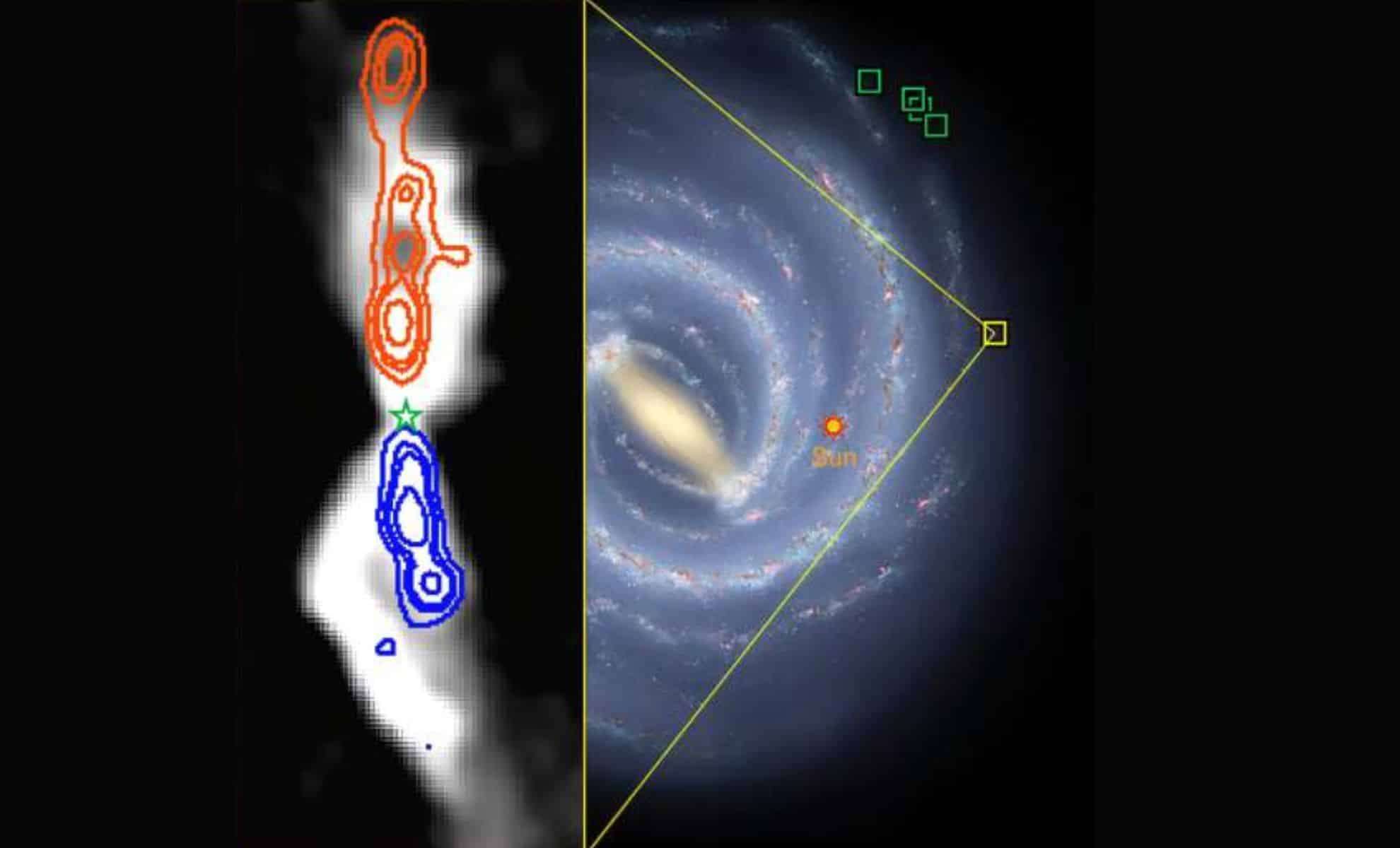
In a significant advancement for star formation studies, astronomers have identified protostellar jets far out in the Milky Way’s outer zone, as detailed in a recent The Astrophysical Journal publication. Utilizing the precision of the Atacama Large Millimeter/submillimeter Array (ALMA), scientists have, for the first time, produced detailed images of protostellar jets and outflows occurring roughly 51,000 light-years from the galaxy’s core. This extraordinary discovery confirms that the fundamental mechanisms behind star formation remain consistent even in regions with limited heavy elements, though the chemical environment uniquely adjusts to these low-metallicity settings.
A Unique Testing Ground at the Galaxy’s Periphery
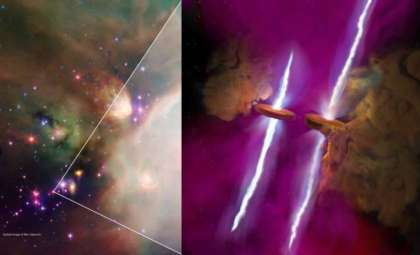
The source under investigation, named Sh 2-283-1a SMM1, is situated approximately 26,000 light-years away from Earth, in a sector of our galaxy with only about a third of the heavy elemental abundance found near the Sun. Such a metal-deficient environment mirrors conditions of the early Milky Way, offering a rare natural platform for exploring star birth in primordial cosmic settings. Observations revealed a bipolar outflow system featuring swift jets streaming from the young star, alongside wider and slower outflows dispersing matter into the neighboring cloud. These data provide an unprecedented window to contrast present-day stellar formation with the processes that likely shaped the earliest stars.
“Achieving resolved observations of jets so far from the galactic center confirms that star formation physics near our Sun universally applies, even in less metal-rich locales,” explained lead researcher Toki Ikeda from Niigata University. This capability to study stellar birth in a distant, chemically simple environment effectively connects our understanding of the modern Milky Way to that of the early universe.

Intermittent Jet Activity and Stellar Development
Velocity analyses indicated that the jets from this protostar are episodic rather than steady. These burst-like ejections occur sporadically every 900 to 4,000 years, projecting material outward before quieter phases allow continued mass build-up from the protostellar disk. This pulsed activity is crucial in managing star mass growth by balancing matter inflow and expulsion. While such phenomena have been observed in regions closer to us, this marks the first documentation at distances exceeding 15 kiloparsecs.
Characterized as a hot core, the protostar features a compact, warm zone enriched with complex molecules encircling the young star. This is only the second known instance of such a chemically active hot core so far from the galactic center. With a luminosity estimated at 6,700 times that of the Sun, it ranks among the most powerful high-mass protostars detected in these far reaches.
Shifts in Chemical Signatures
Beyond the physical properties, ALMA’s data revealed distinct chemical markers in this setting. Observations of molecules like carbon monoxide (CO) and silicon monoxide (SiO) showed ratios lower than those typical around protostars nearer the galaxy’s core. This suggests that shock-induced chemistry and dust characteristics behave differently in these metal-poor outer areas, highlighting adaptive chemical processes amid steady star formation physics.
“Encountering such clear jet formations in the galaxy’s outskirts was surprising,” noted co-author Takashi Shimonishi of Niigata University. “Equally intriguing is the presence of complex organic molecules, which paves the way for exploring star formation from chemical and physical angles in primitive environments.” The detection prompts new questions about the emergence of chemical complexity and its potential influence on future planetary systems.
Broadening Horizons for Star Formation Studies
In addition to Sh 2-283-1a SMM1, molecular outflows were identified from four other protostars in the galaxy’s outer regions, establishing that stellar birth continues robustly even in these remote neighborhoods. This expands our understanding of star creation, confirming that stellar nurseries thrive even in areas previously deemed too sparse or chemically challenged. ALMA’s observations are pushing the boundaries of star formation research, enabling resolved protostellar jet studies at unprecedented distances.
The outcomes hold substantial implications: variations in episodic jet activity and molecular composition tied to metallicity may reveal crucial insights into how planetary systems and organic molecules originated during the universe’s initial epochs. By linking current observations with ancient cosmic conditions, astronomers are constructing a fuller picture of how stars and planetary systems have developed through cosmic history.
- Categories:
- News








0 comments
Sign in to Comment