
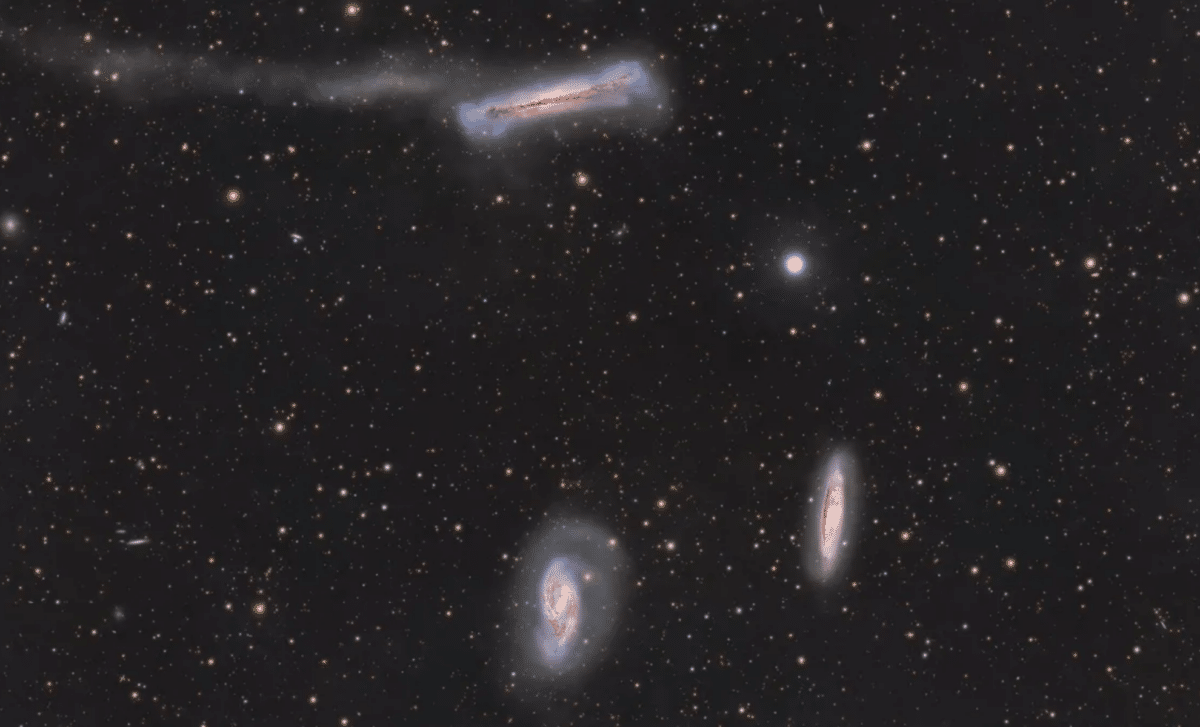
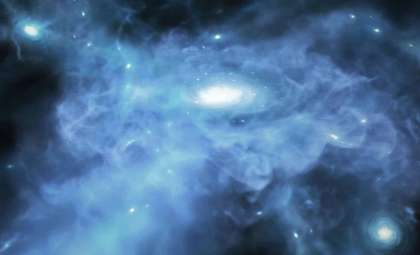
An extraordinary photograph showcasing the Leo Triplet Galaxies and hundreds of distant galaxies has been taken from a quiet village in the Netherlands. Astrophotographer Cornelis Van Zuilen amassed over 60 hours of exposure to produce a breathtaking image spanning millions of light-years. NASA notes that obtaining such detailed depictions of galactic interactions is uncommon, especially when not using a major professional observatory.
Mastering Deep-Space Photography from a Modest Balcony
Van Zuilen’s dedication to capturing deep-space objects is evident through his careful approach and technical expertise. “At the end of 2024, I acquired my Askar 103APO Telescope, which provided sufficient focal length to seriously target galaxies and embark on photographing the entire Messier Catalogue,” he shared with Space.com. This telescope, used alongside a ZWO ASI533MC Pro Camera, enabled Van Zuilen to capture fine galactic details from his tranquil home base in Heiloo. The images reveal intricate features in spiral arms and galactic centers, rivaling clarity typically achieved only by advanced observatories.
Regarding his renewed focus on the Leo Triplet following an earlier project in 2025, Van Zuilen commented:

“After finishing my first image of the Leo Triplet in 2025, I really wanted to see the gigantic tidal tail of NGC 3628 and decided to return with a much more ambitious goal.”
The tidal tail, a long stream of stars and galactic debris extending hundreds of thousands of light-years, offers a vivid indication of gravitational forces molding galaxies over vast timescales, providing a unique perspective on cosmic dynamics.
Meticulous Observations Across 18 Clear Nights
The clarity and complexity of the photo stem from detailed planning and dedication. “Starting from April 6, I captured the Leo Triplet over 18 clear nights, gathering a total of 85 hours of data, with exactly 60 hours and 3 minutes meeting my quality criteria,” Van Zuilen explained. Each night involved precise alignment, calibration, and multiple exposures to detect the faint light of remote galaxies while minimizing atmospheric distortion and light pollution. The final combined image highlights the subtle structures of M65, M66, and NGC 3628, also known as the “Hamburger Galaxy” due to its distinctive dust lane.
Advanced image processing using PixInsight allowed Van Zuilen to merge and enhance the data, unveiling not only the main galactic trio but also hundreds of faint neighboring galaxies. This achievement grants astronomy enthusiasts remarkable detail previously accessible mainly through professional-grade telescopes.
Discovering Hundreds of Galaxies With Precision Software
The completed image is both stunning and scientifically informative. “By employing a PixInsight galaxy identification script, I pinpointed 548 cataloged galaxies within the frame, underscoring the astounding depth achieved with 60 hours of observation from my Heiloo balcony,” Van Zuilen stated. This extensive field reveals the dense population of galaxies in the Leo Constellation and sheds light on the gravitational interactions sculpting NGC 3628’s tidal tail, topics researched by NASA and the National Science Foundation.
This work demonstrates how dedicated amateur astrophotographers can contribute valuable insights to astronomy. Van Zuilen expressed his enthusiasm: “I hope viewers appreciate this final image as much as I do!” The project motivates both professionals and hobbyists to explore new possibilities from unconventional locations.
Tools and Techniques Behind the Stunning Celestial Image
The project’s success relied on an effective combination of superior optics, sensitive imaging equipment, and specialized processing software. The Askar 103APO Telescope provided the necessary focal length and sharpness for resolving distant galaxies, while the ZWO ASI533MC Pro Camera delivered excellent sensitivity and low noise essential for capturing faint light. Accumulating exposure time across many nights enabled detection of subtle details invisible in shorter sessions, showcasing the power of patient, systematic astrophotography.
This impressive accomplishment emphasizes that with dedication and the appropriate gear, remarkable astronomical discoveries can be made outside major institutions. It also serves as inspiration to aspiring astronomers combining scientific zeal with artistic passion to explore space.
- Categories:
- News





0 comments
Sign in to Comment