
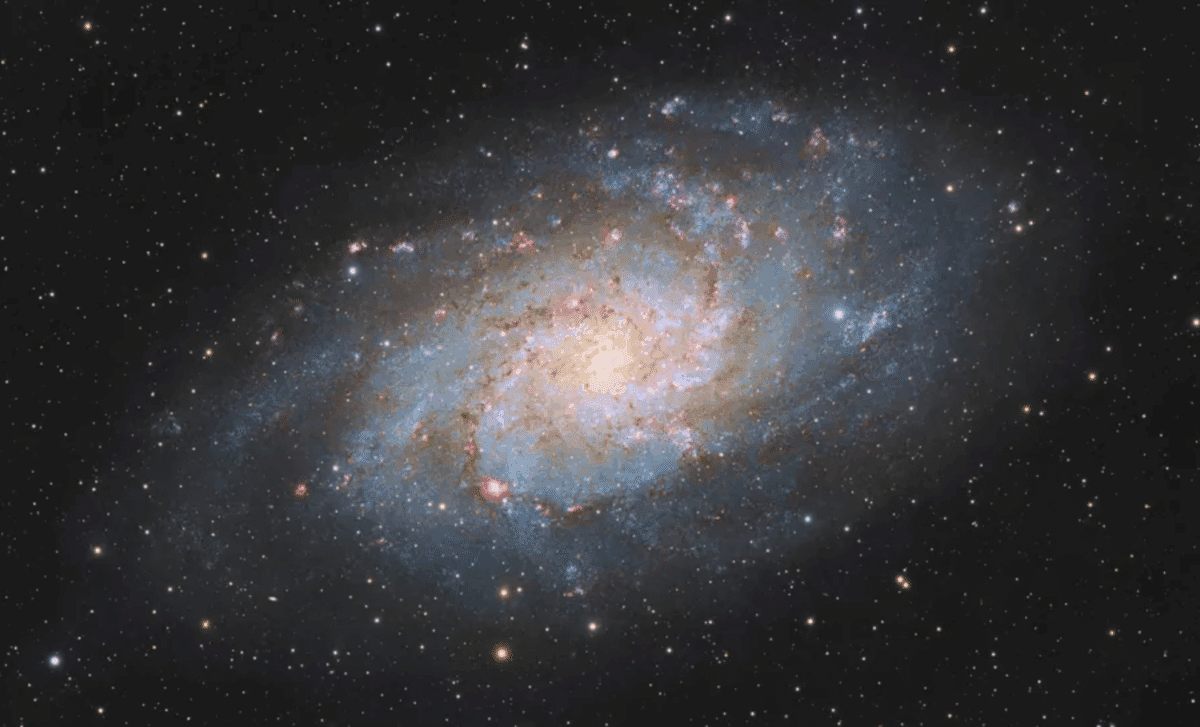
Astrophotography presents a stunning glimpse into the vast cosmos, revealing celestial wonders often invisible to casual observers. Recently, astrophotographer Ronald Brecher focused his camera on the Triangulum Galaxy, located approximately three million light-years from Earth. This spiral galaxy, vibrant with newborn stars, is beautifully captured in Brecher’s latest shot, offering both aesthetic appeal and scientific insight into its intense star formation activity.
Exploring the Triangulum Galaxy Through Advanced Imaging
Known as M33, the Triangulum Galaxy captivates astronomers due to its exceptional rate of star production—far outpacing its neighbor, the Andromeda Galaxy, by producing stars roughly ten times faster. Unlike many spiral galaxies, M33 lacks a prominent central bulge, presenting instead a more dispersed and open structure. Some researchers believe this unique formation points to the possible absence of a supermassive black hole at its core.
For Ronald Brecher, this captivating galaxy served as the perfect test subject for his latest astrophotography gear.

“This is one of my favourite galaxies for testing new equipment,” Brecher shared with Space.com. “For this image, everything was very new — scope, mount, camera, focuser, rotator, flat panel, guide scope and guide camera. Even the PC controlling the equipment was new. After a little bit of tweaking, I’d say everything is performing very well!”
Understanding M33’s Vigorous Star Formation
The spectacular new star creation in the Triangulum Galaxy isn’t just a visual marvel—it holds valuable clues to galactic development phases. With a star formation rate considerably higher than that of the Milky Way, M33 appears to be in a dynamic evolutionary stage. This intensified activity is likely influenced by factors such as interactions with nearby galaxies, abundant interstellar gas, and a relatively weak gravitational field.
Scientists remain curious about what precise conditions fuel such prolific starbirth. How does the distinct galactic form of M33 play into this process? Decoding these mechanisms can shed light on how galaxies mature, especially those experiencing accelerated star formation compared to our own.
Forecasting the Evolution of the Triangulum Galaxy
The radiant display of new stars in the Triangulum Galaxy hints at a vibrant present, but its future involves some cosmic uncertainties. A key question is whether M33 might eventually collide with the Milky Way. Such a collision, propelled by colossal gravitational forces, would significantly alter both galaxies. However, this event—if it happens—is still many millions of years ahead, allowing astronomers ample opportunity for observation and study.
Brecher’s photograph offers a unique personal perspective, highlighting M33's grandeur through the lens of a dedicated astrophotographer pushing the limits of space imaging. His contributions not only enhance scientific knowledge but also inspire others to explore the universe’s stunning mysteries.
Innovations in Gear and Methods
Success in astrophotography depends on skillful techniques and cutting-edge instruments. Brecher utilized a Sky-Watcher Esprit 120 refractor telescope paired with an astronomer camera to collect the faint light of M33. Over several months, from mid-August to late October 2023, he observed the galaxy under the clear skies of Ontario. The final image reflects a meticulous process, with 24 hours dedicated to capturing and refining the cosmic light.
All of Brecher’s equipment was freshly acquired, demonstrating the rapid progress in astrophotographic technology. As these tools improve, the ability to capture ever more detailed images of the cosmos will continue to expand.
- Categories:
- News


0 comments
Sign in to Comment