
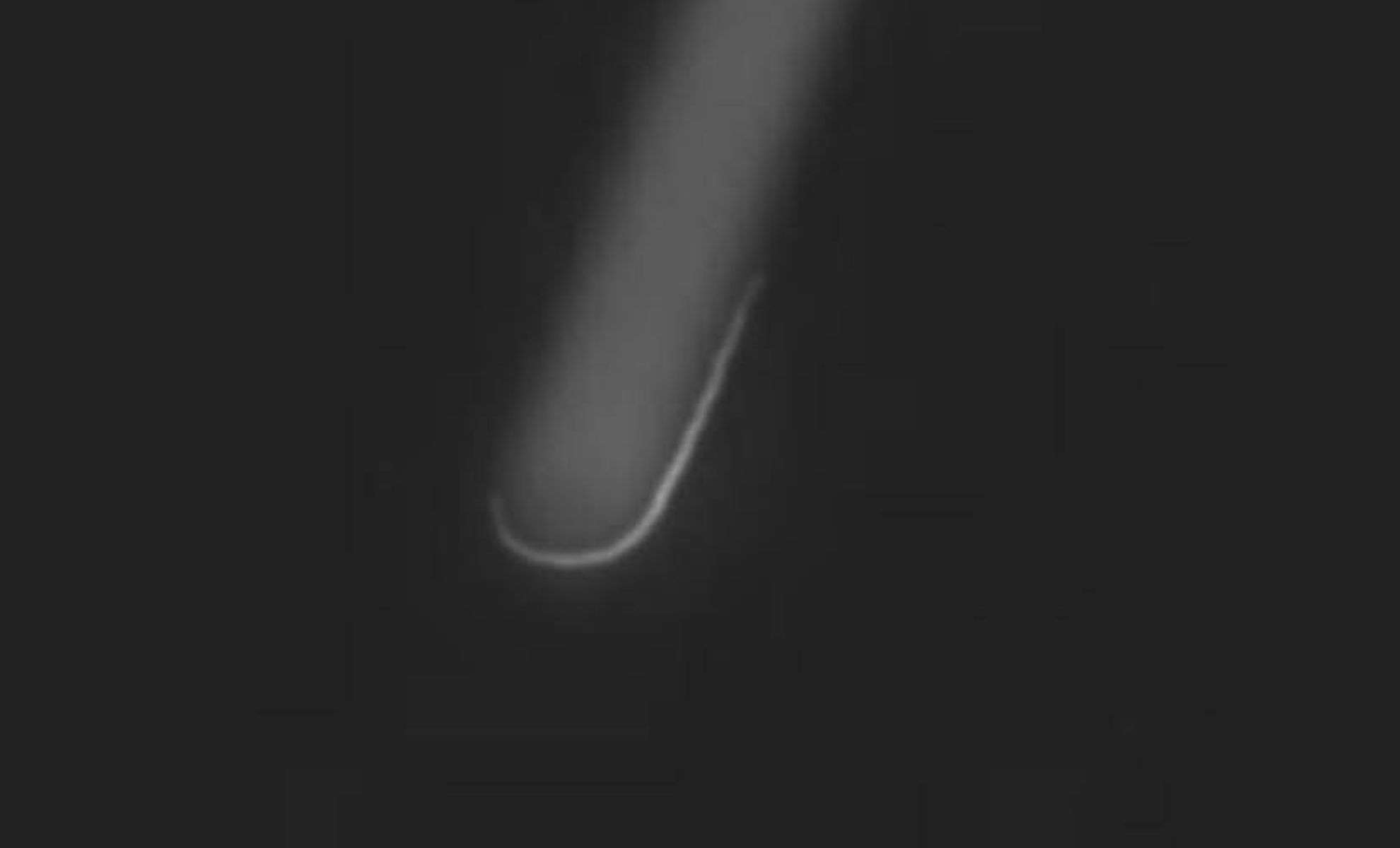
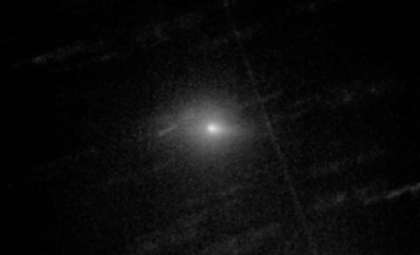
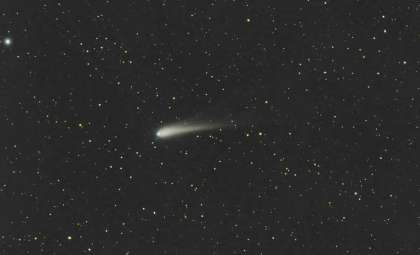
In July 2025, the Earth-impact warning telescope network known as the Asteroid Terrestrial-impact Last Alert System (ATLAS) made a remarkable detection. It spotted an object speeding through our solar system on an escape path, labeled 3I/ATLAS. This visitor is the third interstellar object identified, after ʻOumuamua in 2017 and 2I/Borisov in 2019.
Although the consensus among scientists is that 3I/ATLAS is most likely a natural comet, Harvard astrophysicist Avi Loeb has reignited discussion by suggesting the object might be an extraterrestrial probe.
Natural Comet or Hidden Interstellar Device?
Loeb and his collaborators have noted intriguing aspects of 3I/ATLAS that challenge conventional interpretations. In a recent paper, Loeb explores the possibility—drawing on the “Dark Forest” hypothesis from Liu Cixin’s science fiction—which posits that civilizations might preemptively eliminate others to ensure their own survival.

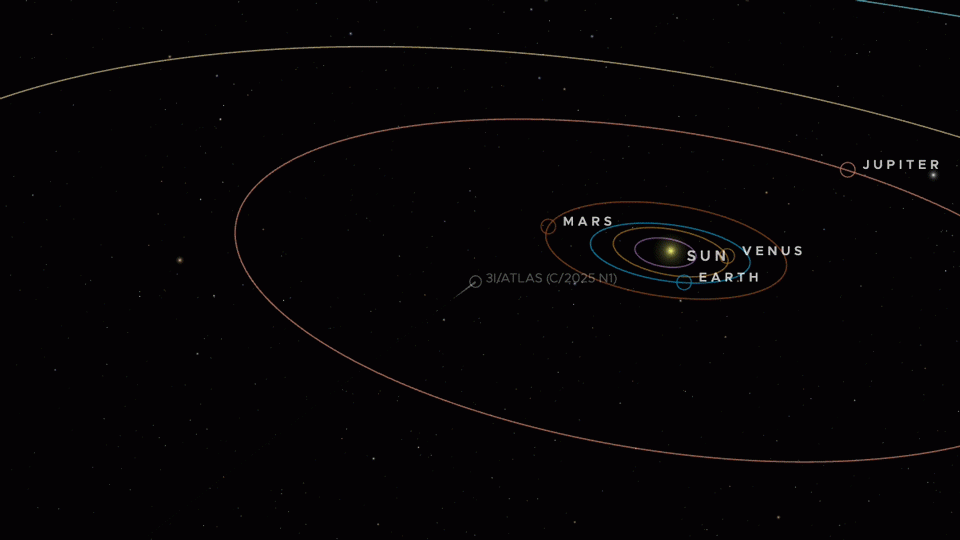
Highlighting 3I/ATLAS’s retrograde orbital orientation close to the ecliptic plane, the team argues this path grants advantages for an extraterrestrial intelligence attempting an Earth approach. They also propose that the object could execute a complex reverse Solar Oberth maneuver, leveraging the Sun’s gravity to decelerate and potentially enable rendezvous with planets like Jupiter or even Earth later in the year.
Though speculative, Loeb insists that extraordinary possibilities deserve study: “Extraordinary claims require extraordinary evidence,” he states, adding that even extraordinary risks warrant scientific attention.
SETI’s Perspective: Prioritizing Scientific Evidence
The broader scientific community remains cautious about Loeb’s alien probe suggestion. In a new preprint on the Earth ArXiv platform, SETI researcher A.K.M. Eahsanul Haque critically examines the data, challenging claims that 3I/ATLAS is artificial.
Haque emphasizes that the object’s orbital plane alignment with the solar ecliptic, considered rare by Loeb, is actually consistent with the galactic disk's orientation, where most stars reside.
“The galactic disk, which is where most stars are, is nearly in line with the solar system’s ecliptic plane.”
He further notes that the object's hyperbolic path, with an eccentricity around 6.1 and velocity near 58 km/s, aligns well with expectations for natural debris expelled from another stellar system. These traits closely mirror prior interstellar objects like ʻOumuamua and 2I/Borisov.
Regarding possible artificial propulsion or unexpected movements, Haque finds no evidence of non-gravitational acceleration in 3I/ATLAS’s trajectory. Unlike ʻOumuamua’s subtle path changes likely due to outgassing, 3I/ATLAS follows a predictable course, reinforcing the natural comet hypothesis favored by many astronomers.
Evaluating the Alien Probe Hypothesis
Loeb has also pointed to the detection of nickel without iron in 3I/ATLAS as a potential clue to an artificial nature, but SETI’s Haque argues that its elemental composition is consistent with natural interstellar materials.
Haque contests Loeb’s suggestion that planetary gravitational interactions might significantly influence the object's path, estimating a slim 0.005% likelihood that 3I/ATLAS encounters planets like Venus, Mars, or Jupiter closely. Other experts, including NASA’s Tom Statler, concur that the object's behavior closely resembles that of a typical comet despite some unique features.
Nonetheless, Loeb estimates a 30-40% chance that 3I/ATLAS is not purely natural, suggesting the possibility becomes stronger if the object exceeds five kilometers in size. Despite the debate, the majority of astronomers emphasize the scientific value of 3I/ATLAS, viewing it as an unparalleled chance to investigate a possible 10-billion-year-old remnant originating from a distant star system as it approaches our Sun.
- Categories:
- Space






0 comments
Sign in to Comment