
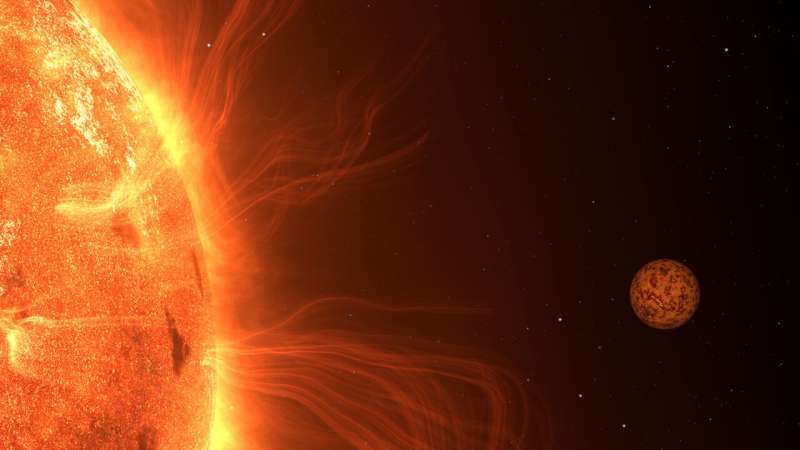
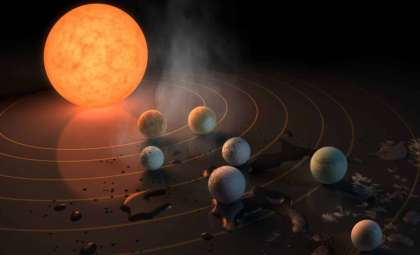
Situated about 40 light-years away, TRAPPIST-1 b belongs to an extraordinary planetary family orbiting a cool red dwarf star. This system fascinates researchers because it contains seven Earth-sized planets, three of which lie within the star's habitable zone.
Recent observations conducted with the James Webb Space Telescope (JWST) have unveiled compelling evidence suggesting that TRAPPIST-1 b may harbor an atmosphere. These results challenge previous assumptions and open fresh pathways for investigating exoplanet atmospheres.
Detecting atmospheres on distant planets is crucial for expanding our understanding in the search for life beyond Earth and identifying environmental conditions that might support extraterrestrial existence.

An actively resurfacing volcanic planet
One groundbreaking discovery about TRAPPIST-1 b is its surprisingly young surface. Scientists estimate that the planet's surface rocks are at most 1,000 years old, a finding that contrasts sharply with the planet’s evolutionary timeline of billions of years. Such youthfulness indicates vigorous geological phenomena, potentially fueled by:
- Powerful volcanic activity
- Ongoing plate tectonics
- Tidal forces from neighboring worlds and the host star
- Magnetic induction heating linked to the star’s magnetic field
These geodynamic forces might be continually reshaping the surface while also replenishing any existing atmosphere with volcanic gases, sustaining a dynamic planetary environment.
Unraveling the atmospheric enigma: carbon dioxide and haze
Initial data had cast doubt on the presence of an atmosphere. However, more in-depth analyses suggest that TRAPPIST-1 b could be enveloped by a dense carbon dioxide atmosphere hidden beneath a hydrocarbon haze, reminiscent of the smog shrouding Saturn’s moon Titan.
This atmospheric composition could clarify puzzling infrared patterns detected by JWST. Hydrocarbon hazes at upper atmospheric levels may cause a temperature inversion—where warmer layers lie above cooler ones—concealing typical carbon dioxide signatures.
Overcoming obstacles in studying exoplanet climates
The TRAPPIST-1 b case underscores the challenges of probing exoplanet atmospheres, even with state-of-the-art tools like JWST. Thin atmospheres on rocky planets generate subtle signals, while the variable nature of the red dwarf host complicates measurements.
To improve detection, researchers are applying advanced techniques such as:
- Monitoring secondary eclipses
- Analyzing phase curves
- Integrating data across multiple wavelengths
These approaches help build a detailed understanding of atmospheric composition and thermal dynamics as the planet orbits its star.
Studying TRAPPIST-1 b and its planets offers more than just atmospheric insights—it contributes to the broader quest of discovering life’s potential elsewhere. By refining observational methods and collecting richer datasets, scientists move closer to addressing the profound question of whether life exists beyond our solar system. This endeavor aligns with efforts to detect signs of life within our cosmic vicinity, spanning distant worlds and nearby celestial bodies.
Ongoing research continues to reshape our view of TRAPPIST-1 b, transforming it from a presumed barren rock to a planet possibly rich in atmosphere and geological vigor. This evolution in understanding highlights the value of persistent observation and the exciting potential for new discoveries in exoplanet science.
- Categories:
- Extraterrestrial life










0 comments
Sign in to Comment