

A small tremor detected underneath northern Utah in 1979 has revealed a surprising geological phenomenon. Recent studies indicate that this earthquake emerged from deep within the Earth’s upper mantle, a zone where seismic activity is traditionally considered impossible.
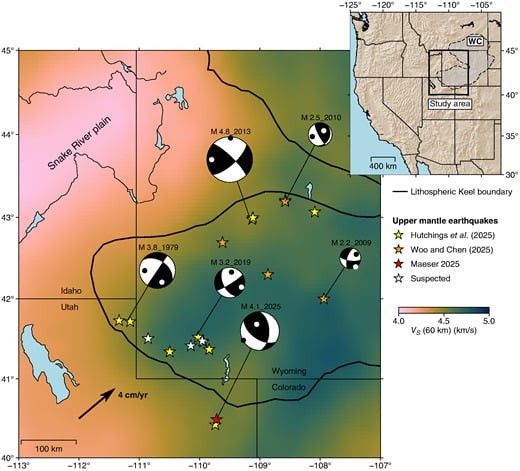
Though it registered a modest magnitude of 3.8, the earthquake’s depth was extraordinary. Data pointed to a source located over 55 miles beneath the surface, far below the Earth’s crust.
Debate persisted for years on whether such a great depth was accurate. Recent reevaluation of this event along with eight similar quakes has reinforced the theory that these incidents were genuine mantle earthquakes rather than errors in measurement.

Unraveling a Seismic Enigma From 1979
When the quake was initially recorded in northern Utah, its unusually deep origin captured scientists’ attention.
The quake’s location within the upper mantle—a layer beneath the crust—was unexpected, as continental earthquakes rarely occur there. Many geologists were skeptical of this result at the time. However, a study recently published in The Seismic Record highlights that George Zandt, then a seismologist at the University of Utah, confirmed the depth data despite widespread doubt.
“I did some other analysis that convinced me of the reality of the deep depth but it was hard to convince others of the highly anomalous mantle earthquake occurring in a region where none should exist,” Zandt said.
The scientific discussion continued for decades. Although the earthquake’s magnitude was modest, its extraordinary depth posed challenging questions.
Additional Deep Earthquakes Confirm the Phenomenon
The intrigue deepened when geology professor Keith Koper at the University of Utah and Zandt undertook a fresh study. Their research expanded beyond the 1979 quake to include eight other deep earthquakes detected in the same vicinity.
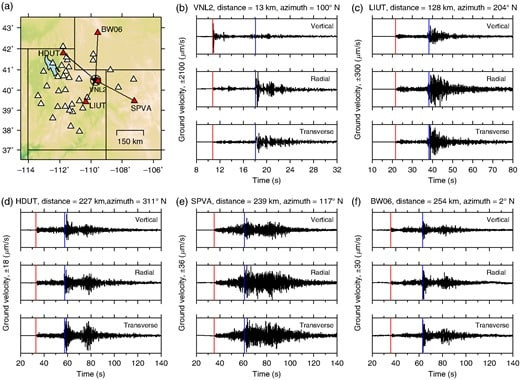
As detailed in The Seismic Record, the findings show all nine events originated inside the Earth’s upper mantle, well beneath the crust-mantle interface. The team classifies them as an “archetypal continental mantle event,” linked to gradual mantle dynamics over vast timescales.
This discovery contrasts sharply with typical shallow crustal earthquakes along fault lines. Notably, the deep mantle quakes lack foreshock and aftershock sequences, and their mechanisms remain poorly understood.
“It’s sort of a mystery in terms of fundamental physics,” Koper said. “How in the world can these things happen?”
Another significant unknown is the potential size these deep quakes may reach.
“Another reason why it’s a big deal is that we have no idea how big they can be,” he added. “With crustal earthquakes, we can measure what we think their maximum size is going to be.”
The Role of an Ancient Crustal Block
The investigation identifies a clustering of these quakes near the western margin of the Wyoming Craton, an ancient lithospheric block spanning northern Utah and southwestern Wyoming. This structure likely influences the unusual seismicity. Mantle temperatures around here can surpass 1,300 degrees Fahrenheit, generating conditions quite distinct from shallower zones.
The mantle slowly circulates around the craton over millions of years, creating redirected flows that accumulate stress.
“On the scale of millions of years, the mantle is hitting the craton and then flowing around it,” Koper explained. “It’s that interaction where that mantle flow is being diverted around this hard cratonic root that’s causing the increased strain rate, the increased deformation and it’s also creating extra stresses.”
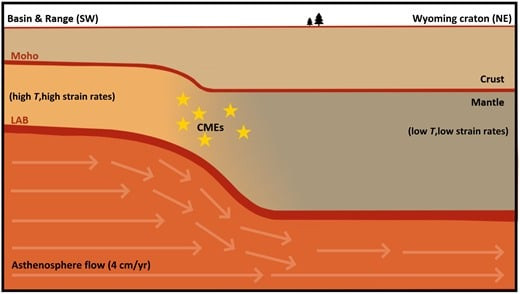
Koper likened this mechanism to an iceberg moving through a fluid medium, with the craton acting as an obstruction to the progressing mantle.
“We think it’s that interaction between the keel of the iceberg and the medium around it that’s leading to these earthquakes,” he said.
While this new analysis doesn’t fully resolve the deep earthquake puzzle, it establishes northern Utah as a hotspot for rare deep-seated seismic activity.
- Categories:
- Science






0 comments
Sign in to Comment