

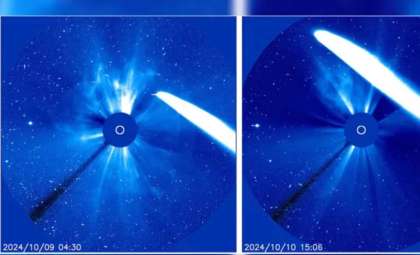
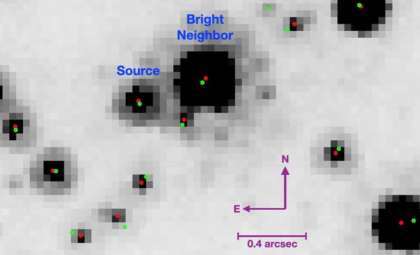
A remarkable celestial object has been detected racing across the solar system, sparking intrigue among astronomers. First observed on July 1, 2025, by teams monitoring asteroid threats, this luminous traveler has prompted curiosity about its origins. The European Space Agency has verified this newcomer, dubbed 3I/ATLAS, as the third known object arriving from beyond our solar neighborhood. Its size and velocity have already drawn significant attention from researchers worldwide.
Tracking Down 3I/ATLAS
Measuring approximately 20 kilometers (12 miles) wide, 3I/ATLAS dwarfs previous interstellar visitors like Oumuamua and Comet 2I/Borisov. Although it will not approach Earth closely, its remarkable brightness allows astronomers to study it from great distances, offering a rare chance to examine an object from another star system in detail.
While 3I/ATLAS will eventually exit the sun’s gravitational reach, its journey offers scientists insights into planetary formation mechanisms beyond our own system. Researchers are eager to unlock secrets about its composition and origin, hoping to broaden our understanding of the cosmos.

Distinct Traits of 3I/ATLAS
Unlike Oumuamua — which was unique due to its lack of a dusty tail and unexplained acceleration — or Borisov, identified clearly as a comet, 3I/ATLAS presents unusual features. Michigan State University astrophysicist Darryl Z. Seligman, actively researching this object, describes it as “exceptionally luminous” and “vastly larger” than the first interstellar visitor.
Notably, 3I/ATLAS was discovered at a much greater distance compared to earlier interstellar objects, yet its exceptional size and brightness enable extended observation periods.
This visitor’s speed also sets it apart. Moving faster than both Oumuamua and Borisov, 3I/ATLAS reinforces evidence of its origin beyond our solar system. Seligman recounts the initial surprise within the astronomical community: “When I woke up… my colleagues were saying things like ‘no, this is definitely interstellar. This is for real.’”
Confirming an Interstellar Path
What conclusively differentiates 3I/ATLAS from solar system objects is its trajectory. Objects arriving from outside our neighborhood follow hyperbolic orbits, which indicate they won’t return after passing through. Seligman explains that these open-ended, unbound paths confirm an object’s interstellar nature.
By tracking the object’s velocity, course, and location across the solar system, astronomers confirm 3I/ATLAS is traveling fast enough to break free from the Sun’s gravitational influence, cementing its status as an interstellar visitor.
Scientific Significance and Future Insights
The intriguing properties of 3I/ATLAS provide researchers with a unique window into untouched material originating far beyond our solar system. Objects like this are believed to be remnants from the earliest stages of planet formation around other stars. Seligman highlights the immense potential for knowledge, including chemical and structural information about these distant realms.
A crucial focus is determining whether 3I/ATLAS exhibits comet-like qualities. Similar to Borisov, if it harbors a visible tail, that would reveal the presence of ices and other volatile compounds. Such features would point to its formation in the cold outer reaches of its home system. The abundance of ice could imply that a massive planet, perhaps a gas giant similar to Jupiter or Neptune, ejected it into interstellar space.
- Categories:
- News









0 comments
Sign in to Comment