
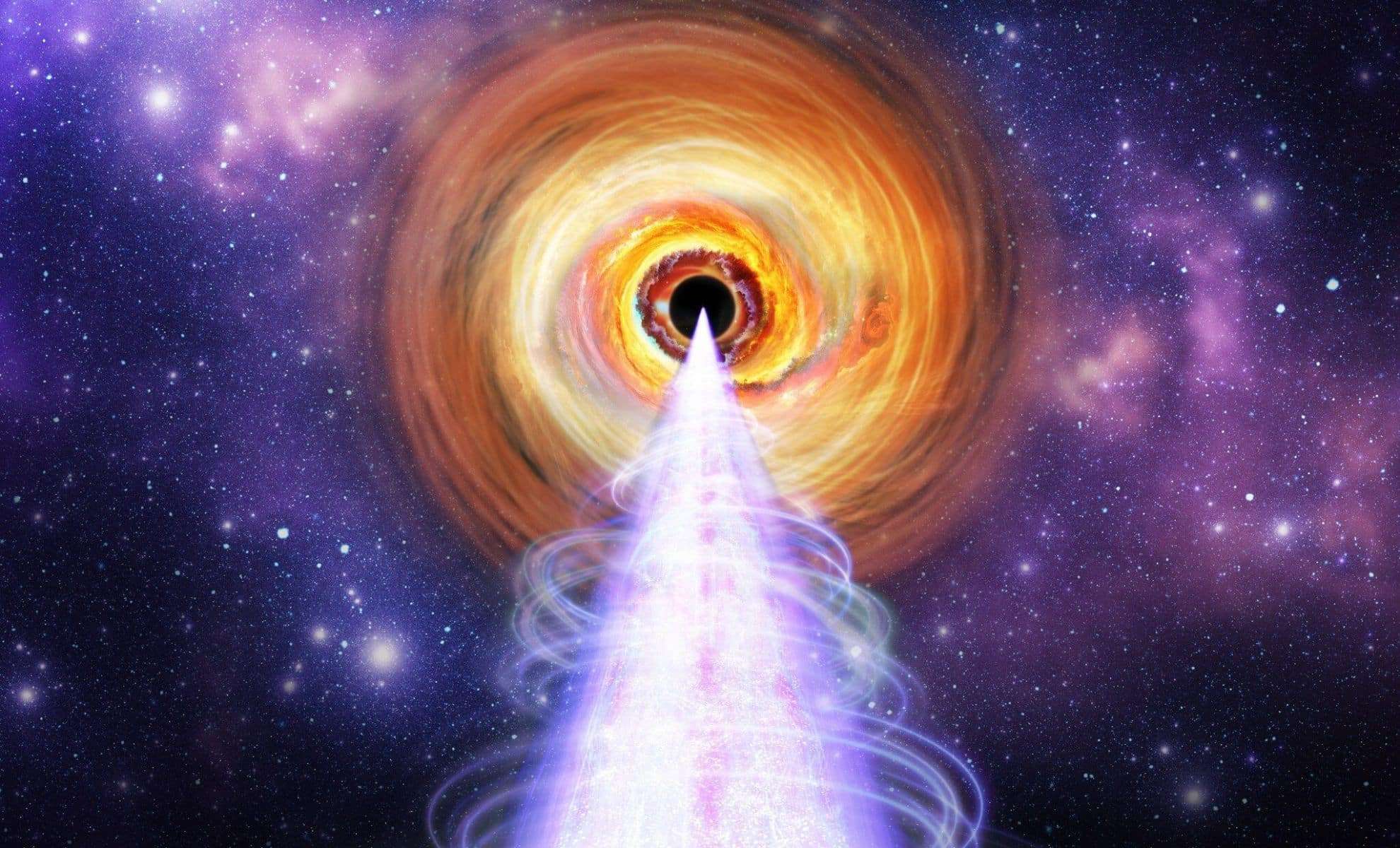
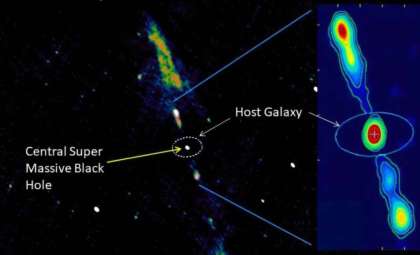
NASA’s Imaging X-ray Polarimetry Explorer (IXPE) has delivered groundbreaking insights into how X-rays originate near supermassive black holes. The findings, detailed in a paper on arXiv, advance our knowledge of high-energy processes in blazars such as BL Lacertae. The study reveals that it’s the electrons, rather than protons, that generate the X-ray emissions within these powerful jets.
Unraveling the Source of X-Rays in Black Hole Jets
The origin of X-rays from jets near supermassive black holes has been a subject of intense debate. The blazar BL Lacertae offered an exceptional opportunity to investigate this phenomenon. Researchers had considered two main possibilities: either protons or electrons were producing the X-rays, each scenario having distinct polarization fingerprints in the emitted radiation.
Lead researcher Iván Agudo noted, “This was one of the biggest mysteries about supermassive black hole jets, and IXPE, with the help of a number of supporting ground-based telescopes, finally provided us with the tools to solve it.”

IXPE’s capability to detect X-ray polarization enabled the team to track the interactions between electrons and photons, confirming that the process called Compton Scattering—where electrons scatter photons—is responsible for the X-ray production.
Revealing Results from IXPE’s Campaign
In November 2023, IXPE conducted a week-long observation of BL Lacertae, collaborating with radio and optical telescopes. During this observation, optical polarization soared to an unprecedented 47.5%, the highest in three decades. In contrast, the X-ray polarization peaked at only 7.6%, a striking disparity. This contrast in polarization levels strongly supports the conclusion that electron-photon interactions via Compton Scattering drive the X-ray emissions.
Steven Ehlert, IXPE’s project scientist, stated, “The fact that optical polarization was so much higher than in the X-rays can only be explained by Compton scattering.”
- Categories:
- News








0 comments
Sign in to Comment