
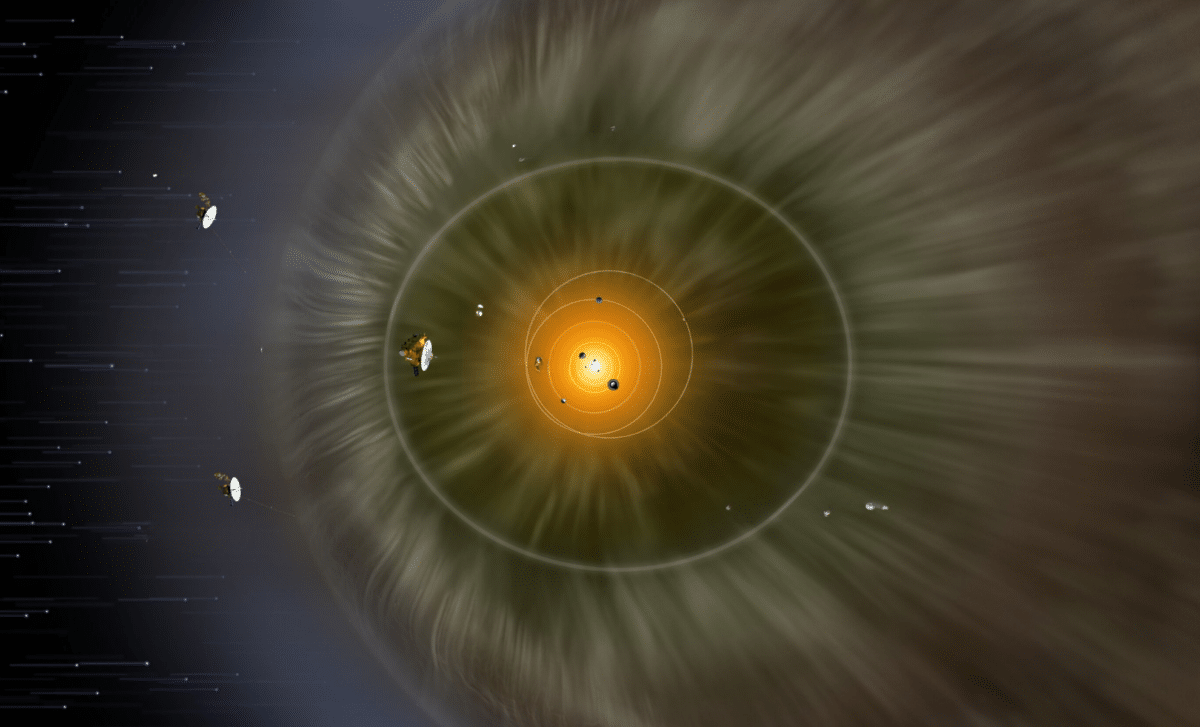
Recent predictive models are aiding astronomers in locating one of the most challenging regions in space: the outermost edge of the Sun’s expansive protective bubble. By merging solar wind forecasts with complex heliosphere simulations, experts are honing in on when NASA’s New Horizons spacecraft might reach the termination shock, a crucial divide marking the boundary between our solar system and the realm of interstellar space. These insights, detailed in Advances in Space Research and The Astrophysical Journal, could direct future missions pushing beyond our planetary neighborhood.
Tracking the Sun’s Outer Reach
Vast distances beyond the orbit of Pluto, conditions surrounding New Horizons grow increasingly alien. The craft is traversing a zone where the influence of the solar wind—a continuous outflow of charged particles emitted by the Sun—diminishes steadily. Ahead lies the termination shock, a boundary where the fast-moving solar wind abruptly slows down after interacting with interstellar material.
Scientists at the Southwest Research Institute (SwRI) utilize a blend of solar wind prediction techniques and detailed heliosphere modelling to estimate the current position of this boundary. The task is complex because the heliosphere is constantly shifting, expanding and contracting in response to the Sun’s fluctuating activity levels. During periods of heightened solar activity, vigorous solar winds push the heliosphere outward; during quieter times, it contracts, drawing the boundary back toward the Sun.

This variability makes locating the termination shock a moving target. Unlike fixed planetary orbits, the heliospheric boundary is dynamic, requiring researchers to forecast both solar output and heliospheric reaction. Incorporating actual solar wind measurements into simulations is enhancing predictions of where this hidden frontier may lie as New Horizons approaches.
Continuing the Path of the Voyager Probes
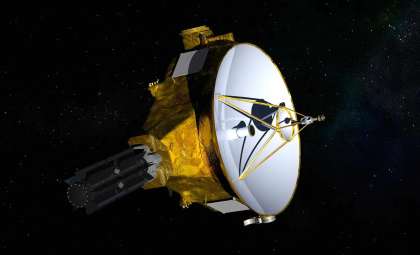
New Horizons has etched a remarkable legacy in space exploration. After capturing humanity’s first detailed images of Pluto in 2015 and visiting Kuiper Belt object Arrokoth, the spacecraft is venturing farther into the outer solar system. Its current course points it toward the front region of the heliosphere, making it a pivotal asset for examining the Sun’s distant sphere of influence.
Scientists are anticipating a unique chance to study a domain previously explored only by the Voyager 1 and Voyager 2 probes, which crossed key heliospheric boundaries into interstellar space. If New Horizons reaches this frontier, it could become the third human-made object to do so, collecting fresh data with advanced instruments in a new sector of the heliosphere.
This mission could deepen understanding of solar wind properties at vast distances, reveal the heliosphere’s interaction with the galactic environment, and track how energetic particles traverse these remote zones. Every discovery refines knowledge about the enormous plasma bubble that shields the solar system from much of the galaxy’s radiation.
Predicted Timeline for a Major Breakthrough Encounter
The newest research, featured in Advances in Space Research and The Astrophysical Journal, outlines a broad but valuable window for New Horizons to cross the termination shock. Depending on solar cycle variations and heliospheric shifts, the spacecraft might reach this landmark between the years 2029 and 2040.
“We want to understand when the spacecraft will reach the termination shock to prepare to take measurements and download data about this region,” said Dr. Jonathan Gasser, lead author of the two papers.
This forecast emphasizes the complexity of the heliosphere’s outermost layers, which behave like a pulsating boundary rather than a fixed shell. Because this region responds dynamically to solar conditions, pinpointing its exact location far in advance involves simulating many potential solar wind scenarios to estimate likely positions.
Multiple Crossings of the Termination Shock Could Occur
A compelling possibility revealed by the studies is that the boundary crossing may not be a single event. The heliosphere’s size fluctuates over time, causing the termination shock to move inward and outward. This suggests that New Horizons might cross the boundary multiple times during its journey.
“Our findings indicate the spacecraft could encounter the termination shock as early as 2029 or as late as 2040, with repeated crossings possible as the heliosphere expands and contracts,” the researchers explain.
Experiencing several transitions would grant scientists the rare chance to observe changes in this boundary under varying solar conditions. Comparing data across multiple passes would validate heliospheric models and enhance predictions about future shifts.
Such observations highlight the ever-changing nature of the solar system’s outer limits, revealing a boundary that more closely resembles a fluid, breathing interface shaped by ongoing solar and galactic interactions.
Implications for the Next Era of Deep Space Exploration
Deciphering the heliosphere’s structure and dynamics is vital not only for understanding the fate of a spacecraft but also for comprehending how cosmic radiation penetrates the solar system. The heliosphere’s shape and size influence the environment faced by missions traveling far from Earth.
Advances in predicting heliospheric boundaries will improve mission planning for distant exploration and clarify how our star interacts with the surrounding galaxy. The heliosphere’s true form remains under debate, with theories ranging from a comet-like tail to a croissant-shaped envelope. Data from New Horizons could help resolve this puzzle.
As it journeys into the far reaches beyond the known planets, New Horizons carries the potential to uncover where the Sun’s protective bubble wanes and where the vast galaxy begins. The coming decade may reveal whether it becomes the next spacecraft to cross a major cosmic frontier.
- Categories:
- Astronomy






0 comments
Sign in to Comment