
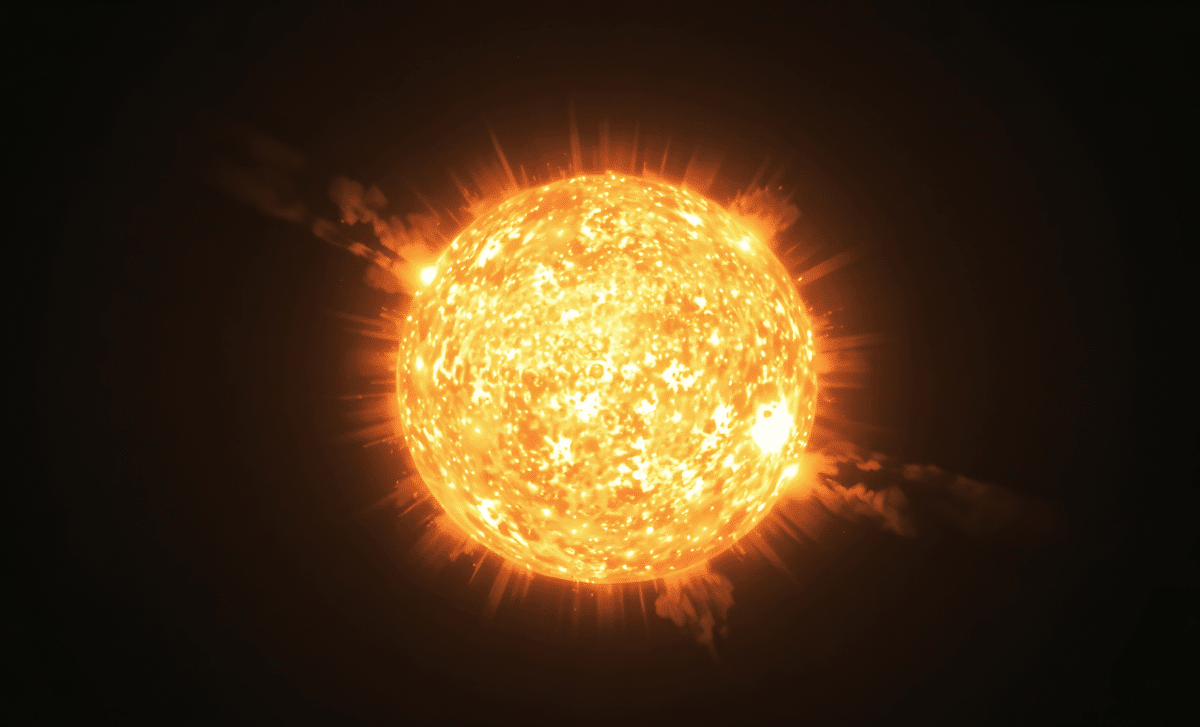
The Southwest Research Institute (SwRI) has shared pioneering insights from NASA’s PUNCH mission, offering an extraordinary, continuous perspective of the solar corona and solar wind with remarkable clarity. This accomplishment signifies a major advance in heliophysics, enabling researchers to better grasp how the Sun’s activity influences the entire solar system.
A Revolutionary Perspective on the Sun’s Outer Atmosphere
For the first time ever, scientists have captured the Sun’s corona and solar wind as a connected and dynamic entity, fulfilling a long-standing objective in solar research. The PUNCH (Polarimeter to Unify the Corona and Heliosphere) mission uses a coordinated fleet of four spacecraft to observe the delicate flow of solar particles spreading outward, shaping the magnetic environment that envelops our planets.
“PUNCH imaging gives us a unique view on the pageantry of the planets and reveals the grandeur of our sun in the cosmos,” said Dr. Craig DeForest, principal investigator of the PUNCH mission at Southwest Research Institute.
Add Cosmo Herald as a Preferred Source

The mission extends observations beyond the Sun, showcasing interactions between solar wind and planets, comets, and the Moon.
The collected images cover a vast range from the Sun’s inner corona to the far reaches of interplanetary space, forming the most extensive visual dataset to date. PUNCH’s sweeping imagery enables scientists to monitor coronal mass ejections (CMEs) as they travel, enhancing the ability to forecast space weather phenomena that could impact Earth’s technological systems and human explorers.
A Cosmic "Golden Fishbowl" Peering Into Our Solar Neighborhood
The advanced cameras onboard PUNCH have captured iconic-looking scenes that offer fresh insights into ongoing solar processes. “Watching solar events sweep past the Moon, planets, and comets brings into focus our place in the solar system. It’s reminiscent of the iconic Apollo-era blue marble image, but PUNCH provides more of a golden fishbowl perspective,” explained DeForest.
This “golden fishbowl” analogy highlights the mission’s immersive and continuous panorama. Unlike earlier instruments that focused on isolated solar regions, PUNCH delivers seamless cinematic views—tracking energized plasma clouds, following the path of solar storms through magnetic fields, and showcasing the complex motions within solar dynamics.
Advancing Space Weather Prediction
Besides providing stunning visuals, PUNCH’s discoveries have profound consequences for space weather forecasting. Powerful solar phenomena like coronal mass ejections race through the heliosphere and can disrupt communication networks, power grids, and spacecraft functioning.
“PUNCH can actually show us directly the violence of space weather as clouds of electrons cross the solar system,” DeForest noted. “Viewing the corona and solar wind as a single system provides a big-picture perspective essential to helping scientists better understand and predict space weather. This forecasting is critical to protecting astronauts, space satellites and electric grid technology from these events.”
By offering a comprehensive view, this mission tracks solar eruptions from their source to their distant impacts. The constant data flow from its four satellites allows near-instantaneous monitoring of solar disturbances, surpassing what traditional ground observatories could achieve.
Unexpected Discoveries: Comets and More
Though primarily centered on solar studies, PUNCH’s wide-ranging vision has unveiled surprising phenomena.
“The NASA Small Explorer’s mission had a bird’s-eye view of the CME in early November that lit up skies across the nation with colorful aurora,” DeForest said. “And we’ve discovered some incredible bonus science that PUNCH performs, tracking comets and other objects. We were able to track the third identified interstellar comet 3I/ATLAS as it traveled through the inner solar system while bright sunlight rendered it invisible to other telescopes and space assets.”
This capability highlights PUNCH’s adaptability, as it can detect faint, moving space objects obscured by the Sun’s brightness. Notably, observing interstellar comet 3I/ATLAS, which originates beyond our solar system, offers valuable information about material formed around other stars.
The Southwest Research Institute, which leads the mission’s design and management, notes that these findings broaden PUNCH’s scientific impact well beyond its initial goals. The mission could eventually contribute to mapping interplanetary dust, studying comet tails, and aiding the development of solar defense strategies to mitigate space weather threats.
- Categories:
- Space





0 comments
Sign in to Comment