
NASA is advancing the future of supersonic aviation with its cutting-edge X-59 jet, a streamlined aircraft crafted to surpass the speed of sound while eliminating the loud sonic boom. Recently, the agency completed key engine performance evaluations, bringing supersonic travel over land closer to reality in a way that won’t cause noise disruptions.
Transforming the Supersonic Experience
Supersonic jets have long struggled with the challenge of generating a sonic boom. When an aircraft travels faster than Mach 1 (around 767 mph or 1,234 km/h), it compresses air waves, producing a sharp sound capable of rattling windows and disturbing residents. This issue prompted the Federal Aviation Administration (FAA) to prohibit commercial supersonic flights over land in 1973, effectively halting civilian supersonic air travel.
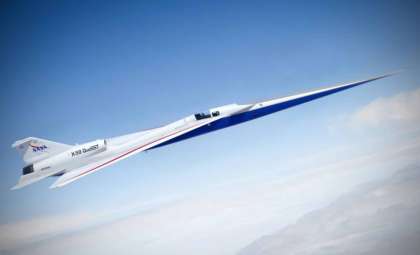
NASA’s X-59 aims to change these regulations. Designed in collaboration with Lockheed Martin, this next-generation jet is engineered to transform the sonic boom into a softer, less intrusive “sonic thump”—comparable to the sound made by a closing car door. This advancement could usher in a new age of ultra-fast air travel, significantly cutting journey times on international routes.

Engineering Quiet Supersonic Speed
The X-59 incorporates a distinctive design with functionality at its core. Its 99-foot-long body is notably slender, reducing the intensity of shockwaves during supersonic flight. Unlike traditional aircraft, its engine is positioned atop the fuselage, strategically reducing the noise footprint experienced by people on the ground.
NASA conducted extensive engine tests from October through February, pushing the X-59’s enhanced F414-GE-100 powerplant through a series of performance trials such as throttle responsiveness, afterburner operation, and cooling efficiency—all achieving successful results.
“The airflow remained consistent and stable, matching wind tunnel predictions. There were no issues with vibration or structural integrity, and all components requiring cooling were properly maintained,” stated Raymond Castner, propulsion lead at NASA’s Glenn Research Center.
A Glimpse Into Tomorrow’s Air Travel
Should the X-59 prove its quiet supersonic capabilities, NASA plans to present the findings to aviation authorities like the FAA and International Civil Aviation Organization (ICAO). This could lead to lifting the longstanding ban on commercial supersonic flights over land.
Such a shift would allow airlines to offer rapid passenger service, drastically reducing journey durations. Picture getting from New York to Los Angeles in less than two hours or traveling from London to Tokyo in only five. While the Concorde hinted at this potential before its retirement in 2003, noise, fuel efficiency, and cost limitations made it impractical. NASA’s X-59 intends to overcome these barriers.
Meanwhile, private industry is also making strides to revive commercial supersonic flights, with Boom Supersonic’s recent successful testing of the XB-1 demonstrator marking a notable achievement.
Next Steps for the X-59 Program
Although engine testing marks a vital progression, NASA still has tasks ahead before the X-59's maiden flight. These include conducting electromagnetic interference analyses, studying the aircraft's behavior during data system failures, and performing runway taxi evaluations.
Once airborne, the X-59 will fly at an altitude of 55,000 feet (16,764 m) at speeds reaching 925 mph (1,489 km/h). NASA intends to undertake an extended flight campaign over several communities to monitor reactions to the aircraft’s subtle sonic thump. This research, extending through 2027, is critical for validating the feasibility of quiet supersonic travel.
This article has been republished from gizmodo.com.
- Categories:
- Aircraft






0 comments
Sign in to Comment