
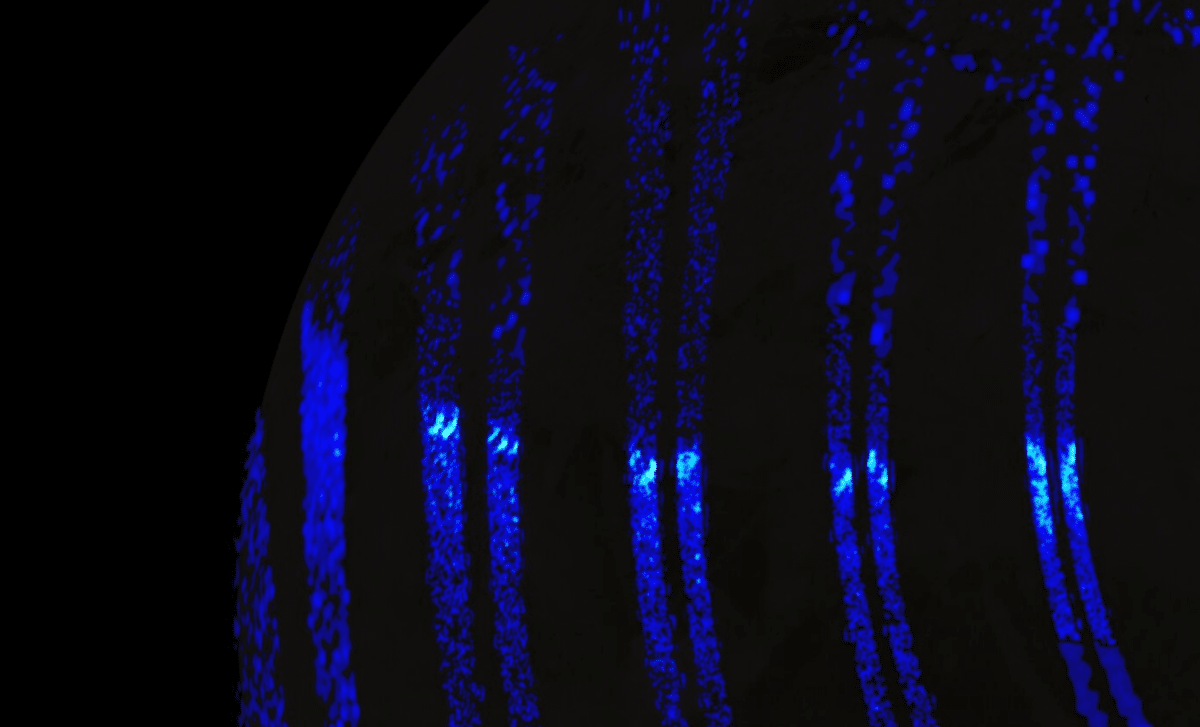
A team of scientists has uncovered fascinating new information about the auroras on Ganymede, the largest moon orbiting Jupiter. Led by researchers at the University of Liège, this study reveals remarkable parallels between Ganymede's auroras and those found on Earth, offering vital clues about the underlying mechanisms that generate auroras throughout the solar system. Utilizing high-definition data from NASA's Juno spacecraft, which conducted a flyby of Ganymede in 2021, the researchers detailed the auroras and investigated their causes. Despite differing atmospheric environments, the research suggests that the core auroral physics are surprisingly consistent across various planetary bodies.
Understanding Auroras: The Interaction of Magnetic Fields and Solar Wind
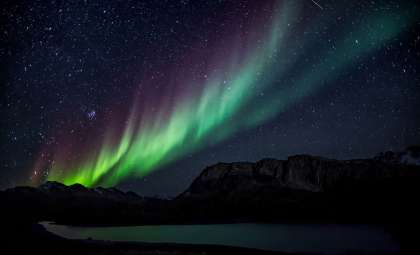
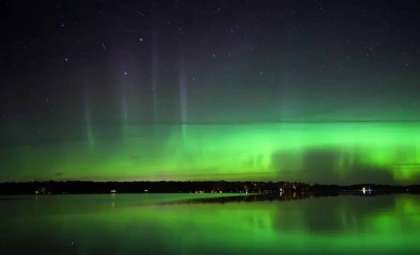
Auroras are dazzling displays of light often visible near Earth’s poles, caused when a planet’s magnetic field interacts with charged particles streaming from the sun, known as the solar wind. On Earth, these spectacular lights occur as solar particles collide with the atmosphere, exciting molecules like oxygen and nitrogen and producing vibrant glows. These effects predominantly happen at the magnetic poles where Earth's magnetic lines guide particles into the atmosphere.
The recent discoveries about Ganymede’s auroras indicate that the essential physical processes behind these phenomena are shared beyond Earth.

“Auroras are also observed on Ganymede and are caused by the precipitation of electrons in its thin oxygen atmosphere,” explains Philippe Gusbin, whose master’s thesis in Space Sciences formed the foundation for this study.
Unlike Earth, however, Ganymede’s tenuous atmosphere presents a distinct context for aurora formation, significantly influenced by its interaction with Jupiter’s immense magnetosphere.
Juno’s Detailed Capture of Ganymede’s Aurora
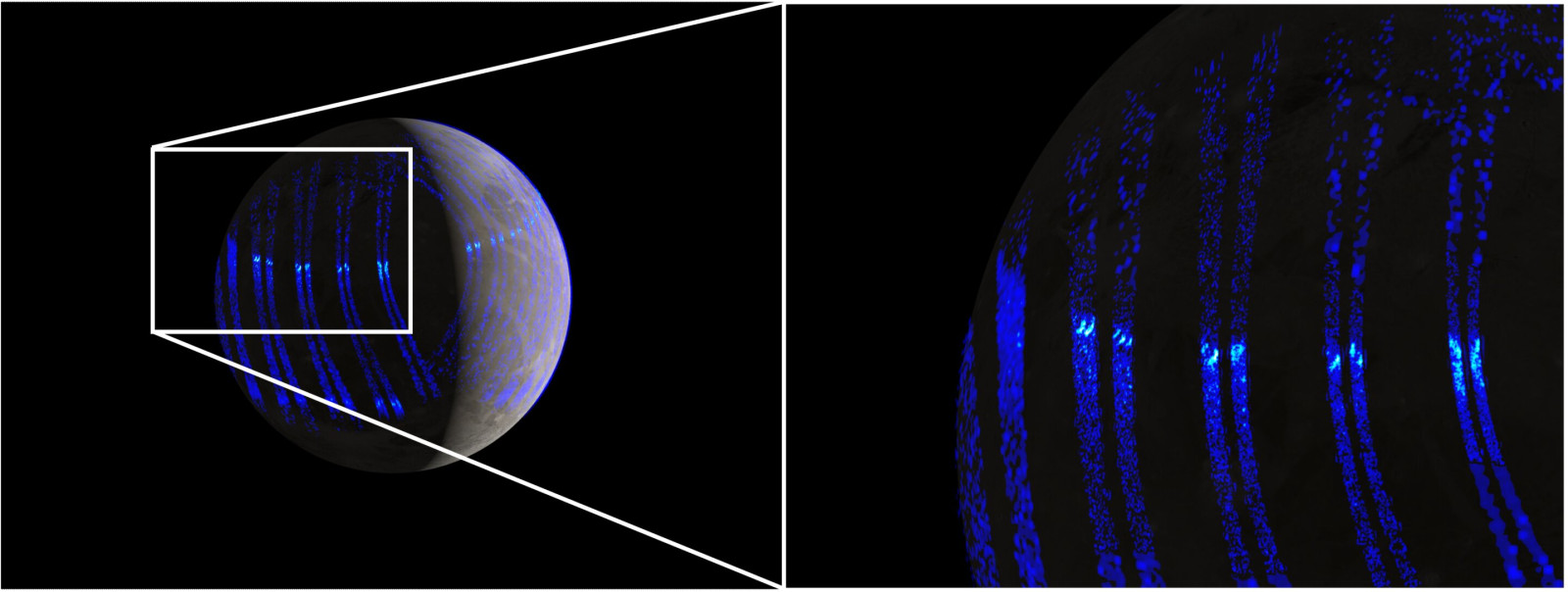
Prior to data from the Juno mission, observations of Ganymede’s auroras were limited and lacked fine detail, as terrestrial telescopes could not resolve small-scale structures. Juno’s ultraviolet spectrograph delivered groundbreaking high-resolution images, unveiling the auroras' complex features like never before.
“Observations of Ganymede’s auroras prior to Juno were limited by the spatial resolution of ground-based observations, and they could not resolve the small-scale structures typical of planetary auroras,” Gusbin notes.
This level of detail revealed that Ganymede’s auroras do not appear as uniform curtains but rather as fragmented patches. This segmented pattern echoes auroral displays seen on Earth and Jupiter, providing important clues to the auroral dynamics shaped by magnetic environments across the solar system.
Auroras Beyond Ganymede: A Common Cosmic Display
Ganymede is not alone in showcasing auroras; planets such as Venus, Mars, Jupiter, Saturn, and Uranus also produce these luminous phenomena, with differing formation processes. Jupiter’s auroras stand out due to the planet’s vast magnetosphere and intense solar wind activity. Venus and Mars exhibit auroras absent global magnetic fields, resulting in unique auroral behaviors. Ganymede is particularly notable as the only moon known to possess a self-generated magnetic field akin to Earth’s.
The findings, published in Astronomy & Astrophysics, reinforce the idea that auroral mechanisms share fundamental similarities across diverse environments, enriching our understanding of space weather’s influence on various celestial bodies.
Distinctive Auroral Features: Beads and Patches
High-resolution imagery of Ganymede’s auroras uncovered small, bead-like luminous patches embedded within the display. As Alessandro Moirano, post-doctoral researcher at the University of Liège, explains, “Similar structures, known as ‘beads,’ have been observed in the auroras of Earth and Jupiter, where they are linked to sub-storms and dawn storms, large-scale rearrangements of the magnetosphere that release enormous amounts of energy and produce intense auroral activity.” These localized light bursts correspond to magnetic disturbances, mirroring intensified auroras during geomagnetic storms on Earth.
These observations hint that auroral phenomena, despite varying planetary environments, arise from shared magnetic and energetic processes. This insight advances our knowledge of auroras on other worlds and informs models of space weather impacts throughout the solar system.
Looking Ahead: The Future of Studying Ganymede’s Aurora
Although Juno’s flyby yielded invaluable data about Ganymede’s auroral activity, the brief encounter—spanning less than 15 minutes—limited long-term understanding of these phenomena. Since Juno will not revisit Ganymede, many questions remain unanswered.
“Juno’s close observations of Ganymede lasted less than 15 minutes, and the spacecraft will never fly over Ganymede again. Therefore, we do not know how common these patches are or how they evolve over time,” says Bertrand Bonfond, an astrophysicist involved in the study.
Looking forward, the upcoming ESA’s Juice (Jupiter Icy Moons Explorer) mission, expected to reach Ganymede in 2031, promises extended scrutiny of the moon’s auroras with an ultraviolet spectrograph similar to Juno’s. Juice aims to monitor auroral variations over time, potentially unlocking new insights into Ganymede’s magnetic interactions and auroral behavior for the first comprehensive study of this captivating moon.
- Categories:
- Astronomy







0 comments
Sign in to Comment