

NASA’s Perseverance rover has revealed the strongest evidence yet of a long-lost shoreline on Mars. Located in the Jezero crater, this discovery includes wave-shaped rocks and signs of underground water alteration, extending the period during which conditions favorable to life might have existed on the Red Planet.
Researchers from Imperial College London led the investigation into a region called the Margin unit, which exhibits clear geological features indicative of both subsurface water interactions and shoreline-related formations. This suggests that Mars’s environment was likely wetter and more sustained over time than earlier believed.
A Landscape Formed by Both Volcanism and Water
Before this analysis, the origin of the Margin unit was debated—whether it was lake sediment accumulation or volcanic rock later modified by water activity. The study published in the Journal of Geophysical Research: Planets uses high-resolution imagery from Perseverance to confirm that both descriptions apply.

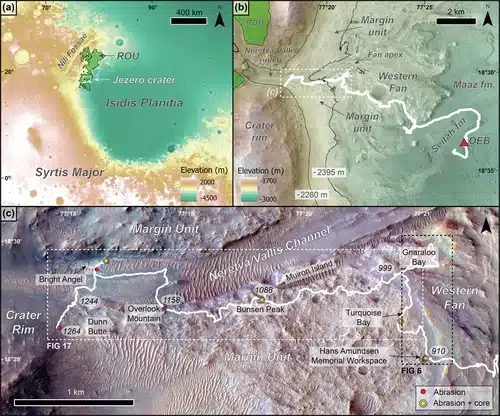
The rock formation likely originated as igneous material, possibly stemming from a magma chamber or lava lake beneath Jezero. Over time, underground water rich in carbon dioxide chemically transformed olivine minerals into iron- and magnesium-enriched carbonates.
“This transformation… indicates that water circulated below the surface of the Margin unit, altering the rock over vast timescales,” said Professor Sanjeev Gupta of Imperial’s Department of Earth Science and Engineering.
These mineral changes are comparable to Earth’s hydrothermal systems, renowned for supporting microbial ecosystems, making these Martian sites promising for finding ancient signs of life.
Definitive Evidence of an Ancient Martian Beach
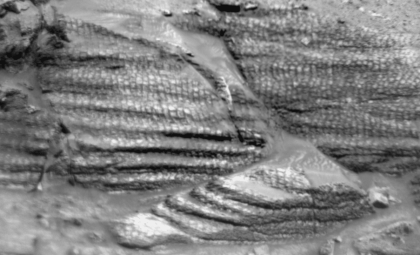
In the lower sections of the Margin unit, scientists identified layered sandstone containing smooth grains of olivine and carbonate minerals, which match the characteristics of deposits shaped by wave dynamics at shorelines. “We are observing what used to be a beach,” commented Alex Jones, Ph.D. candidate and principal author. Jones explained that wave activity from Jezero’s ancient lake wore down volcanic rock fragments, rounding them and depositing sandy layers.
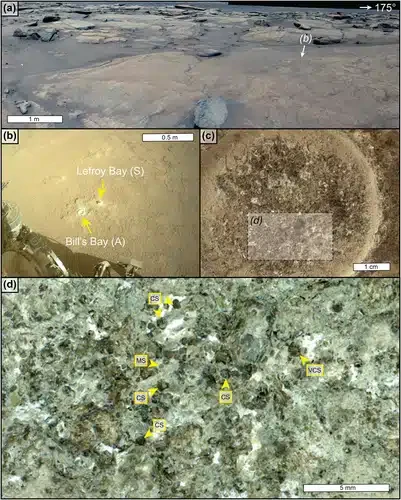
The ancient beach’s location underneath delta deposits, formed by a prehistoric river, indicates stable and calm lake environments at Jezero existed even before the delta's formation, expanding our understanding of when habitable settings appeared on Mars.
Jezero’s Evolving Lake History
This work complements earlier research from the same team that identified evidence of a younger lake blocked by natural dams near Jezero. The Bright Angel formation contained mudstone strata reflecting long-duration water coverage in parts of the valley.
Together, these studies reveal a more complex picture of Mars’s water history, highlighting repeated and extended episodes of surface and subsurface water presence. As Jones noted:
“Jezero crater continues to prove it is the ideal place to investigate past habitability on Mars, and to help answer the question of whether life ever emerged.”
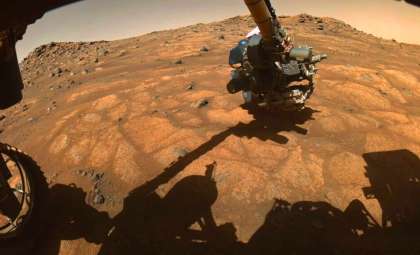
Perseverance has gathered three core samples from the Margin unit and one from Bright Angel, all preserved for NASA’s forthcoming Mars Sample Return mission. These samples may unlock key evidence about volcanic history, climate conditions, and possible ancient microbial life on Mars.
- Categories:
- Space









0 comments
Sign in to Comment