

Researchers have documented an exceptional gamma-ray eruption from the far-off blazar TXS 2013+370, shedding fresh light on the behavior of jets in active galactic nuclei.
Captured in February 2021, this phenomenon offered a unique chance for high-resolution multi-frequency VLBI polarimetric observations.
The observation campaign covered frequencies of 22, 43, and 86 GHz, marking the inaugural multi-band detailed study of this source. Findings released on November 19 via an arXiv preprint provide groundbreaking perspectives on the magnetic field configurations and variability influences in blazars.
Tracking the Blazar’s Outburst: Pioneering Multi-Frequency VLBI Polarimetry of TXS 2013+370
A spectacular gamma-ray burst from TXS 2013+370 allowed astronomers unprecedented insight into one of the cosmos’ most powerful high-energy sources. Utilizing Very Long Baseline Interferometry (VLBI), scientists simultaneously monitored the blazar at 22, 43, and 86 GHz, achieving angular resolutions near 0.1 milliarcseconds. This multi-frequency measurement represents the most comprehensive analysis of this blazar to date.

“Our study features polarimetric VLBI observations of TXS 2013+370 at 22, 43, and 86 GHz during a remarkable GeV flare on February 11, 2021, reaching angular resolutions approaching ∼0.1 mas. This is the first multi-frequency polarimetric VLBI examination of this target,” the team detailed.
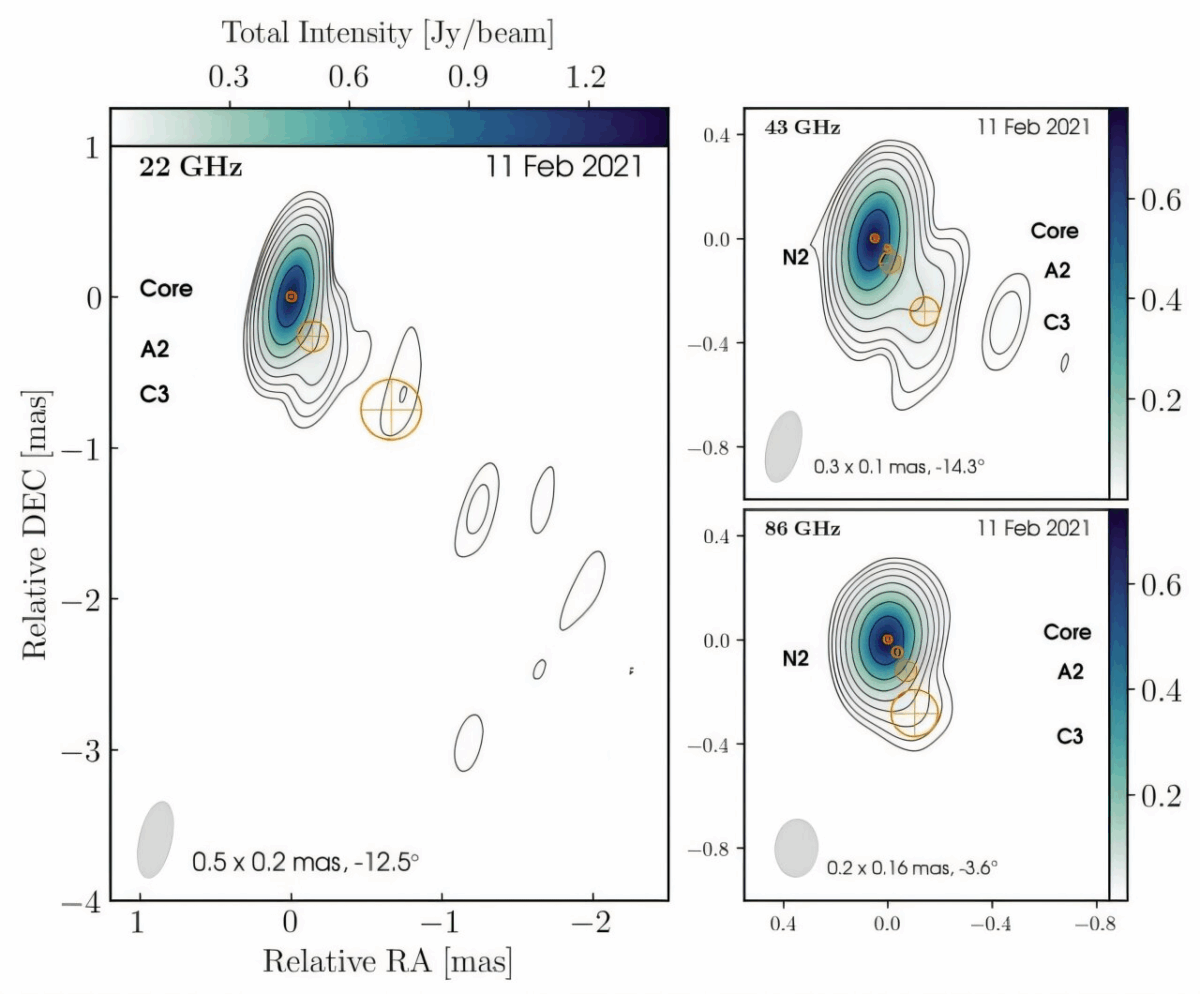
Known for their extreme variability and intense emissions, blazars are key cosmic laboratories for studying relativistic jets. This particular flare stood out both for its timing and intensity, combined with the coordinated use of VLBI across multiple bands. The high-energy flare, reaching GeV levels, was first detected by satellites, triggering swift follow-up by ground-based radio observatories.
Published November 19 on the arXiv preprint, the report describes how polarization features were rigorously examined and jet components resolved with micro-arcsecond precision. These insights are crucial for decoding the magnetic field structures that maneuver jet collimation and energize particles. The researchers noted core and inner jet morphology changes indicating a dynamic rearrangement of magnetic fields during the flare.
Decoding Jet Structure: Insights from Polarization Mapping
By integrating data from three frequencies, the team built a detailed spectrum and polarization profile of the blazar’s jet, uncovering intricate magnetic field alignments, variations in fractional polarization, and evolving features in the core region. The innermost jet exhibited electric vector position angle (EVPA) rotations, suggesting turbulence or shock waves moving within the jet flow.
A striking discovery was the strong frequency-dependent shifts in polarization angles, signifying Faraday rotation caused by magnetized plasma along the emission path. These observations enabled estimates of magnetic field intensities and offered clues about the jet base’s physical environment.
The multi-frequency dataset also allowed rare examination of core shift phenomena, where the locations of radio cores vary with observing frequency due to synchrotron self-absorption effects. The results pointed to a magnetized, optically thick base of the jet.
Importantly, the analysis connected the timing of the gamma-ray burst to fluctuations in overall brightness and polarization levels, supporting models where magnetic reconnection or shock fronts drive sudden energy discharge. Such a detailed investigation is particularly notable for TXS 2013+370, a northern sky blazar seldom targeted in high-resolution VLBI studies.
- Categories:
- Physics















0 comments
Sign in to Comment