
Locating the universe’s earliest stars within the Milky Way has propelled our grasp of cosmic evolution to new heights. These primordial stars, formed mere moments after the Big Bang, serve as invaluable portals into the universe’s infancy, shedding light on the mechanisms that influenced the formation of galaxies and elemental matter. The recent findings, published in Astronomy & Astrophysics, underscore the importance of these stars in piecing together the foundations of galactic development and the origin of the universe’s building blocks.
Delving into the Origins of the Oldest Stellar Bodies
Tracking down the most ancient stars across the cosmos has been a meticulous and technologically demanding pursuit. Pinpointing stars that ignited just a few hundred million years after the Big Bang, allows astronomers to examine the universe’s first stellar generations. These stars are not merely vestiges of antiquity; they embody cosmic archives holding data about the early universe’s chemical structure and star formation dynamics. According to Elena Tomasetti from the Università di Bologna,
“This project beautifully shows how combining expertise from different fields can open new windows on fundamental questions.”
Add Cosmo Herald as a Preferred Source

The stars uncovered in this investigation deliver critical evidence to researchers. They capture a glimpse of the universe during its formative epochs, aiding scientific inquiry into the birth of the first stars post-Big Bang. Evaluating their elemental makeup and age equips astronomers to better understand early cosmic conditions. Tomasetti highlights that the precision of available data was essential to overcome the inherent complexities in dating these stars.
“Measuring the age of stars is, in itself, a complex challenge, but we now live in an era in which the quantity and quality of available data allow us to achieve unprecedented precision.”
The synergy between advanced data collection and analytical methods enables scientists to date stars with exceptional accuracy, refining our chronology of the universe’s evolution. Continuous enhancements in Gaia mission data promise even more precise stellar age calculations, opening fresh avenues for studying star formation and galactic progression.
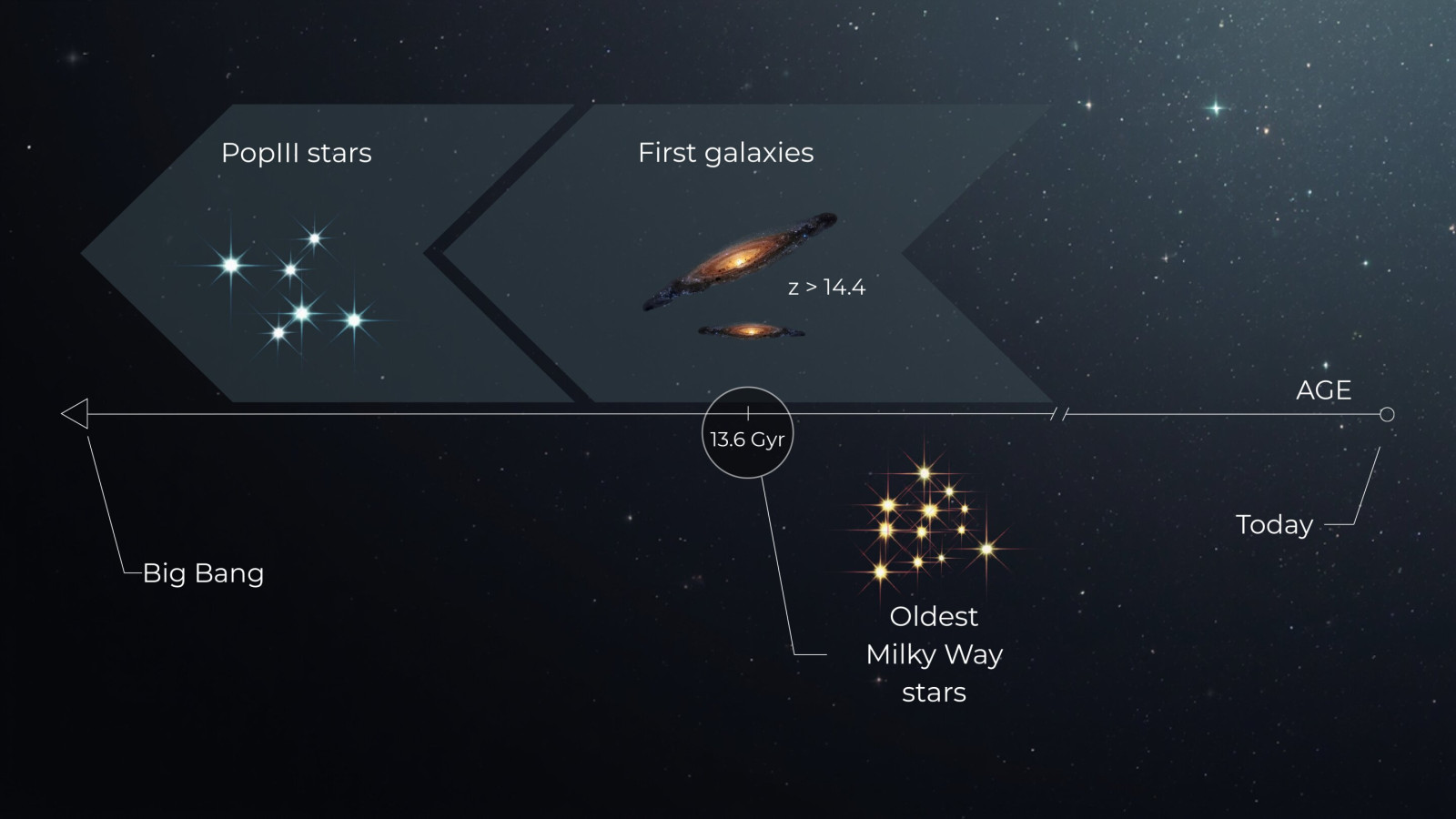
Gaia’s Critical Contributions to Defining Stellar Ages
The Gaia mission has transformed our view of the Milky Way by delivering precise readings of star locations, distances, and trajectories. These advancements let researchers determine stellar ages with unmatched exactness. As Cristina Chiappini from AIP explains,
“With Gaia, the Milky Way has effectively become a near-field cosmology laboratory. We can now estimate stellar ages with unprecedented precision.”
Gaia's extensive datasets underlie current stellar research and pave the way for future discoveries. By incorporating more data, astronomers aim to construct an increasingly accurate galactic timeline. Chiappini points out, “The next breakthrough will be accuracy, anchoring the Galactic timeline with far greater certainty.” As upcoming Gaia data releases approach, our comprehension of the universe’s beginnings will continue to deepen.
Looking ahead, missions such as the proposed HAYDN project are set to build upon Gaia’s achievements, pushing the boundaries of stellar age determination. These future endeavors promise to revolutionize our cosmic chronology and sharpen key cosmology models.
Why Ancient Stars Are Vital to Understanding Cosmic Origins
Detailed in Astronomy & Astrophysics, the identification of these early stars brings new opportunities for exploring the universe’s birth and the environmental factors that spurred the formation of galaxies, stars, and planets. Representing the first sources of cosmic light, these stars hold essential clues about the elemental compositions shaping the early universe. Analyzing their elements allows scientists to track processes behind stellar evolution over billions of years.
Beyond their scientific role, these stars illuminate the story of chemical enrichment following the aftermath of the Big Bang. By mapping element distributions such as carbon, oxygen, and iron, researchers unravel nucleosynthesis pathways responsible for dispersing the universe’s building blocks. This understanding is crucial for modeling galaxy development and fresh star formation.
Discovering these ancient stellar bodies marks a pivotal advancement in cosmology, refining our frameworks for the universe’s earliest phases. Each new star studied adds richness to our collective knowledge, driving progress toward answering foundational cosmic questions.
Advancing Precision in Assessing Stellar Lifespans
Ongoing improvements in measuring stellar ages signal a new era for cosmological research, with substantial breakthroughs on the horizon. Future investigations will focus on increasing measurement precision, enabling the creation of sophisticated, detailed universe timelines. Chiappini remarks that “The HAYDN mission concept, with AIP participation, aims to provide that decisive step” toward enhanced stellar aging techniques. This initiative will build upon Gaia’s legacy, taking our cosmic understanding to unprecedented heights.
Utilizing state-of-the-art observational instruments alongside powerful computing, astronomers will sharpen their age estimations and evolve more precise star formation and evolution models. These advancements will deepen insight not only into the Milky Way but also into the greater cosmos, unveiling new information about the dawn of galaxies, stars, and planets.
As we continue to study the universe’s earliest stars, the future of cosmology is poised for remarkable growth. Enhanced accuracy promises to illuminate some of humanity’s most profound questions about the cosmos’ origin and development.
- Categories:
- News







0 comments
Sign in to Comment