

Utilizing the power of the Australian SKA Pathfinder (ASKAP), researchers have unveiled a radio transient signal repeating every 36 minutes, a discovery that could alter prevailing models of stellar phenomena. This source, dubbed ASKAP J1424, was detailed in a study shared on March 9, 2026, via the arXiv preprint platform. Its puzzling features have led scientists to consider possibilities ranging from a white dwarf binary system to an entirely unprecedented cosmic object.
The Evolutionary Map of the Universe Project Expands Radio Astronomy Horizons
Discovered through the comprehensive Evolutionary Map of the Universe (EMU) project, which leverages ASKAP’s extensive sky coverage, ASKAP J1424 emerged as part of large-scale radio surveys. These surveys enable astronomers to explore vast celestial regions and detect transient radio signals that earlier technology could not observe with such precision. EMU’s capability to scan the sky repeatedly over long periods is vital for pinpointing elusive radio phenomena like long-period transients.
ASKAP J1424 joins an expanding list of intriguing objects noted for their extensive rotational periods and strong magnetic influences.

“We discovered ASKAP J1424 in a circular polarization search of a 10 h ASKAP observation, conducted on 2025-01-09 (scheduling block SB70271) as part of the Evolutionary Map of the Universe survey,” the researchers wrote in their paper.
This observation, documented in the arXiv preprint, represents the latest advance in efforts to better understand transient radio emissions—a category still largely enigmatic.
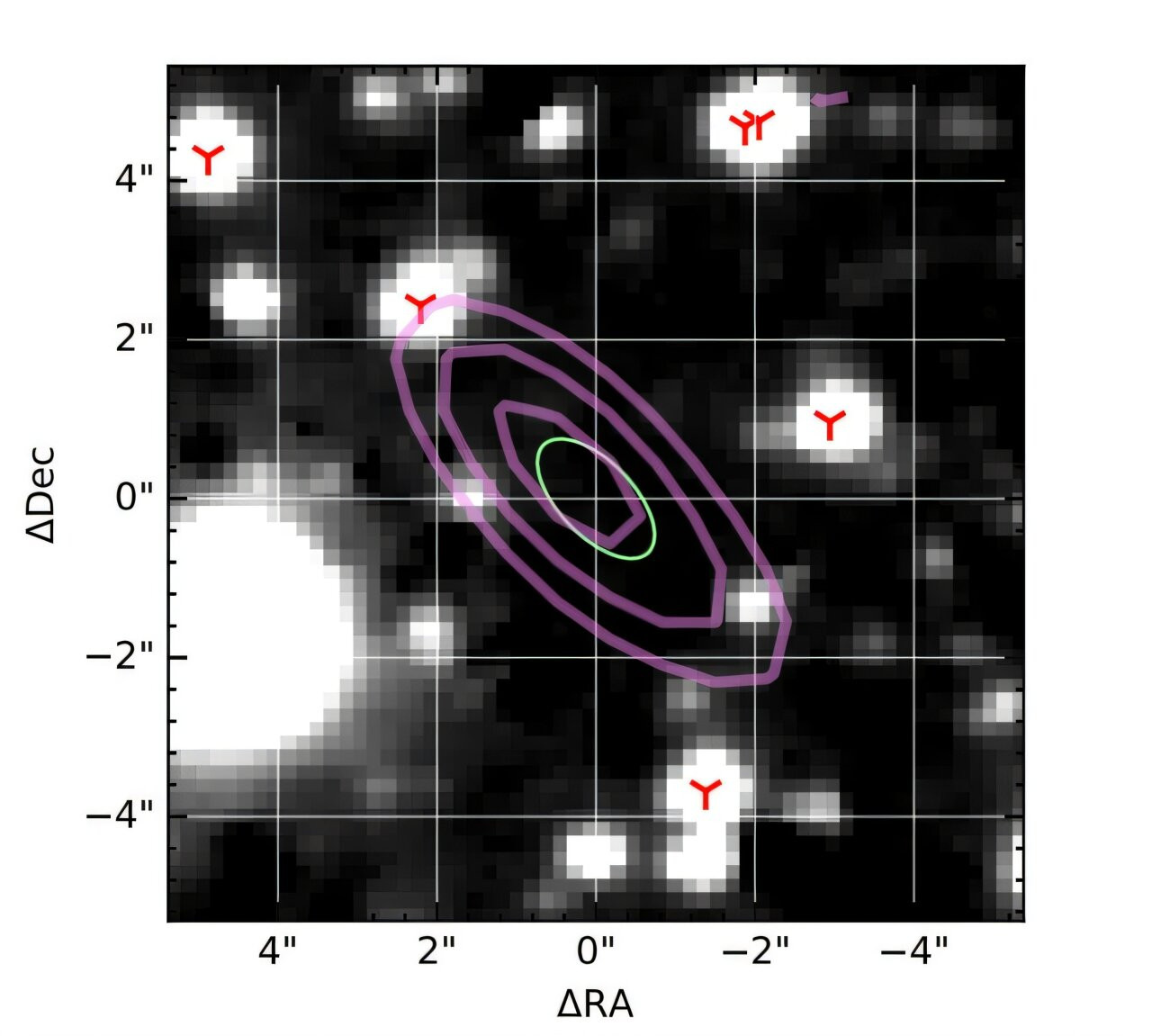
ASKAP J1424’s 36-Minute Cycle: A Persistent Enigma
ASKAP J1424 is notable not only for its lengthy 36-minute interval (2,147.27 seconds) but for its remarkably consistent pulse profile maintained over eight days. Such persistent signals are rare among known long-period transients and have captivated the astrophysical community. A standout trait is its distinctly polarized emission—100% polarized throughout the pulse duration, shifting from elliptical to fully linear polarization. This strange pattern suggests that ASKAP J1424 might belong to a fundamentally new category of stellar entities.
Despite thorough searches, no corresponding optical or infrared emissions connected to ASKAP J1424 have been identified, complicating efforts to classify the source. Researchers hypothesize that it may represent a white dwarf binary system, where powerful magnetic interactions between the white dwarf and a companion star’s magnetically driven wind produce the unusual radio emissions, as detailed in a related study on white dwarf magnetism.
“Further monitoring (e.g. as part of the planned second phase of the VAST [Variables And Slow Transients] Galactic survey) will allow us to determine whether the observed emission follows an intermittent activity pattern, or was powered by a one-off or stochastic event such as accretion of plasma from a companion,” the researchers concluded.
The Path Forward: Unlocking the Secrets of ASKAP J1424
ASKAP J1424’s identification opens a fresh chapter in the study of long-period radio transients, an area gaining momentum as astronomers seek to decrypt complex magnetic behaviors in stellar systems. Continued observations, as urged by the research team, are essential to determine whether this transient emits cyclically or results from rare, unpredictable occurrences such as plasma accretion.
A vital component in this endeavor will be the upcoming second phase of the Variables And Slow Transients (VAST) Galactic survey, designed to capture detailed data on transient phenomena throughout the Milky Way. This initiative aims to explore sky regions rich in transient activity, providing an opportunity for in-depth study of ASKAP J1424. The findings from this phase may revolutionize current understanding of magnetic stellar dynamics and broaden our cosmic perspective.
- Categories:
- Astronomy












0 comments
Sign in to Comment